Short answer: for most adults, 4,000 IU (100 micrograms) of vitamin D a day is not too much, but it is the maximum. The NHS says adults should not take more than 100 micrograms a day, so 4,000 IU sits right at the UK safe upper limit, not above it. Most people only need 400 IU (10 micrograms) a day, so a high-strength dose is something to use knowingly, not by default.
Key takeaways
- The NHS advice for everyone in the UK is 10 micrograms (400 IU) a day in autumn and winter.
- The safe upper limit for adults and children aged 11 to 17 is 100 micrograms (4,000 IU) a day.
- The limit applies to your total from all supplements, so add up multivitamins and fortified products too.
- Children under 11 have lower limits. Never give an adult high-strength product to a child.
- If you have kidney problems, a high calcium level or take certain medicines, check with your GP first.
In this guide
The UK vitamin D limits at a glance
The NHS recommends that everyone, including pregnant and breastfeeding women, considers taking 10 micrograms of vitamin D a day during autumn and winter, roughly October to March.
It also sets clear upper limits. These are the most you should take in a day, not a target.
| Age group | Everyday advice | Do not exceed (per day) |
|---|---|---|
| Adults and 11 to 17s | 10µg (400 IU) | 100µg (4,000 IU) |
| Children 1 to 10 | 10µg (400 IU) | 50µg (2,000 IU) |
| Babies under 12 months | 8.5 to 10µg (340 to 400 IU) | 25µg (1,000 IU) |
Source: NHS vitamin D guidance. Some people with medical conditions may not be able to safely take this much, so check with your doctor if that applies to you.
IU and micrograms: a quick conversion
Labels use either international units (IU) or micrograms (µg or mcg). The conversion is simple: 1 microgram = 40 IU.
- 10µg = 400 IU (the everyday NHS dose)
- 25µg = 1,000 IU (a common “higher strength” tablet)
- 100µg = 4,000 IU (the adult upper limit)
So a 4,000 IU product gives ten times the everyday amount, in one dose.
Who a 4,000 IU dose might suit
For most people, 400 IU is enough. A higher daily amount is usually something a GP suggests after a blood test shows low levels.
The NHS also notes that some groups may not get enough vitamin D from sunlight and should consider a supplement all year round. These include people who are rarely outdoors, people in care homes, people who usually wear clothes that cover most of their skin outdoors, and people with dark skin, such as those of African, African-Caribbean or South Asian heritage. We cover this in more depth in our guide to vitamin D for women who wear hijab.
Being in one of these groups does not automatically mean you need 4,000 IU. It means it's worth taking vitamin D every day and, if you are worried, asking your GP whether a test makes sense.
The simple rule: 400 IU is the everyday dose. 4,000 IU is the ceiling. Anything in between is fine for adults, as long as your total from all sources stays at or under 4,000 IU.
How to add up your total
The upper limit is for everything you take, not each product. This is where people most often go over without realising.
Check the labels of anything else you take regularly:
- Multivitamins, which often contain 5 to 25µg
- Separate vitamin D tablets, sprays or gummies
- Fish oil or cod liver oil products
- Fortified drinks or shakes taken daily
For example, a 4,000 IU (100µg) product plus a multivitamin with 10µg adds up to 110µg. That's over the limit. If you take a high-strength product, choose a multivitamin without vitamin D, or ask a pharmacist to check your stack.

What happens if you take too much?
Vitamin D is stored in the body, so very high intakes build up over time. The NHS warns that taking too many supplements over a long period can cause too much calcium to build up in the body (hypercalcaemia). This can weaken the bones and damage the kidneys and heart.
You can't overdose on vitamin D from sunlight. Problems come from supplements, usually at doses well above the limit or from stacking several products.
The government's guide on taking vitamin D supplements safely also warns against very high-strength products bought online, especially for children.
A note on vitamin K2 and blood thinners
Many high-strength vitamin D products now include vitamin K2. Vitamin K contributes to normal blood clotting and to the maintenance of normal bones. You can read why the two are often paired in our D3 and K2 explainer.
Because of its role in clotting, vitamin K can affect how some anticoagulants such as warfarin work. If you take any blood-thinning medicine, don't start a K2 product without speaking to your GP or anticoagulation clinic.
Check with your GP or pharmacist before taking high-strength vitamin D if you:
- are pregnant or breastfeeding
- are under 18 (high-strength adult products are not for children)
- have kidney disease, kidney stones, sarcoidosis or a high calcium level
- take blood thinners, heart medicines, diuretics or other prescribed medication
- have been prescribed vitamin D already

Vegan · halal & kosher approved · for adults
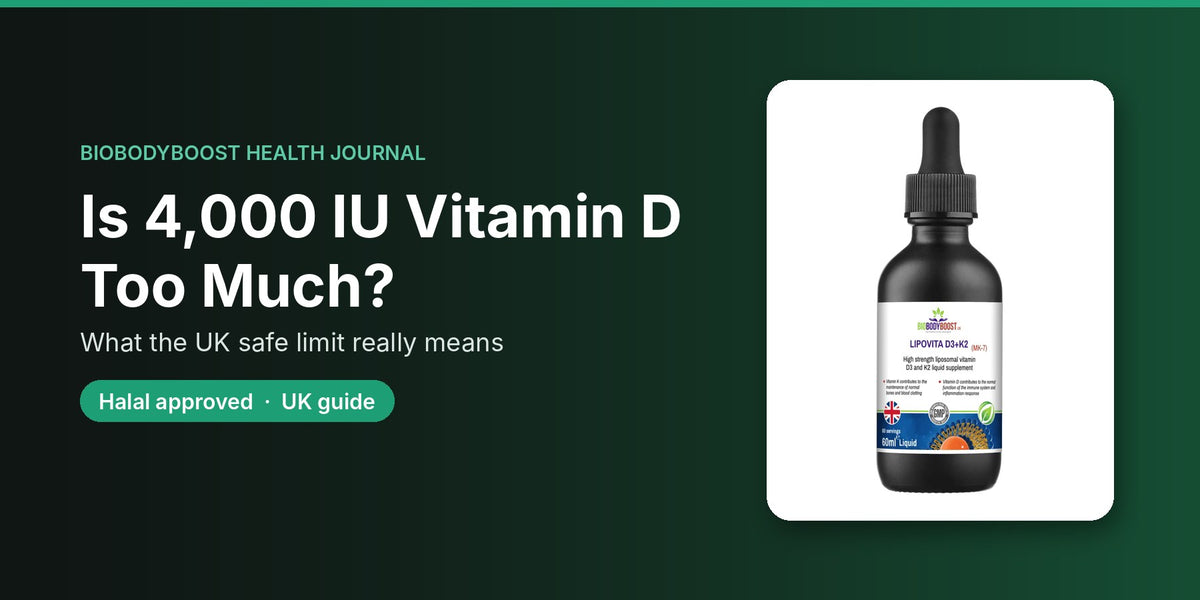
Lipovita D3 + K2 Drops
- 100µg (4,000 IU) algae-sourced vitamin D3 per 1ml
- 100µg vitamin K2 as MK-7, in a liposomal liquid
- Vitamin D contributes to the normal function of the immune system
HALAL10 10% off your first order
Shop Lipovita →One 1ml serving provides the full adult upper limit, so don't take it alongside other vitamin D products. More on the formula in our liposomal D3 and K2 sourcing guide, and on why some vitamin D isn't halal in is vitamin D3 halal?
Questions people ask
Is 4,000 IU of vitamin D safe to take every day?
For most adults, yes. 4,000 IU (100µg) is the NHS upper limit for adults, so it is safe as long as it's your total daily intake from all supplements. Some people with medical conditions should take less, so check with your GP if you have one.
Is 4,000 IU too much for a child?
For children aged 1 to 10, yes. Their upper limit is 2,000 IU (50µg). For babies under 12 months it is 1,000 IU. Use a product made for children; see our children's vitamin D guide.
Should I take 4,000 IU instead of 400 IU in winter?
Not automatically. The NHS everyday advice is 400 IU. A higher dose is usually for people advised by a health professional, or those who know they get very little sun.
Do I need to take vitamin D in summer?
Most people in the UK can make enough from sunlight between late March and the end of September. People who rarely get sun on their skin may need it all year.
What are the signs of too much vitamin D?
Too much vitamin D can raise calcium levels, which may cause symptoms such as feeling sick, thirst, needing to wee often and confusion. If you're worried, stop taking it and speak to your GP or call NHS 111.
Sources: NHS: vitamin D · GOV.UK: vitamin D supplements, how to take them safely · EFSA: dietary reference values for vitamin D · GB NHC register
This article is general information, not medical advice. Food supplements should not replace a varied, balanced diet and healthy lifestyle. Do not exceed the recommended intake. Speak to your GP or pharmacist before taking high-strength vitamin D if you have a medical condition or take medication.