
Vitamin D3 supplementation is close to universal advice for UK adults, given how little UVB sunlight reaches this latitude for most of the year. What gets far less attention is the form the D3 is delivered in — and for vegans and halal-observant consumers specifically, the sourcing question is more complicated than most labels let on.
The Vitamin D3 Sourcing Problem
Vitamin D3 (cholecalciferol) is overwhelmingly manufactured from lanolin — a fatty substance extracted from sheep's wool. Lanolin-derived D3 is the industry default because it's cheap and effective, but it is not vegan (wool is an animal by-product) and its halal status depends on the source: some scholars accept lanolin from live-sheared sheep as halal-neutral, while others require confirmation of the shearing method and supply chain to avoid any association with non-halal slaughter.
Algae-derived D3 sidesteps both issues entirely. Extracted from lichen (a fungus-algae symbiote, not a plant, which is why some vegan certifications specifically verify it) rather than sheep's wool, algal D3 is unambiguously vegan and halal by source, with no supply-chain verification needed.
What "Liposomal" Actually Means
Vitamin D is fat-soluble, which means it needs to be delivered alongside fat to absorb properly — a plain D3 tablet taken on an empty stomach can absorb poorly. Liposomal delivery wraps the D3 (and K2) molecule in a sphere of phospholipids, mimicking the structure of a cell membrane, which the body can absorb more directly through the gut lining rather than relying on bile-dependent fat digestion.
This matters most for people with any degree of fat malabsorption (including some digestive conditions) and for anyone who finds capsules harder to take consistently than liquid drops. It also allows for combining D3 with K2 in a single liquid dose without needing an oil-based capsule.

The full ingredient breakdown: algae-sourced D3, fermentation-derived MK-7, and sunflower lecithin for liposomal delivery — no lanolin, no gelatin.
Why D3 and K2 Are Paired
Vitamin K2 (specifically the MK-7 form) works downstream of vitamin D in calcium metabolism: D3 increases calcium absorption from the gut, while K2 activates proteins (osteocalcin and matrix Gla-protein) that direct that calcium toward bone and away from soft tissue and arteries. Supplementing D3 without K2 in very high doses is a scenario some researchers have flagged as worth pairing with adequate K2 status, which is the rationale behind combination D3+K2 products rather than D3 alone.
EFSA has authorised the claim that vitamin D contributes to the maintenance of normal bones and normal muscle function, and separately that vitamin K contributes to normal blood clotting and the maintenance of normal bones (Regulation (EU) 432/2012) — these are the two claims underpinning combination D3+K2 formulas on UK labels.
MK-7 vs MK-4: Which K2 Form Matters
Vitamin K2 comes in several forms, but MK-7 (menaquinone-7) has a substantially longer half-life in the bloodstream than the shorter-chain MK-4 form, meaning it maintains more stable blood levels from a once-daily dose rather than needing multiple doses per day. MK-7 sourced from fermentation (typically natto or a comparable fermentation process) is the form most commonly used in vegan D3+K2 products, and it's inherently free of animal input.
Dosage Considerations
UK government guidance recommends 10 micrograms (400 IU) of vitamin D daily for the general population, particularly October to March, though clinical and research doses used to correct deficiency are often considerably higher under practitioner guidance. Higher-strength liposomal formats — such as 4000 IU per serving — are generally positioned for those with confirmed low vitamin D status or higher-latitude, low-sun-exposure lifestyles, rather than as a universal starting dose; anyone unsure of their vitamin D status should consider testing before supplementing at high doses long-term.
Our Approach
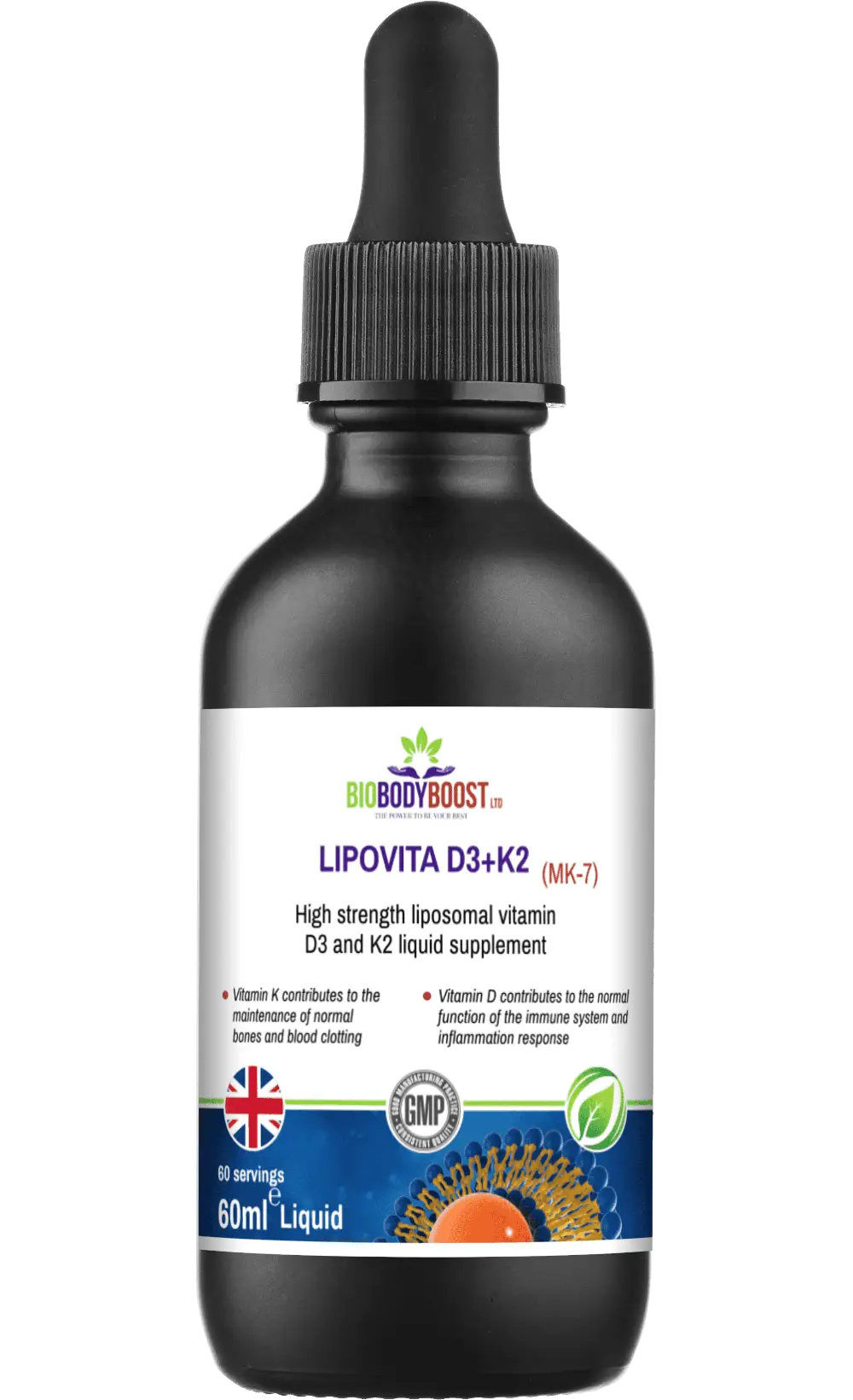
Our Lipovita D3+K2 Liposomal Drops uses algae-sourced vitamin D3 and fermentation-derived MK-7, delivered in a sunflower-lecithin liposomal base rather than a lanolin-derived, animal-sourced D3. The liquid drop format also avoids the gelatin capsule shells used in most D3+K2 softgels, making it suitable for vegans, vegetarians and halal-observant consumers without any sourcing ambiguity.
Frequently Asked Questions
Is vitamin D3 usually vegan?
No. Most vitamin D3 on the UK market is derived from lanolin (sheep's wool grease), which is not vegan. Vegan D3 is sourced from algae/lichen instead — always check the source on the label, as "D3" alone doesn't confirm origin (vitamin D2, from mushrooms, is separately vegan but generally considered less effective at raising blood levels than D3).
Is lanolin-derived vitamin D3 halal?
It depends on sourcing and scholarly interpretation. Some accept lanolin from live-sheared sheep as halal-neutral since no slaughter is involved; others require full supply chain verification. Algae-derived D3 removes this ambiguity entirely, which is why many halal-certified brands use it by default.
Why take D3 and K2 together rather than D3 alone?
K2 works downstream of D3 in calcium metabolism, directing calcium absorbed via D3 toward bones rather than soft tissue. The two nutrients are commonly paired for this reason, particularly at higher D3 doses.
What does liposomal mean for vitamin absorption?
Liposomal delivery wraps the vitamin in a phospholipid sphere that the gut can absorb more directly, rather than relying on bile-dependent fat digestion — relevant for fat-soluble vitamins like D3 and K2, which otherwise require dietary fat present to absorb well.
Is this product halal approved?
Yes, our Lipovita D3+K2 Drops are halal approved, using algae-sourced D3 and fermentation-derived MK-7 with no animal-derived ingredients in the formula.
This article is for general information and does not constitute medical advice. Speak to a healthcare professional before starting any new supplement, particularly regarding vitamin D dosage if you have kidney disease or are on blood-thinning medication (relevant to vitamin K intake).