
Millions of UK adults take vitamin D3 supplements every winter — on NHS advice, and entirely correctly. But the majority are taking D3 alone. The science increasingly suggests this misses a critical co-factor: vitamin K2. Here's the biology behind why D3 and K2 need to be taken together, which form of K2 actually matters, and why this has become one of the most important nuances in supplement science.
What Vitamin D3 Does
Vitamin D3 (cholecalciferol) functions less like a vitamin and more like a steroid hormone. Once converted to its active form (1,25-dihydroxyvitamin D) in the kidneys, it acts on receptors throughout the body, regulating over 200 genes. Its best-known function is dramatically increasing calcium absorption in the gut — typically increasing absorption from around 10–15% to 30–40% of dietary calcium.
This is why D3 is essential for bone health, immune function and muscle performance. But the calcium absorption mechanism is where the K2 story begins.
The Problem: Where Does the Calcium Go?
When D3 increases calcium absorption, that calcium needs to go somewhere. In an ideal system, it goes into bones. In the absence of adequate vitamin K2, it can end up elsewhere — including arterial walls and soft tissue. This process, called vascular calcification, is associated with arterial stiffness and cardiovascular risk.
Research published in Nutrients found that vitamin K2 supplementation significantly improved arterial stiffness and reduced vascular calcification markers in post-menopausal women. A large Dutch cohort study (Rotterdam Heart Study) found that higher dietary K2 intake was associated with reduced arterial calcification and lower cardiovascular mortality.
The K2 Mechanism: Two Critical Proteins
Vitamin K2 activates two key proteins through a process called carboxylation:
- Osteocalcin — deposits calcium into bone matrix, directly supporting bone density
- Matrix Gla Protein (MGP) — the most potent known inhibitor of arterial calcification. Removes calcium from blood vessels and soft tissue.
Both proteins require K2 to function. Without K2, they circulate in an inactive (undercarboxylated) form, unable to perform their calcium-routing function. D3 increases the calcium available, K2 determines where it goes.
MK-7 vs MK-4: Which Form of K2 Matters
Two forms of K2 are available in supplements:
- MK-4 — half-life of 1–2 hours. Needs to be taken multiple times daily to maintain blood levels.
- MK-7 — half-life of 72 hours. A single daily dose maintains consistent blood levels throughout the day and night. Derived from natto (fermented soybean) and suitable for vegans and halal consumers.
MK-7 at 100mcg daily is the dose used in most clinical studies showing meaningful effects on osteocalcin activation and arterial health. Lower doses appear in some products but may not reach the threshold for MGP activation.
Liposomal D3: Why Absorption Format Also Matters
Vitamin D3 is fat-soluble. Standard D3 capsules and tablets require dietary fat for absorption — taken without food, a significant portion isn't absorbed. Liposomal delivery encapsulates D3 in phospholipid spheres (the same structure as cell membranes), allowing absorption independent of meal timing via endocytosis. This is particularly relevant for consistent daily supplementation where people don't always take supplements with food.
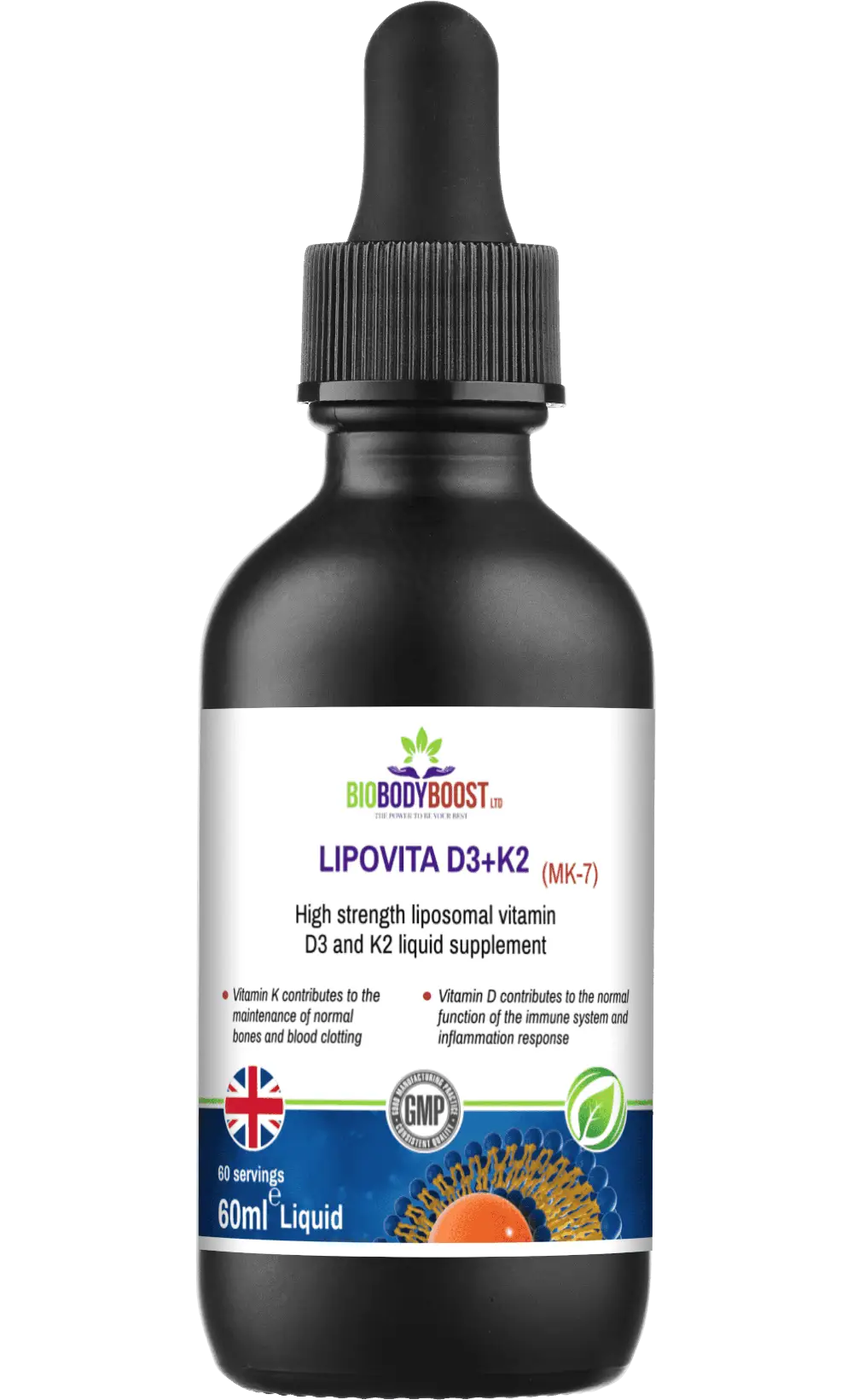
Lipovita D3+K2 by BioBodyBoost combines 4,000 IU lichen-derived D3 (vegan and halal certified — not from sheep lanolin) with 100mcg MK-7 K2 in a liposomal liquid format. No bovine gelatine, no animal-derived ingredients. View the full halal supplement range.