Vitamin D deficiency in UK Muslim women who cover — whether hijab (head and neck covered, face visible) or niqab (full face veil) — is one of the most significant and most underdiscussed nutritional issues in UK public health. Studies conducted specifically in this population find deficiency rates between 80–95%, compared to approximately 20% in the general UK population. The implications are not trivial — vitamin D deficiency at these rates affects bone health, immune function, metabolic health, mental health and pregnancy outcomes.
Why Is the Deficiency So Severe?
Three factors combine to create an extreme deficiency risk:
1. UV-B efficiency and skin tone
Vitamin D3 (cholecalciferol) is synthesised in the skin when UV-B radiation (290–315nm wavelength) strikes 7-dehydrocholesterol in the dermal layer. The efficiency of this synthesis depends on melanin content — melanin is a natural UV-B absorber that protects skin from sun damage but simultaneously reduces vitamin D synthesis efficiency. British South Asian adults (the majority of UK hijab-wearing women) require 3–5 times more UV-B exposure than white British adults to produce the same amount of vitamin D3.
2. Coverage area and UV-B exposure
The skin surface area exposed to UV-B determines the amount of vitamin D3 that can be synthesised. A woman wearing hijab with face and hands exposed has approximately 10–15% of total skin surface available for synthesis. A niqab wearer has approximately 5–10%. In contrast, a person in a short-sleeved T-shirt and shorts exposes 50–60% of skin surface. Combined with melanin-reduced efficiency, the effective UV-B synthesis capacity of a hijab-wearing British South Asian woman is perhaps 5–15% of the baseline used to set UK dietary recommendations.
3. UK latitude and seasonal UV-B
Above 52° latitude (approximately the level of Birmingham), UV-B intensity is insufficient for skin vitamin D synthesis from October to April — regardless of how much skin is exposed. Glasgow is at 55.9°N. London is at 51.5°N. This means that even at the southernmost tip of England, there are 5–6 months per year when no vitamin D can be synthesised from sunlight regardless of clothing.
The combination of these three factors means that a British South Asian Muslim woman wearing hijab in Glasgow receives effectively zero UV-B-mediated vitamin D synthesis from October to April, and only marginal amounts in summer. Without supplementation, severe deficiency is almost certain.
What Are the Health Consequences?
Bone health — rickets and osteomalacia
Vitamin D is essential for calcium absorption. Without adequate vitamin D, calcium cannot be absorbed efficiently from food regardless of intake. In children, this causes rickets (soft, deformable bones). In adults, it causes osteomalacia (diffuse bone pain and weakness) and accelerates osteoporosis. Rickets rates in British South Asian children are significantly higher than in any other ethnic group in the UK — a direct consequence of maternal and infant vitamin D deficiency.
Immune function
Immune cells express vitamin D receptors. Vitamin D regulates the innate immune response and modulates autoimmune reactivity. Severe vitamin D deficiency is associated with increased susceptibility to respiratory infections, tuberculosis (elevated in South Asian UK communities) and autoimmune conditions.
Pregnancy outcomes
Vitamin D deficiency during pregnancy increases risk of pre-eclampsia, gestational diabetes, low birthweight and — most critically — neonatal rickets. The developing foetal skeleton requires calcium from the mother, which requires maternal vitamin D. The NHS recommends vitamin D throughout pregnancy; for hijab-wearing Muslim women, the recommended dose is almost certainly insufficient.
Mental health
Vitamin D receptors are expressed in the brain. Low vitamin D correlates with depression and seasonal affective disorder in population studies. For UK Muslim women with extremely high deficiency rates, this connection may be clinically relevant.
What Dose Does a Hijab-Wearing UK Muslim Woman Actually Need?
The NHS recommends 400 IU (10mcg) for all UK adults from October to April. This is the dose needed to prevent deficiency in a person with normal UV-B exposure supplementing to fill a seasonal gap. For a British South Asian Muslim woman wearing hijab with near-zero UV-B synthesis year-round, 400 IU is wholly inadequate to raise or maintain vitamin D levels.
Studies in similar populations suggest 2,000–4,000 IU daily is needed to achieve optimal blood levels (75–125 nmol/L) — 5–10 times the NHS minimum recommendation. The UK government’s Scientific Advisory Committee on Nutrition (SACN) notes that 4,000 IU daily is safe for adults as an upper maintenance dose.
Ideally, get a 25(OH)D blood test through your GP to establish baseline and monitor progress. Testing is available free on the NHS when there are clinical indicators of deficiency.
The Form of Vitamin D3 Matters for UK Muslim Women
Most vitamin D3 supplements are derived from lanolin — a fat from sheep wool. While most UK Islamic scholars consider lanolin-derived D3 permissible, others have doubts. Lichen-derived D3 resolves this question entirely — it is plant-derived, vegan, and unambiguously halal under all scholarly positions.
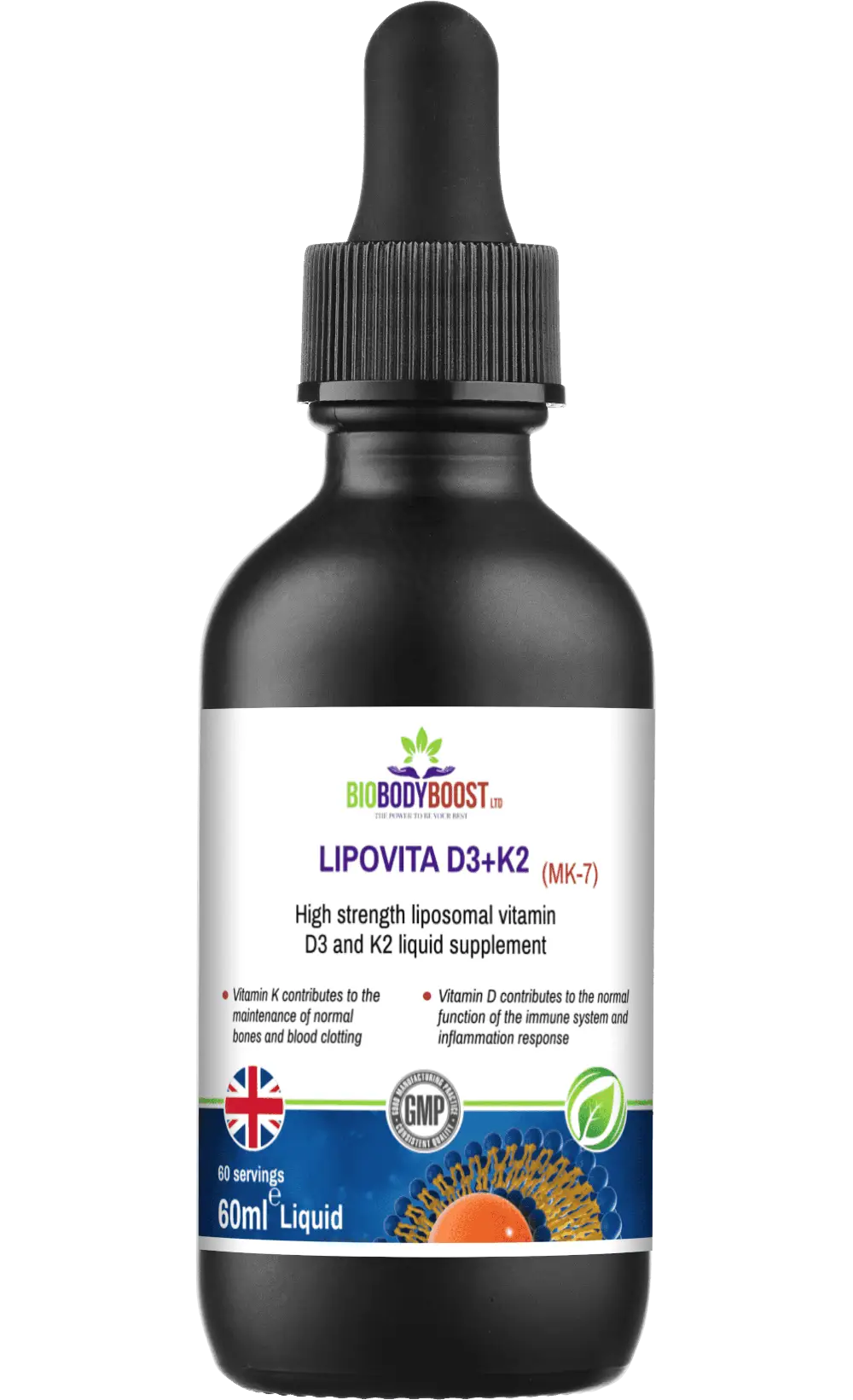
Lipovita D3+K2 by BioBodyBoost provides 4,000 IU lichen-derived D3 with 100mcg MK-7 K2 in a liposomal liquid that does not require food for absorption. Fully halal certified. No lanolin. No debate. This is the most practical vitamin D format for UK Muslim women — three drops daily in water, juice or any food. Browse the full range.