Most men’s supplement content targets the gym floor — protein, creatine, pre-workout. That’s a fraction of what matters for men’s health across the lifespan. This guide covers the evidence-based nutritional priorities for UK Muslim men specifically: what actually works, what the evidence says, and which halal-certified products address each priority. It also covers the areas that carry stigma in Muslim communities — energy, libido, fertility — with the same evidence-first approach applied to everything else.
The NHS notes that men are less likely than women to seek medical advice for health concerns — a pattern particularly pronounced in some UK Muslim communities where male health stigma is significant. Nutritional support is not a substitute for GP assessment when symptoms warrant it, but a well-designed supplement foundation reduces a meaningful number of preventable deficiencies.
1. Zinc — the most critical mineral for men
Zinc has more male-specific functions than any other single mineral. It carries the EU-authorised claim for “normal testosterone levels in the blood” — based on its role as a cofactor for testosterone synthesis in the Leydig cells of the testes. It is also required for sperm production (spermatogenesis), DNA synthesis in rapidly dividing cells, prostate function and normal immune response. UK NDNS shows zinc insufficiency in approximately 20–30% of UK males, with vegetarian and vegan men at highest risk (plant-based zinc from phytate-rich foods has significantly lower bioavailability than animal-source zinc).
What research shows: Prasad et al. (1996, Nutrition) found that zinc restriction reduced serum testosterone by 75% in healthy young men over 20 weeks, and that zinc supplementation restored testosterone in zinc-deficient older men. A 2010 Biological Trace Element Research study found zinc supplementation at 30mg/day for 4 weeks significantly increased testosterone in zinc-deficient wrestlers. The effect is specifically in deficient men — zinc does not raise testosterone above normal in men with adequate zinc status. Our Magnesium 3 Complex provides zinc 10mg (100% NRV) as zinc citrate in HPMC capsule, halal certified. For higher-dose zinc specifically, Daily Multi Complex provides zinc 15mg (150% NRV).
2. Magnesium — free testosterone and sleep
Magnesium influences testosterone bioavailability independently of zinc. Testosterone circulates bound to sex hormone-binding globulin (SHBG) — only the unbound “free” testosterone is biologically active. Magnesium competes with testosterone for SHBG binding, increasing the free fraction. A 2011 study in Biological Trace Element Research (n=399) found serum magnesium was independently and significantly associated with total and free testosterone in both sedentary and active men. Additionally, magnesium’s role in sleep quality is directly relevant: testosterone is primarily produced during sleep (particularly stage 3 NREM deep sleep), and poor sleep quality significantly reduces testosterone output. Our Magnesium 3 Complex — 300mg elemental magnesium glycinate + malate + taurate. Halal certified, vegan.
3. Maca root — energy, libido and the evidence
Maca (Lepidium meyenii) is a Peruvian root vegetable with a long history of use for energy and reproductive health. It does not affect testosterone directly — its mechanism appears to be via the hypothalamic-pituitary axis and independent plant compounds (macamides) that affect the endocannabinoid system. This makes it complementary to zinc and magnesium rather than overlapping.
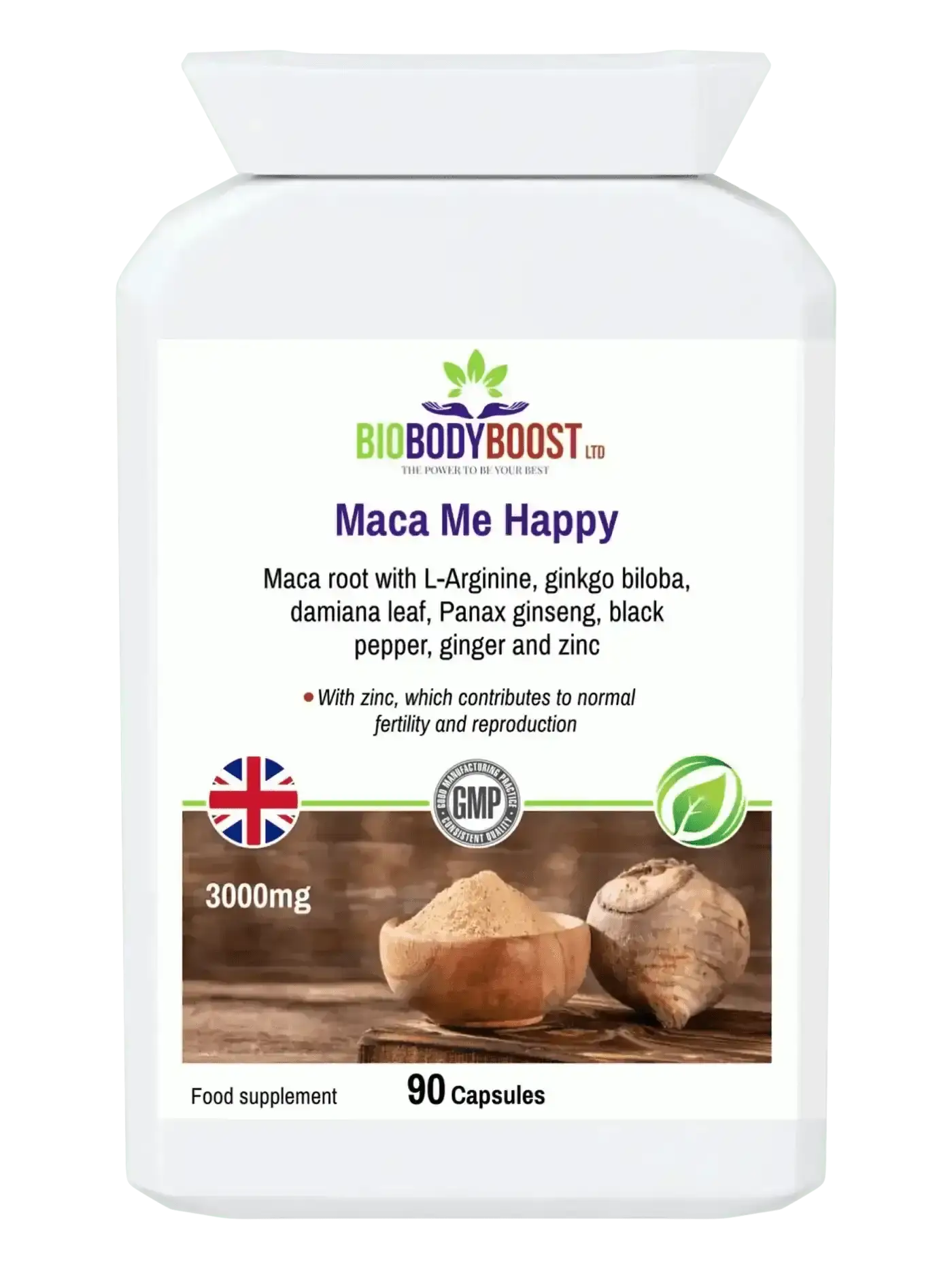
What research shows: Gonzales et al. (2009, Asian Journal of Andrology, n=57) found 8 weeks of maca supplementation significantly improved sexual desire vs placebo without affecting testosterone. A 2010 randomised controlled trial in CNS Neuroscience and Therapeutics (n=39) found maca significantly improved sexual dysfunction associated with SSRI antidepressants in both men and women. A 2016 systematic review in BMC Complementary Medicine confirmed maca improved subjective sexual function in both healthy adults and those with mild ED. Our Maca Me Happy — 3,000mg maca root equivalent with zinc and Korean ginseng. Halal certified, vegan.
4. Ashwagandha KSM-66 — stress, testosterone and male vitality
Chronic stress elevates cortisol, which directly suppresses testosterone production via the hypothalamic-pituitary-gonadal axis. Ashwagandha reduces cortisol (Langade 2019 RCT: 23% reduction in cortisol vs placebo) and has been shown to raise testosterone in stressed men. Wankhede et al. (2015, Journal of the International Society of Sports Nutrition, n=57 male resistance trainers) found KSM-66 ashwagandha at 600mg/day for 8 weeks significantly increased testosterone, muscle size and recovery vs placebo. Our ZenBlend — KSM-66 ashwagandha with rhodiola, L-theanine, niacin and B vitamins. Halal certified, vegan.
5. Creatine — the foundation for Muslim men training
Already the most evidence-supported strength supplement available (300+ studies, 30 years). For Muslim men training around prayer times and Ramadan, creatine’s halal certification and flexible dosing timing (can be taken at Suhoor or Iftar without timing concerns) makes it the ideal training supplement foundation. It also has the mitochondrial biogenesis and cognitive benefits detailed in the creatine longevity guide. Our Creatine Monohydrate — 100% pure, halal certified, vegan. 3–5g daily.
6. Male fertility — the stigma gap
Male factor infertility contributes to approximately 50% of infertility cases but is significantly under-discussed, particularly in communities where male infertility carries significant stigma. The NHS estimates 1 in 7 UK couples has difficulty conceiving, with male factor involved in half of cases. The evidence-based nutritional approach for sperm quality:
- Zinc: essential for spermatogenesis. Zinc deficiency reduces sperm count and motility. EU-authorised claim for “normal fertility and reproduction.”
- Selenium: required for sperm tail formation and motility. EU-authorised claim for “normal spermatogenesis.” CardioVital contains selenium alongside nattokinase.
- Folate: required for sperm DNA synthesis. Deficiency associated with increased sperm DNA fragmentation.
- Antioxidants: sperm DNA is vulnerable to oxidative damage. A 2019 Cochrane review found antioxidant supplementation significantly improved live birth rates in men with subfertility.
- L-Carnitine (in BioBrain): L-carnitine is found in high concentrations in the epididymis and is required for sperm motility via fatty acid energy metabolism in sperm cells.
If you have been trying to conceive for over a year (or 6 months if over 35), the NHS recommends speaking to your GP — nutritional support is adjunctive to medical assessment, not a replacement for it.
The halal men’s health stack at a glance
| Product | Key male benefit | Halal |
|---|---|---|
| Magnesium 3 Complex | Zinc for testosterone + free T via SHBG + sleep quality | ✅ |
| Maca Me Happy | Libido, energy, sexual function (Gonzales 2009 RCT) | ✅ |
| ZenBlend (KSM-66) | Cortisol reduction → testosterone support + stress | ✅ |
| Creatine Monohydrate | Strength, muscle, mitochondria, cognitive function | ✅ |
| BioBrain | L-Carnitine for sperm motility + cognitive energy | ✅ |
Does zinc increase testosterone in men?
In zinc-deficient men, yes significantly. Prasad et al. 1996 (Nutrition) found zinc restriction reduced testosterone by 75% in young healthy men, and zinc repletion restored it in deficient older men. The effect is specific to correcting deficiency — zinc supplementation does not raise testosterone above normal physiological range in men who are already zinc-sufficient. Approximately 20–30% of UK men are below optimal zinc status (higher in vegetarians and vegans). The EU-authorised health claim confirms: zinc “contributes to the maintenance of normal testosterone levels in the blood.”
Is maca root halal UK?
Yes — maca (Lepidium meyenii) is a root vegetable, entirely plant-origin. It is inherently halal, vegan and kosher with no animal involvement. The compliance check is the capsule shell (HPMC in BioBodyBoost products) and manufacturing environment. Maca Me Happy uses HPMC plant-derived capsules, halal certified. Maca does not affect testosterone directly — it acts via a different pathway (macamides affecting endocannabinoid signalling and the hypothalamic-pituitary axis) and is therefore a complementary addition to zinc and ashwagandha rather than a competing mechanism.