Quick answer: creatine is not just a sports performance supplement. In the context of aging and mitochondrial health, creatine has three distinct mechanisms that make it one of the most evidence-supported longevity supplements for adults over 45: it directly buffers ATP production during high-demand periods, it has been shown to stimulate mitochondrial biogenesis (the creation of new mitochondria) via PGC-1α pathways, and it supports neuronal energy metabolism in the brain — where mitochondrial decline contributes to cognitive aging. At 3–5g/day, the safety record is exceptional and the cost is trivial.
Creatine’s role in the mitochondrial energy system
The phosphocreatine energy system operates in parallel with mitochondrial ATP production. When energy demand spikes beyond what the ETC can supply immediately — the first 10–30 seconds of maximal effort — phosphocreatine (PCr) donates its phosphate group to ADP to regenerate ATP instantly, via creatine kinase. Mitochondria then regenerate phosphocreatine during recovery using the ATP they produce aerobically.
This PCr shuttle is not separate from mitochondrial function — it is coupled to it. In the heart and skeletal muscle, creatine kinase is physically associated with the outer mitochondrial membrane, facilitating rapid energy transfer between mitochondrial ATP production and the cell’s energy consumers. Creatine supplementation increases muscle PCr stores by approximately 20–30%, expanding this buffer capacity and reducing the oxygen debt incurred during high-intensity effort.
Mitochondrial biogenesis: the longevity mechanism
Beyond buffering, creatine has emerging evidence for directly stimulating mitochondrial biogenesis — the creation of new mitochondria via PGC-1α (peroxisome proliferator-activated receptor gamma coactivator 1-alpha) activation. PGC-1α is the master regulator of mitochondrial biogenesis and is activated by exercise, cold exposure, caloric restriction and certain compounds including creatine.
What research shows: A 2014 study in the Journal of Physiology (Smith et al.) found creatine supplementation combined with resistance training significantly increased skeletal muscle PGC-1α expression and mitochondrial biogenesis markers vs resistance training alone in older adults. A 2020 review in Nutrients (Clarke et al.) confirmed that creatine supplementation in aging populations supports mitochondrial integrity alongside lean mass preservation. The biogenesis mechanism is most pronounced in older adults — consistent with addressing an age-related decline in PGC-1α activity rather than amplifying already-adequate function.
Muscle and bone: the physical longevity case
Sarcopenia (age-related muscle loss) begins in earnest after age 45 and accelerates after 60 — with muscle mass declining at approximately 1–2% per year and strength declining faster. This is not cosmetic. Sarcopenia is an independent predictor of all-cause mortality, falls and fractures, insulin resistance, metabolic syndrome and loss of functional independence.
Creatine combined with resistance training is the single most evidence-supported nutritional intervention for sarcopenia prevention. A 2003 meta-analysis in the Journal of Strength and Conditioning Research confirmed creatine supplementation produced 8% greater strength gains and 14% greater lean mass gains than resistance training alone across pooled trials. For adults over 45, this is a primary use case that goes well beyond athletic performance.
For bone density: a 2005 MSSE RCT found creatine combined with resistance training significantly improved bone mineral density at the femoral neck vs training alone in postmenopausal women — the same population at highest osteoporosis risk.
Brain mitochondria and cognitive aging
Approximately 5% of total body creatine is stored in the brain. Neuronal creatine supports the same PCr energy buffer function in neurons that it does in muscle — providing rapid ATP regeneration during high neuronal firing demand. Brain creatine declines with age and is lower in vegetarians and vegans (who have no dietary creatine intake).
A 2022 Nutrients meta-analysis (Dolan et al., 13 trials) confirmed creatine supplementation significantly improved memory and processing speed, with the largest effects in sleep-deprived conditions and in populations with lower baseline brain creatine (vegans, vegetarians, older adults). The cognitive application of creatine in the over-45 population is an underrecognised extension of its mitochondrial energy mechanism — the same phosphocreatine buffer that supports muscle performance also supports neuronal ATP availability during cognitive demand.
BioBodyBoost Creatine Monohydrate for longevity
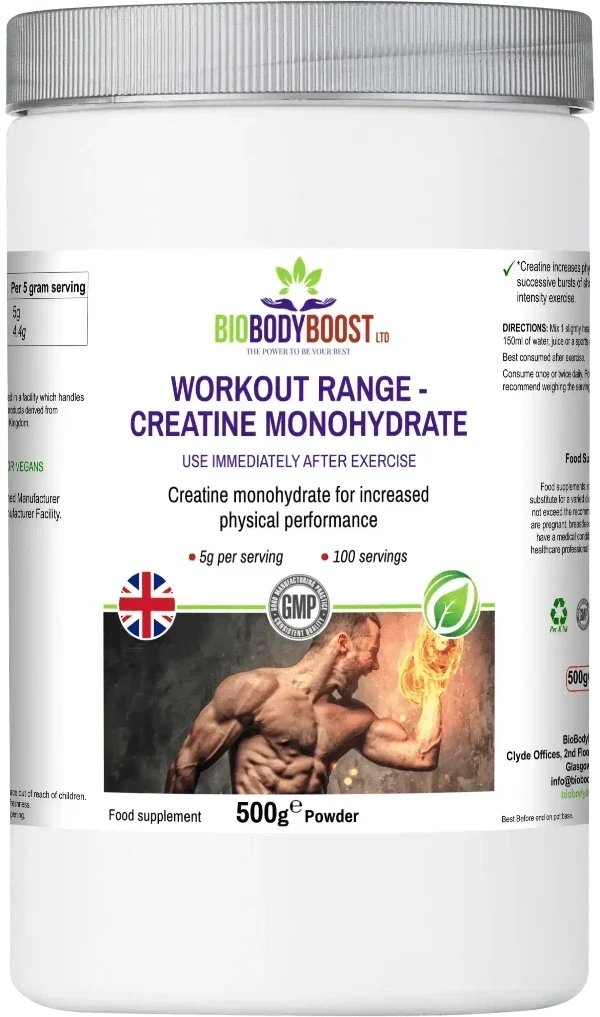
BioBodyBoost Creatine Monohydrate is 100% pure creatine monohydrate — the form used in every major longevity, strength and cognitive trial. No fillers, no proprietary blends, no flavourings. Halal certified, vegan, kosher. 3–5g daily dissolved in water — the simplest, most cost-effective longevity supplement available. Pairs naturally with resistance training and with the other mitochondrial support products in the BBB range.
Return to the full mitochondria and aging guide.
Is creatine good for people over 45?
It is one of the most evidence-supported supplements for adults over 45 specifically — more so than for young adults, because it addresses mechanisms that actively decline with age. Three reasons: (1) creatine combined with resistance training is the most evidence-supported intervention for sarcopenia (muscle loss after 45), producing 8% greater strength and 14% greater lean mass gains than training alone; (2) creatine stimulates mitochondrial biogenesis via PGC-1α in older adults, partially reversing age-related decline in mitochondrial number; (3) creatine supports brain energy via the phosphocreatine buffer, with cognitive improvements confirmed in a 13-trial meta-analysis. At 3–5g/day from creatine monohydrate, it is safe, inexpensive and broadly beneficial after 45.
Does creatine improve brain function in older adults?
Evidence supports this. A 2022 Nutrients meta-analysis (13 trials) confirmed creatine supplementation significantly improved memory and processing speed, with larger effects in people with lower baseline brain creatine — which includes older adults (whose brain creatine declines with age), vegans and vegetarians. The mechanism is the phosphocreatine energy buffer in neurons — the same system that supports muscle performance. During high cognitive demand, rapid ATP regeneration from PCr supports sustained neuronal firing. The cognitive application of creatine in aging is underexplored in mainstream awareness but mechanistically well-supported.
Is creatine safe for long-term use over 45?
Yes — creatine monohydrate has one of the best safety records of any supplement, with 30+ years of research and no established upper safe limit. A 2021 systematic review in the Journal of Strength and Conditioning Research found no adverse renal effects from long-term creatine supplementation in healthy adults. People with pre-existing kidney disease should discuss with their GP before supplementing. For healthy adults over 45, 3–5g/day creatine monohydrate is safe for indefinite long-term use and the evidence for ongoing benefit — muscle mass, mitochondrial biogenesis, cognitive support — is strongest with consistent daily use.