Krill oil is generally considered halal. Most scholars treat all sea creatures as halal, and in the Hanafi school, which allows fish only, a published Hanafi fatwa permits krill oil by comparing krill to prawns.
The bigger question is usually the capsule. Most krill oil comes in gelatine softgels, so the gelatine source decides whether the product you buy is halal.
Key takeaways
- Shafi'i, Maliki and Hanbali scholars generally treat all sea creatures as halal, krill included.
- In the Hanafi school, only fish are halal. Prawns are debated, and a Hanafi fatwa from FatwaCentre treats krill like prawns and permits krill oil.
- Check the capsule shell: bovine or fish gelatine is only acceptable if the source is halal.
- Krill is a crustacean. Avoid it if you have a shellfish allergy, and talk to your GP if you take blood thinners.
In this guide
What krill oil is
Krill are tiny shrimp-like crustaceans from the Southern Ocean. Krill oil is pressed and extracted from them, usually Euphausia superba (Antarctic krill).
Like fish oil, it provides the omega-3 fats EPA and DHA. The difference is that in krill oil, much of the omega-3 is bound to phospholipids rather than triglycerides. It also contains astaxanthin, the pigment that makes krill pink.
What the four schools say
The disagreement is not about krill oil specifically. It comes from a wider question: which sea creatures are halal?
| School | Sea creatures | Krill oil |
|---|---|---|
| Shafi'i | Generally all sea creatures are halal | Generally permitted |
| Maliki | Generally all sea creatures are halal | Generally permitted |
| Hanbali | Generally all sea creatures are halal (with a few exceptions) | Generally permitted |
| Hanafi | Only fish are halal; prawns are disputed | Permitted by analogy with prawns, per a FatwaCentre fatwa |
Many British Muslims of South Asian heritage follow the Hanafi school, so this row matters most in the UK.
The Hanafi answer on IslamQA (FatwaCentre, checked by Mufti Abdur-Rahman Mangera and Mufti Zubair Patel) states that "in the Hanafi school sea creatures are impermissible except for fish". It then argues that krill are anatomically close to prawns, so "prawns and krill should have the same ruling", and concludes: "we do not see any reason to prohibit the use of krill oil" (read the fatwa).
If you personally avoid prawns because you follow the stricter Hanafi view, apply the same rule to krill. An algae-based omega-3 avoids the question entirely. If unsure, ask a scholar you trust.
The capsule problem
Even if the oil is acceptable to you, the capsule might not be. Krill oil is almost always sold as a softgel, and softgels are usually made from gelatine.
- Pork gelatine: not halal.
- Bovine (beef) gelatine: halal only if it comes from halal-slaughtered cattle. Look for halal approval on the product.
- Fish gelatine: accepted by most scholars, as fish are halal in all four schools.
- Plant-based shells (for example starch or seaweed-based): no gelatine question, but rare for krill oil.
This is the same issue we cover in is cod liver oil halal?. If a label simply says "gelatine" with no source and no halal approval, contact the brand before buying.
Some krill oil suppliers have sought halal approval for the oil itself. Aker BioMarine, a major krill oil producer, announced a halal version of its krill oil ingredient in 2021 (Nutrition Insight). That covers the ingredient, not every finished product made with it, so still check the brand.
Five label checks
- Capsule shell source. Pork, beef, fish or plant? Is the product halal approved?
- Halal approval on the finished product. Not just a claim about the raw oil.
- Blends. Some "krill" products are mixed with ordinary fish oil. Check the ingredients list.
- Flavourings. Ask the brand if a flavouring is listed with no further detail.
- EPA and DHA per daily dose. Krill oil often provides less than fish oil, so compare the numbers, not the headline milligrams. Our omega-3 label guide shows how.
Krill vs fish oil vs algae oil
| Krill oil | Fish oil | Algae oil | |
|---|---|---|---|
| Halal question | Hanafi debate (like prawns) + capsule | Oil halal in all schools; check capsule | None from the source; check capsule |
| Omega-3 form | Partly phospholipid | Triglyceride or ethyl ester | Usually triglyceride |
| EPA + DHA per capsule | Often lower | Often higher | Varies, often DHA-rich |
| Allergy | Crustacean (shellfish) | Fish | No fish or shellfish |
| Suitable for vegans | No | No | Usually yes |
The NHS recommends at least 2 portions of fish a week, including 1 of oily fish (NHS: fish and shellfish). A supplement is an extra, not a replacement for a varied diet. For a full overview, see our UK omega-3 guide.
Who should avoid krill oil
Do not take krill oil if you have a shellfish or fish allergy. Crustaceans are one of the 14 allergens that must be declared on UK food labels (Food Standards Agency). Talk to your GP or pharmacist first if you take blood-thinning medication (anticoagulants or antiplatelets), have a bleeding disorder or surgery coming up, or are pregnant or breastfeeding. Not for under-18s unless a health professional advises it.
If you have ever reacted to prawns, crab or lobster, do not assume krill oil is safe. The NHS explains the signs of a food allergy and when to get urgent help (NHS: food allergy).

A halal krill oil option
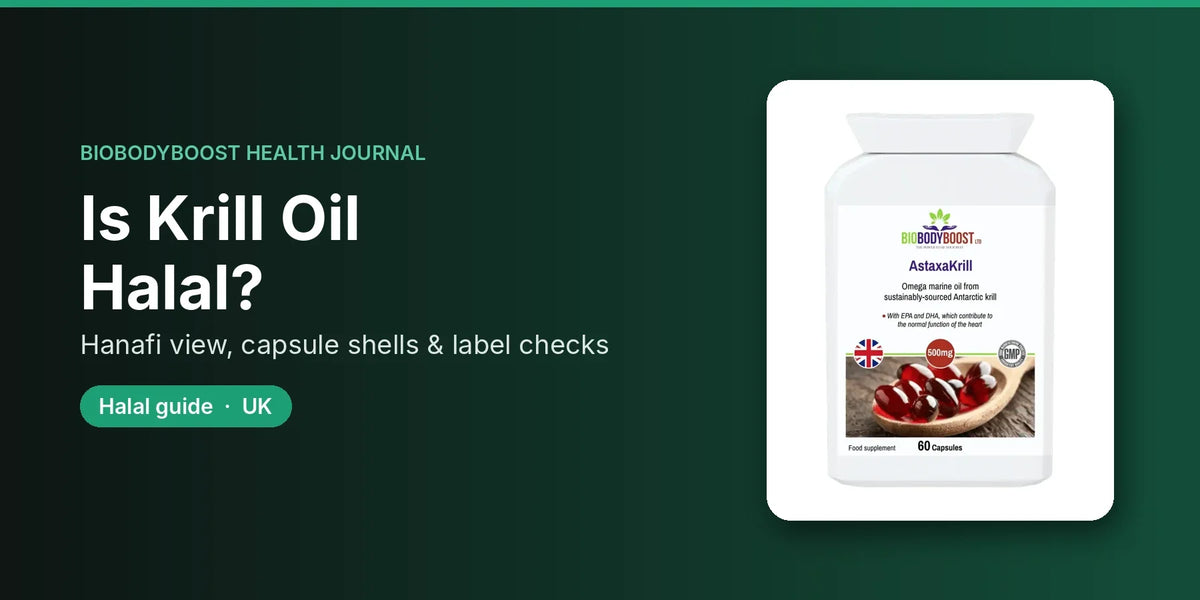
Our AstaxaKrill uses Antarctic krill oil (Superba) and a bovine gelatine capsule. It is listed as halal registered, so the gelatine question is covered, but it is not suitable for vegetarians, vegans or anyone with a shellfish allergy.

Halal registered · Contains crustacean
AstaxaKrill Antarctic Krill Oil
- 500mg krill oil per capsule, 200mg phospholipids
- 60mg EPA and 27.5mg DHA per capsule, plus 50µg astaxanthin
- Bovine gelatine capsule, listed as halal registered
HALAL10 10% off your first order
Shop AstaxaKrill →EPA and DHA contribute to the normal function of the heart; the beneficial effect is obtained with a daily intake of 250mg of EPA and DHA (GB authorised claims, EFSA health claims). Two AstaxaKrill capsules provide 175mg, so it does not reach that amount on its own. If that matters to you, see our krill oil dosage guide or choose a higher-dose omega-3.
Questions people ask
Is krill oil halal for Hanafis?
A Hanafi fatwa from FatwaCentre permits it, treating krill like prawns. If you personally avoid prawns, you may prefer to avoid krill too, or choose algae oil.
Is krill halal to eat?
Krill takes the same ruling as krill oil. Shafi'i, Maliki and Hanbali scholars generally permit it; Hanafi scholars differ over prawns, and krill follows that debate.
Are krill oil capsules halal?
Only if the capsule is halal too. Most are gelatine softgels, so check whether the gelatine is pork, beef or fish, and whether the product is halal approved.
Is krill oil better than fish oil?
Different rather than better. Krill oil has omega-3 partly in phospholipid form plus astaxanthin, while fish oil usually gives more EPA and DHA per capsule for the price.
Can I take krill oil with a shellfish allergy?
No. Krill is a crustacean. Choose an algae-based omega-3 and speak to your GP if you are unsure.
Sources: FatwaCentre: permissibility of krill oil · NHS: fish and shellfish · FSA: food allergy and intolerance · NHS: food allergy · GB authorised health claims · EFSA: health claims · Nutrition Insight: halal krill oil
General information, not medical or religious advice. Food supplements should not replace a varied diet and healthy lifestyle. Contains crustacean. Not suitable for anyone with a fish or shellfish allergy, or during pregnancy or breastfeeding. Speak to your GP or pharmacist before use if you take medication, especially blood thinners. For religious rulings, consult a qualified scholar.