Key takeaways
- A sunnah fast means no food or drink from dawn to sunset, so capsules and powders go at suhoor or after iftar.
- Creatine works by topping up muscle stores over time. Taking it every day matters more than the exact time.
- In a UK winter the fast is short (under 10 hours in London in December), so training after Maghrib is easy.
- Drink steadily from iftar to suhoor. You cannot catch up on water in one go.
- Take prescribed medication? Speak to your GP or pharmacist before fasting.
In this guide
On a Monday or Thursday sunnah fast you take supplements at suhoor before dawn, or after iftar at sunset. Swallowing a capsule or a drink of powder during the fasting hours breaks the fast.
For creatine, the timing on any one day matters less than taking it every day, so fasting days need not break your routine. Here is a simple plan.
What a sunnah fast involves
Many Muslims fast voluntarily on Mondays and Thursdays, following the Prophet ﷺ. In a hadith graded hasan he said: "Deeds are presented on Monday and Thursday, and I love that my deeds be presented while I am fasting" (Jami' at-Tirmidhi 747).
The fast is the same as in Ramadan: no food, no drink and nothing swallowed from dawn (Fajr) until sunset (Maghrib). For questions about your own situation, ask your local imam.
Sunnah fasting vs the 5:2 diet
Two fasting days a week sounds like the 5:2 diet, and diet guides from the big retailers cover 5:2 in detail. But the two are very different, and that changes how you plan supplements and training.
| Sunnah fast | 5:2 diet | |
|---|---|---|
| Food | None from dawn to sunset, then normal meals | Small amounts allowed across the day |
| Water | None during the fast | Allowed |
| Supplements | Suhoor or after iftar only | Any time |
| Purpose | Worship | Weight management |
Because water is off the table too, the main practical risk is not drinking enough, not hunger.
Supplement timing on a fasting day
Think of the fasting day as two windows: suhoor before Fajr, and the evening from Maghrib until you sleep.
| Supplement | Best window | Why |
|---|---|---|
| Creatine | After iftar, or after an evening workout | Easy to take with a big glass of water |
| Vitamin D | With suhoor or the iftar meal | Taking it with a meal makes it a habit |
| Magnesium | Evening, after iftar | Fits a wind-down routine |
| Multivitamin | Suhoor | Keeps your usual morning habit |
The NHS advises everyone to consider 10 micrograms of vitamin D a day in autumn and winter, and all year if you cover most of your skin outdoors or have dark skin (NHS: vitamin D).
For Ramadan-specific questions, see our guide to supplements and fasting in Ramadan.
Creatine on Mondays and Thursdays
Creatine increases physical performance in successive bursts of short-term, high-intensity exercise. This authorised claim is based on a daily intake of 3g.
The key word is daily. Creatine builds up in your muscles over weeks, so you do not lose its effect by taking it at night instead of in the morning on fasting days.
- Keep the dose the same. Take your usual serving after iftar.
- Take it with plenty of water. Mix with at least 150ml, then keep drinking through the evening.
- Don't double up at suhoor to "make up" for the day. There is no need.
- Do not take it during the fast. A drink of creatine breaks it like any other drink.
Worried about water weight? See does creatine make you bloated? Want to mix it into your iftar chai? See creatine in tea or chai.

When to train
In December, Fajr in London is around 6am and Maghrib is just before 4pm, so the fast lasts under 10 hours. That makes UK winter the easiest time of year for sunnah fasting.
- After iftar (best for most people). Eat a light iftar, wait an hour or so, train, then have a proper meal.
- Just before Maghrib. A short, lighter session, so you can eat and drink straight afterwards.
- Morning, fasted. Keep it easy. Hard sessions without water are not a good idea.
Hydration tip: the NHS recommends 6 to 8 glasses of fluid a day. On a fasting day, spread them out: two at iftar, two or three through the evening, and two at suhoor.
Who should check first
Speak to your GP or pharmacist before fasting or changing supplements if you are pregnant or breastfeeding, have diabetes, kidney or heart problems, or take prescription medication. Do not change how you take a medicine without professional advice. Creatine is not recommended for under-18s.
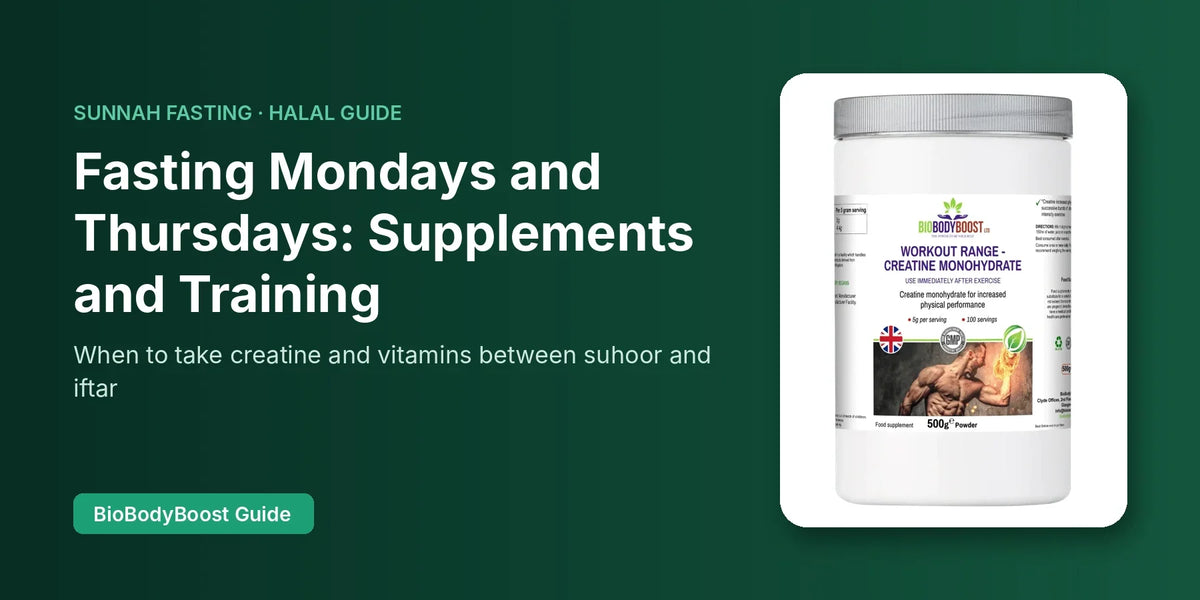
A halal approved creatine with one ingredient

Vegan · Halal approved
Creatine Monohydrate 500g
- Pure creatine monohydrate, nothing added
- 5g per serving, 100 servings per pot
- Unflavoured; made in the UK in an Informed Manufacturer Facility
HALAL10 10% off your first order
Shop Creatine →Want the background on sourcing? Read is creatine halal? For an evening magnesium, see magnesium glycinate vs malate vs taurate.
Common questions
Can I take supplements while fasting on Monday and Thursday?
Not during the fasting hours. Swallowing a capsule or drinking a powder breaks the fast. Take them at suhoor or after iftar instead.
Should I stop creatine on fasting days?
No need. Take your usual dose after iftar. Taking it every day matters more than the time of day.
Is it OK to train while doing a sunnah fast?
Most healthy adults can train on a fasting day. Training after iftar is easiest, because you can drink water before and after.
How is a sunnah fast different from intermittent fasting?
Most intermittent fasting plans allow water, and 5:2 allows some food. A sunnah fast allows neither from dawn to sunset.
Is BioBodyBoost creatine halal?
Yes. It is halal approved and vegan, and contains only creatine monohydrate.
Sources: Jami' at-Tirmidhi 747 · NHS: vitamin D · NHS: water, drinks and your health · Guy's and St Thomas' NHS: taking medicines during Ramadan · GOV.UK: GB nutrition and health claims register
General information, not medical or religious advice. Food supplements should not replace a varied diet and healthy lifestyle. Do not exceed the recommended intake. Not for under-18s. Speak to your GP or pharmacist before use if you are pregnant, breastfeeding, taking medication or have a medical condition.