Key takeaways
- A cup of haldi doodh made with one teaspoon of turmeric gives roughly 30 to 80mg of curcumin.
- A turmeric capsule can give more in one go: ours gives 150mg per capsule.
- Haldi doodh is a food. The UK's food safety advisers found a teaspoon a day of ground turmeric stays within the safe daily intake.
- Capsules need more care: do not stack products, and speak to your GP if you take medicines or have liver or bile duct problems.
In this guide
Haldi doodh and turmeric capsules both give you curcumin, but a capsule usually gives more, in a measured dose. A cup of haldi doodh is a comforting food with a modest, variable amount.
Neither is better for everyone. It depends on why you want it, and on your health and medicines.
How much curcumin is in a cup of haldi doodh?
Curcumin is the main yellow compound in turmeric. Ground turmeric is mostly not curcumin.
In a 2021 survey of turmeric products bought in the UK, carried out for the Food Standards Agency, ground turmeric contained roughly 0.7% to 1.9% curcumin. The survey is summarised by the UK Committee on Toxicity (COT statement on turmeric and curcumin).
The COT used 4g as a teaspoon of turmeric. So one level teaspoon in your milk gives roughly 30 to 80mg of curcumin. Half a teaspoon, which many family recipes use, gives about half that.
The honest answer: you never quite know how much curcumin is in your cup. It depends on the brand of haldi, how fresh it is and how much you spoon in.
Haldi doodh vs turmeric capsules side by side
| Haldi doodh (1 tsp) | CurcuminBoost (1 capsule) | |
|---|---|---|
| Curcumin | About 30 to 80mg, varies | 150mg, stated on label |
| Calories | From the milk, ghee and any sugar | Negligible |
| Dairy | Yes, unless you use plant milk | No, vegan |
| Taste and stains | Earthy; stains mugs and teeth | None |
| Best for | A warm bedtime ritual and family tradition | A known, consistent amount |
Turmeric has a long history in South Asian home kitchens and Ayurvedic practice, and haldi doodh is traditionally used as a warming winter drink. Turmeric and curcumin have no authorised health claims in the UK, so we do not make any for either option.
Black pepper, milk and ghee: do they matter?
Curcumin does not dissolve well in water, so many families add a pinch of black pepper and make haldi doodh with full-fat milk or a little ghee.
Black pepper contains piperine. Supplement makers often add piperine to help absorption, but the COT describes that claim as questionable. Our capsules contain 5mg of piperine, as listed on the label, and we do not claim it multiplies absorption.
Taking turmeric with food that contains some fat is a sensible, simple habit, whether it is in a mug or a capsule.
How much is too much?
The UK COT uses an acceptable daily intake (ADI) of up to 3mg of curcuminoids per kg of body weight. For a 70kg adult that is about 210mg a day.
- The COT found that ground turmeric samples taken at a teaspoon a day all stayed within the ADI.
- Some supplements, taken at their label dose, can go over it. The COT linked turmeric supplements to rare cases of liver injury, including at lower doses in some people.
- The risk is higher if you take other medicines, or have liver, gallbladder or bile duct problems.
Speak to your GP or pharmacist before taking a turmeric supplement if you are pregnant or breastfeeding, under 18, take any regular medicine (especially blood thinners), or have liver, gallbladder or bile duct problems.
Stop and get medical advice if you notice yellow skin or eyes, dark urine or tummy pain (NHS: jaundice).
Our label allows 1 to 3 capsules a day with food. One capsule a day keeps most adults within the ADI. Do not add other turmeric supplements on top, and talk to your pharmacist before going above one a day. A normal cup of haldi doodh alongside one capsule is still a modest amount for most adults.

Which one suits you?
- Choose haldi doodh if you enjoy it as a food and a family ritual. Keep it to around a teaspoon of turmeric.
- Choose a capsule if you want a stated amount, no dairy, no calories and no yellow mugs.
- Lactose intolerant? Make haldi doodh with oat or soya milk. See our guide to lactose intolerance in South Asian diets.
For the difference between turmeric powder and curcumin extract, read turmeric vs curcumin. For winter basics like vitamin D, see our winter supplements guide.
A halal approved turmeric capsule

Vegan · Halal & kosher approved
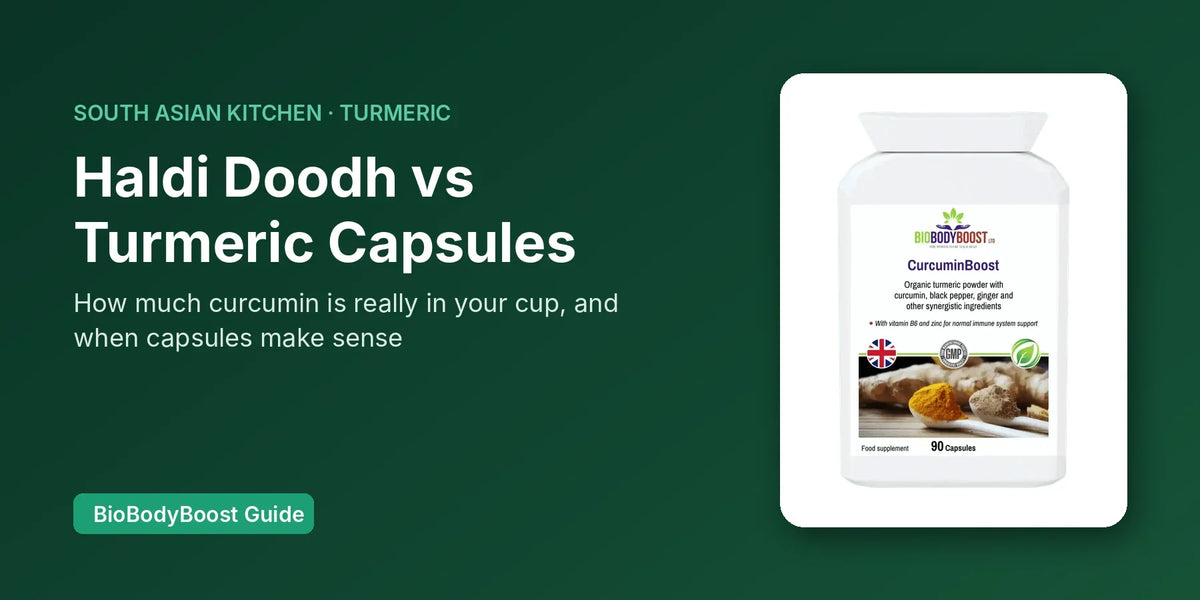
CurcuminBoost Organic Turmeric
- 150mg curcumin per capsule from organic root powder plus extract
- With ginger and black pepper, in a plant HPMC capsule
- Zinc contributes to the normal function of the immune system
HALAL10 10% off your first order
Shop CurcuminBoost →Questions people ask
Is haldi doodh or a turmeric capsule better?
A capsule gives a known, larger amount of curcumin. Haldi doodh gives a smaller, variable amount as part of a warm drink. Pick the one that fits your aim and your health.
How much curcumin is in a teaspoon of turmeric?
Based on UK survey data, roughly 30 to 80mg in a 4g teaspoon. It varies by brand and freshness.
Can I drink haldi doodh and take turmeric capsules?
A normal cup with one capsule is a modest amount for most adults. Do not combine several turmeric supplements, and ask your pharmacist if you take medicines.
Is it safe to drink haldi doodh every night?
Turmeric in normal food amounts, around a teaspoon a day, stayed within the UK safe daily intake. If you have liver or bile duct problems, ask your GP.
Is turmeric halal?
Turmeric is a plant, so it is halal. With capsules, check the shell is not gelatine and look for halal approval. CurcuminBoost uses a plant HPMC capsule and is halal approved.
Sources: GOV.UK: COT statement on turmeric and curcumin supplements · GOV.UK: COT lay summary · NHS: jaundice
General information, not medical advice. Turmeric and curcumin have no authorised health claims. Food supplements should not replace a varied diet and healthy lifestyle. Do not exceed the stated dose. Not for under-18s. Speak to your GP or pharmacist before use if pregnant, breastfeeding, taking medication or managing a health condition.