
Quick answer: most collagen supplements do exactly one thing — supply collagen peptides from an external source (fish or cattle) for your body to absorb and use as raw material. What almost none of them do is support the enzymes your own skin cells use to build new collagen from scratch. That second mechanism depends on specific cofactors — vitamin C, copper and zinc chief among them — and it's the part of the formula most brands skip entirely to keep the ingredient list short and the collagen dose number impressive on the front of the pack.
Two different jobs, often confused as one
"Collagen supplement" gets treated as a single category, but it's really doing (or not doing) two separate jobs:
- Supplying collagen peptides — hydrolysed collagen from fish or cattle, broken into small peptide fragments your gut can absorb, which then circulate and get used as building-block material, some of it reaching skin, hair and nail tissue.
- Supporting endogenous collagen synthesis — your own fibroblast cells manufacture collagen continuously throughout life (though the rate declines from the mid-20s), and that manufacturing process depends on specific enzymatic cofactors being present in adequate amounts. Without them, the process is bottlenecked regardless of how much collagen peptide you're supplying externally.
A supplement that only does the first job is not wrong or fraudulent — supplying peptides is a real, evidenced mechanism on its own. But a formula built around both jobs is addressing a more complete picture than one addressing only external supply.
The cofactor most formulas actually skip: vitamin C
This is the clearest, best-documented example. Vitamin C is a required cofactor for prolyl hydroxylase and lysyl hydroxylase — the two enzymes responsible for stabilising the collagen triple-helix structure during synthesis inside your own cells. Without adequate vitamin C, these enzymes cannot function properly, and the collagen your body attempts to build comes out structurally unstable. This isn't a subtle or debated mechanism: it's the reason scurvy (severe vitamin C deficiency) causes connective tissue breakdown, bleeding gums and poor wound healing — all downstream of collagen synthesis failing at the enzymatic level.
The EU-authorised health claim reflects this directly: vitamin C contributes to normal collagen formation for the normal function of skin. This is a synthesis claim, not an antioxidant claim — it's specifically about vitamin C's role in your body making collagen, distinct from any collagen you've ingested.
Copper: the cross-linking step nobody mentions
Once collagen molecules are synthesised, they need to be cross-linked into stable fibres — a process driven by the enzyme lysyl oxidase, which requires copper as a cofactor. Without sufficient copper, newly synthesised collagen remains structurally weaker and less resistant to breakdown. Copper has an EU-authorised claim for contributing to normal connective tissue maintenance, directly relevant to this cross-linking function.
What a "peptides only" formula is actually missing
When a collagen product lists collagen peptides as essentially the only active ingredient, it's supplying raw material without necessarily supporting the two mechanisms above. This isn't a flaw specific to any one brand — it's a common pattern across the category, since a single named ingredient at a high dose photographs well on packaging in a way that a seven-ingredient cofactor stack doesn't.
What a formula built around both mechanisms looks like

400mg Peptan Type I collagen alongside vitamin C, copper, zinc and silica — the synthesis and cross-linking cofactors, not just the peptide supply.
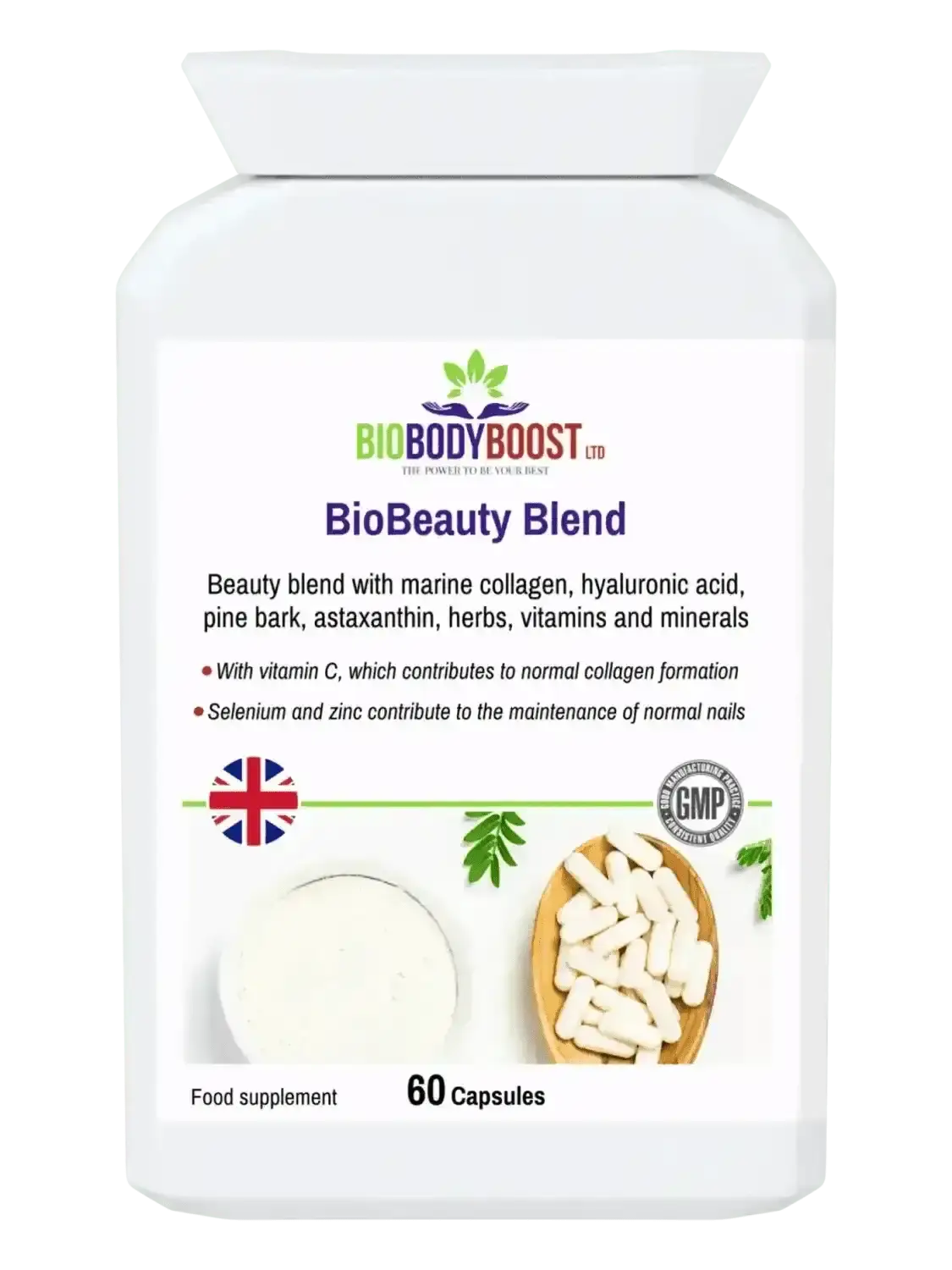
Our BioBeauty Blend pairs 400mg of branded Peptan® Type I marine collagen with vitamin C (40mg, 50% NRV) for synthesis, copper (0.5mg) for cross-linking, zinc (5mg) and bamboo silica for connective tissue and keratin structure, alongside a botanical antioxidant complex (pine bark, pomegranate) to help protect existing collagen from oxidative breakdown. It's built to address collagen supply and collagen-building capacity together, rather than supply alone. Halal registered.
The cluster: dig deeper into each mechanism
- Vitamin C and collagen synthesis: why most collagen supplements skip the cofactor that makes it work
- Copper, zinc and silica: the overlooked minerals behind your body's own collagen production
- Silicon collagen boosters (like BioSil) vs collagen peptides: what's actually different
Frequently Asked Questions
Does collagen supplement help your body make its own collagen?
It depends on the formula. Collagen peptides alone supply raw material your body can use, but don't directly support the enzymatic process your fibroblast cells use to synthesise new collagen. That synthesis process depends on cofactors — vitamin C for the hydroxylation step, copper for cross-linking — which are frequently absent from single-ingredient collagen peptide products.
Why isn't there an EU health claim for collagen itself?
EFSA has not authorised a specific health claim for collagen peptides as an ingredient. This is why formulas built around regulated claims lean on vitamin C, zinc, copper, biotin and similar nutrients, which do carry authorised claims for skin, hair and nail maintenance at their declared doses — the collagen is the substrate, the cofactors are what the regulated claims are actually built on.
Can I get these cofactors from a separate multivitamin instead?
In principle, yes, if the multivitamin provides adequate vitamin C, copper and zinc at the same time you're taking a collagen supplement. In practice, a formula built to include both in one product removes the need to coordinate two separate supplements and confirm the doses actually overlap correctly.
This article is for general information and does not constitute medical advice. Speak to a healthcare professional before starting any new supplement, particularly if pregnant, breastfeeding, or managing a diagnosed health condition.
BioBodyBoost — Halal Certified UK Supplements
Use code HALAL10 for 10% off your first order — halal approved under UHA Certificate Ref. 24623, UK made. Shop Hair, Skin & Beauty UK →