
Quick answer: silicon-based "collagen generator" supplements (BioSil being the best-known example) and collagen peptide supplements work through genuinely different mechanisms, not competing versions of the same thing. Silicon-based products supply zero collagen peptides at all — they're built entirely around stimulating your body's own fibroblast cells to produce more collagen. Collagen peptide products do the opposite: they supply raw material without directly targeting the stimulation side. Neither approach alone covers the full picture, which is the actual gap a combined formula is trying to close.
How silicon-based collagen generators actually work
BioSil, the most widely recognised product in this category, is built around choline-stabilised orthosilicic acid (ch-OSA) — a patented, bioavailable form of silicon paired with choline to aid absorption. The manufacturer's own clinical trials (funded by BioMinerals N.V., the patent holder) found improvements in hair strength, skin elasticity and nail brittleness over 20-40 week periods. The proposed mechanism is that bioavailable silicon supports the enzymatic activity of fibroblasts — the cells responsible for producing collagen — rather than supplying any collagen itself.
This is a genuinely different approach from collagen peptides: BioSil contains no collagen, no vitamin C, and no copper. It's built entirely around one mechanism (silicon-supported endogenous stimulation) rather than combining stimulation with supply.
The honest limitation on both sides
Being direct about the evidence quality on the silicon side: the published trials behind ch-OSA are funded by the product's own manufacturer, which doesn't make the findings false, but does mean they haven't been independently replicated by unconnected research groups at the same scale as, say, the vitamin C collagen-synthesis mechanism, which is textbook biochemistry rather than a single company's clinical programme.
Collagen peptide supplements have their own honest limitation: multiple independent randomised controlled trials support modest improvements in skin elasticity and hydration, but a peptide-only product supplies raw material without directly addressing the enzymatic synthesis and cross-linking steps your body performs on that material — the mechanisms covered in our vitamin C and copper, zinc and silica articles in this series.
Where a combined approach sits
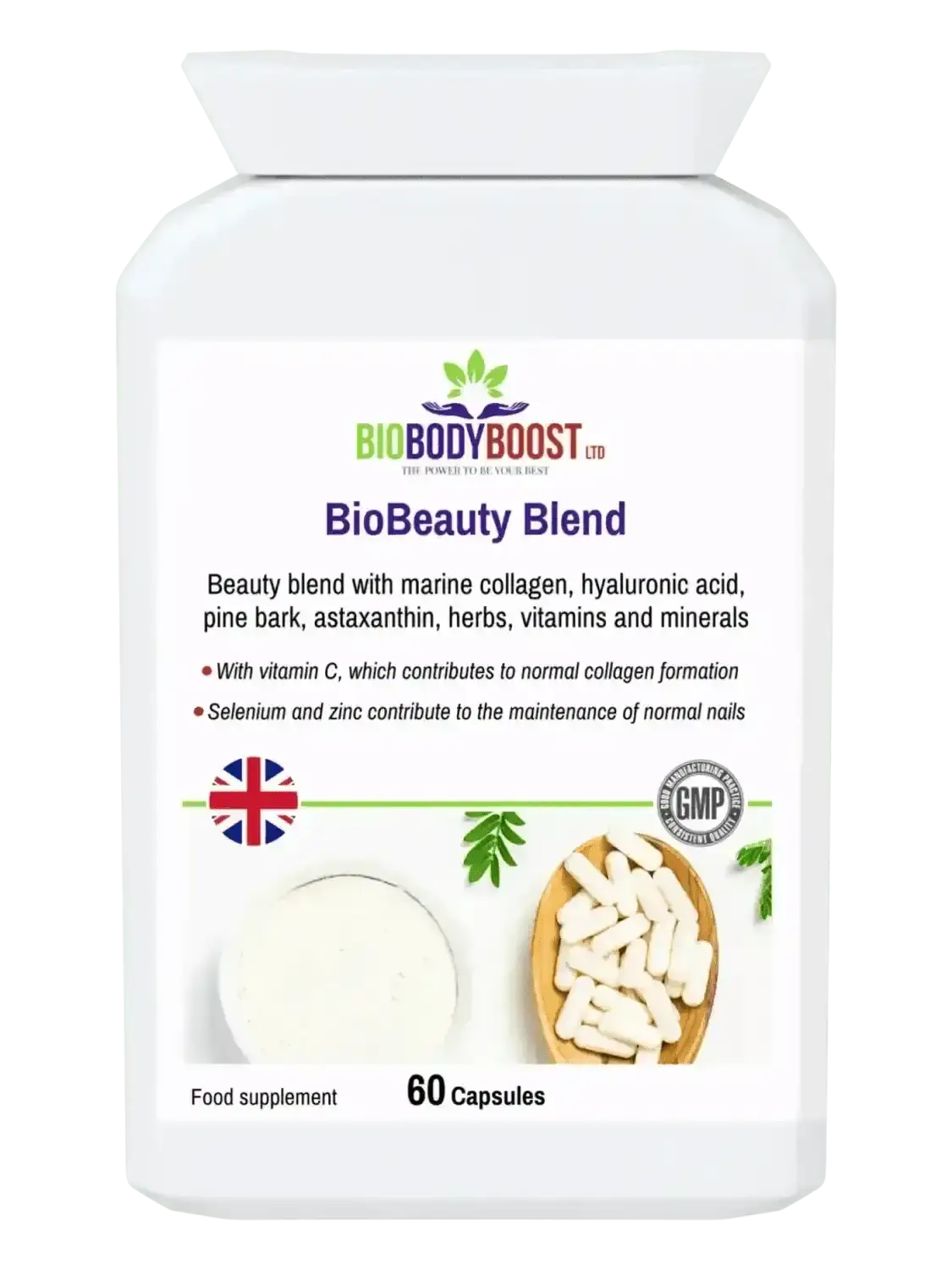
A formula that supplies collagen peptides alongside vitamin C (synthesis), copper (cross-linking) and silica (structural support) is attempting to address both sides of the equation — raw material supply and the body's own building process — rather than choosing one mechanism exclusively. This isn't a claim that it out-performs either single-mechanism approach in a head-to-head trial (that comparison hasn't been run), but it is a structurally different, more complete formulation logic than either a peptides-only or a silicon-only product on its own.
The halal question this category rarely addresses

Bamboo silica alongside collagen and the full cofactor stack, with third-party halal certification declared.
Silicon-generator products in this category are typically marketed on vegan status, but halal certification specifically is rarely mentioned at all — choline can be sourced from multiple routes, some plant-derived and some not, and without a named third-party halal certifying body, that sourcing isn't independently verified either way. Our BioBeauty Blend carries halal registration alongside its combined collagen-plus-cofactor formula, addressing a compliance gap that exists across most of this specific product category, not just the peptide-only side of it.
The full cluster
- Does a collagen supplement help your body make its own collagen?
- Vitamin C and collagen synthesis
- Copper, zinc and silica for collagen
Frequently Asked Questions
Is BioSil better than collagen peptides?
They're not directly comparable, since they work through different mechanisms — BioSil supplies zero collagen and is built around silicon-supported fibroblast stimulation, while collagen peptides supply raw material without directly targeting that stimulation step. No head-to-head trial comparing the two approaches has been published; the honest answer is that they're solving different parts of the same overall problem.
Does silicon actually help your body make collagen?
The clinical evidence specifically behind choline-stabilised orthosilicic acid (the patented form used in products like BioSil) shows improvements in hair, skin and nail measures over 20-40 week trials, though these studies are manufacturer-funded rather than independently replicated at the same scale. Silicon does have a plausible, evidenced role in connective tissue formation more broadly.
Is BioSil halal?
This isn't clearly stated by the manufacturer. BioSil is marketed as vegan, but vegan status and halal certification are separate questions, and no named third-party halal certifying body appears on the product's own materials. Choline sourcing specifically can vary by route, which is exactly the kind of detail halal certification is meant to verify independently.
This article is for general information and does not constitute medical advice. Speak to a healthcare professional before starting any new supplement, particularly if pregnant, breastfeeding, or managing a diagnosed health condition.
BioBodyBoost — Halal Certified UK Supplements
Use code HALAL10 for 10% off your first order — halal approved under UHA Certificate Ref. 24623, UK made. Shop Hair, Skin & Beauty UK →