
Quick answer: vitamin C isn't just an antioxidant riding alongside collagen supplements — it's a required cofactor for the specific enzymes your own cells use to synthesise collagen, meaning a collagen supplement without adequate vitamin C is supplying raw material to a process that can't complete properly. This is well-established, textbook biochemistry, not a marketing claim: it's the exact mechanism behind scurvy, a disease defined entirely by collagen synthesis failure.
The enzymes vitamin C actually enables
Collagen is built as a triple-helix structure — three protein chains wound together — and that structure only becomes stable through a modification step called hydroxylation, carried out by two enzymes: prolyl hydroxylase and lysyl hydroxylase. Both enzymes require vitamin C (ascorbic acid) as an essential cofactor to function. Without it, the enzymes cannot properly hydroxylate the proline and lysine amino acids in the developing collagen chain, and the resulting molecule is structurally unstable — it doesn't fold into the strong triple-helix that gives collagen its tensile strength.
This is a textbook, uncontested mechanism in biochemistry, not an emerging or debated theory. It's taught in undergraduate biochemistry specifically because scurvy provides such a clean, historically documented illustration of what happens when this single cofactor is absent.
Scurvy: the deficiency case that proves the mechanism
Scurvy — severe vitamin C deficiency — was historically common among sailors on long voyages without access to fresh fruit, and its symptoms map directly onto collagen synthesis failure: bleeding gums, wounds that won't heal, weakened blood vessel walls, and joint pain. Every one of these symptoms traces back to the same root cause — without vitamin C, the body cannot properly hydroxylate and stabilise new collagen, so existing collagen structures (gums, blood vessels, healing wounds) gradually fail without being replaced by functional new material.
You don't need to be anywhere near scurvy-level deficiency for this to matter for a collagen supplement's effectiveness. The relevant question isn't "do I have scurvy" — it's whether a collagen product is providing enough vitamin C alongside the collagen peptides to support the synthesis step the body still needs to perform on its own.
The EU-authorised claim, and what it actually says
Vitamin C carries an EU-authorised health claim: contributes to normal collagen formation for the normal function of skin. This is worth reading precisely — it's a claim about collagen formation (synthesis), not about collagen you've ingested. It's the regulatory acknowledgment of the exact mechanism described above: vitamin C's role in your body's own collagen-building machinery, separate and distinct from any collagen peptides you take orally.
Interestingly, this is also why there is no equivalent EU-authorised claim for collagen peptides themselves — EFSA has not approved a specific health claim for ingested collagen. The vitamin C claim is the actual regulated foundation underneath most "collagen for skin" marketing, whether or not the product itself contains meaningful vitamin C.
Why some collagen supplements don't include it
Single-ingredient collagen peptide products — the most common format in the category — are built around one headline ingredient at an impressive-sounding dose (5g, 10g collagen) rather than a broader formula. Adding vitamin C, copper and other cofactors dilutes the simplicity of that single-ingredient story, even though it's addressing a real gap in what the product can actually achieve mechanistically.
What an adequately dosed formula looks like
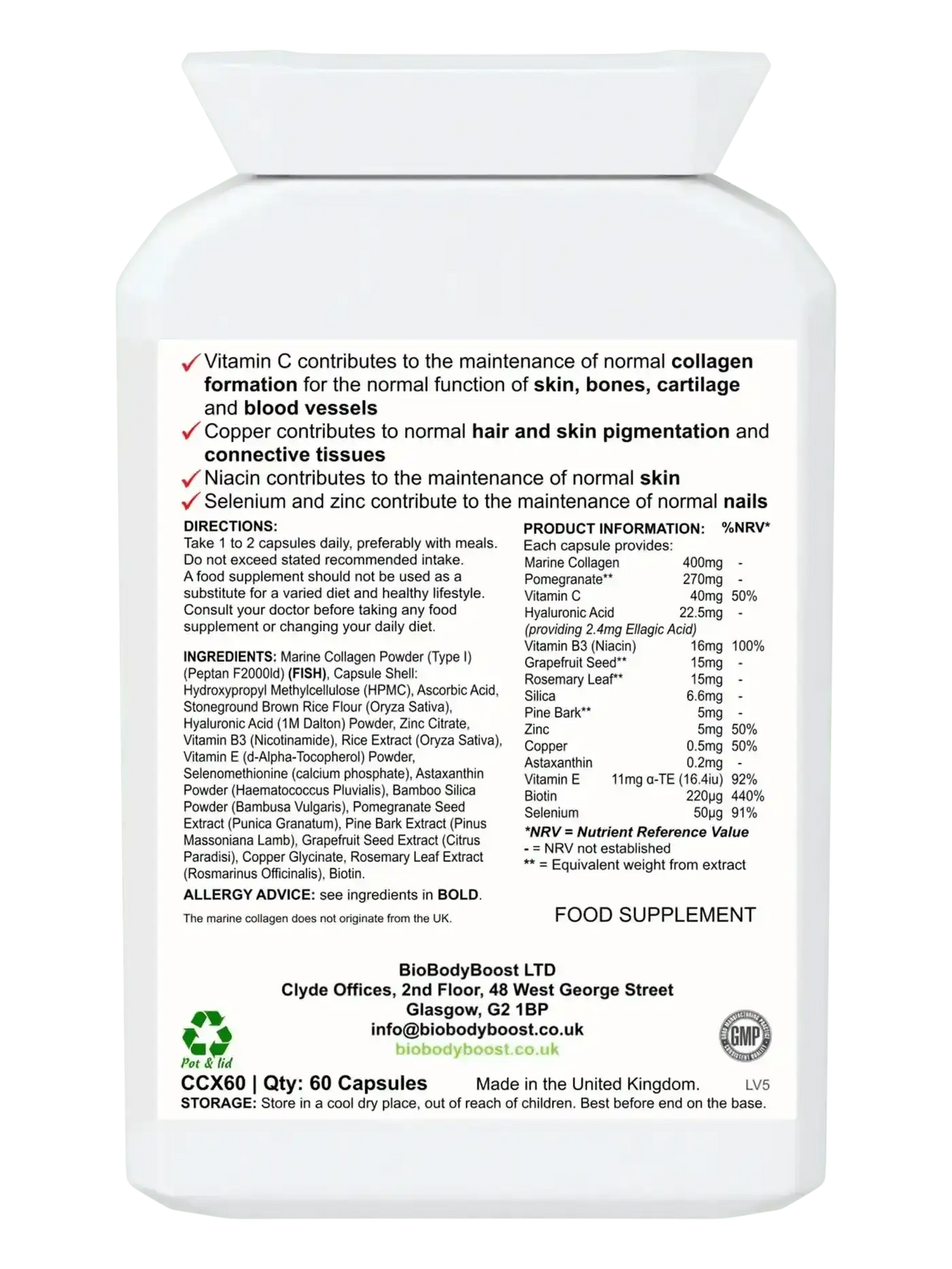
Our BioBeauty Blend provides 40mg vitamin C (50% NRV) alongside 400mg of Peptan® Type I marine collagen — dosed specifically to support the synthesis claim, not included as an afterthought. This sits within our broader collagen synthesis vs supply guide, which also covers copper's role in collagen cross-linking.
Frequently Asked Questions
Why do I need vitamin C if I'm already taking collagen?
Because collagen peptides you ingest are raw material, but your body still needs to synthesise its own new collagen continuously — a process that depends on vitamin C as an enzymatic cofactor for prolyl and lysyl hydroxylase. Taking collagen without adequate vitamin C means one part of the system is well-supplied while the synthesis machinery may still be under-supported.
How much vitamin C do I need for collagen synthesis specifically?
The EU-authorised claim threshold for vitamin C's collagen formation benefit is met at 12mg per day (15% NRV), though many formulas provide considerably more. BioBeauty Blend provides 40mg (50% NRV) per serving.
Is this the same vitamin C used for immune support?
Yes — it's the same nutrient (ascorbic acid), but vitamin C carries multiple separate EU-authorised claims covering different functions: collagen formation, immune system support, and protection of cells from oxidative stress among them. The collagen formation claim is specifically about the hydroxylation enzymes described above.
This article is for general information and does not constitute medical advice. Speak to a healthcare professional before starting any new supplement, particularly if pregnant, breastfeeding, or managing a diagnosed health condition.
BioBodyBoost — Halal Certified UK Supplements
Use code HALAL10 for 10% off your first order — halal approved under UHA Certificate Ref. 24623, UK made. Shop Hair, Skin & Beauty UK →