
Marine collagen is one of the fastest-growing supplement categories in the UK, and the market has a quality problem. Walk into any health shop or search Amazon and you’ll find hundreds of products — from 1g capsules at £9.99 to 10g powders at £45. Nearly all of them claim to improve skin, hair, nails and joints. The reality is more nuanced: dose, hydrolysation and source determine whether a collagen supplement works at all. Most products on the market fail at least one of these criteria.
What Makes Marine Collagen Different
Marine collagen is primarily Type I collagen — the most abundant collagen type in the human body, making up over 80% of the collagen in skin, tendons, ligaments and bone. This makes it the most relevant type for skin elasticity, hair and nail strength, and wound healing.
Bovine collagen contains a mix of Types I and III. For skin-focused applications, the marine Type I profile is more targeted. Marine collagen also has a lower average molecular weight than bovine, which gives it marginally better absorption characteristics in the gut — our bovine vs marine collagen guide covers the comparison in full.
The Dose Problem: Why Most Collagen Capsules Are a Waste of Money
This is the most important thing to understand when buying collagen. The clinical evidence for skin and joint benefits is based on doses of 5–10g of hydrolysed collagen per day. Most capsule products provide 0.5–2g per serving. At these doses, you are below the threshold of almost all published clinical research.
If you’re taking collagen capsules and not noticing results after 3 months, this is almost certainly the reason. Capsule formats simply cannot deliver a therapeutic dose without requiring you to take 10–20 capsules per day. A collagen powder is the only practical format for reaching the clinical dose in a single serving.
Hydrolysed vs Native Collagen
This distinction matters enormously for absorption. Collagen is the body’s most abundant structural protein and is made of very large molecules. Native (non-hydrolysed) collagen molecules are far too large to cross the gut wall intact. Hydrolysed collagen peptides are broken down into short chains of 2,000–5,000 Daltons that can cross the gut wall intact, appear in blood within 60 minutes, and directly stimulate fibroblasts to produce new collagen. Always look for “hydrolysed” on the label.
Purity: What “clean” Collagen Actually Requires
Fish-derived ingredients carry a genuine, specific purity concern most collagen marketing skips entirely: heavy metal accumulation from the water the fish lived in, and cross-contamination in shared manufacturing facilities. “Purity” isn’t a marketing adjective — it's a testable claim, and the only way to verify it is independent, third-party batch testing rather than a brand's own say-so.
The credential worth checking for specifically is Informed Manufacturer (or the related Informed-Sport programme) — a genuine third-party certification that batch-tests finished products for banned substances and contaminants, run independently of the brand selling the product. A supplement carrying this certification has had its actual manufacturing facility audited and its batches tested, not just its ingredient list reviewed on paper.

Every EU-authorised claim declared on the label — vitamin C, biotin, niacin and zinc doses, not vague marketing language.
Sourcing: Where Marine Collagen Actually Comes From
Marine collagen is extracted from the by-products of the commercial fish processing industry — skin, scales and sometimes bones that would otherwise be discarded — rather than fish farmed specifically for collagen extraction. This matters for two reasons: it's a genuinely more efficient use of an existing supply chain than farming an animal purely for collagen, and it's why marine collagen is classified as pescatarian rather than fully plant-based — it is an animal-derived ingredient, just not a land-animal one. For halal compliance specifically, fish-derived collagen avoids the bovine gelatine and slaughter-method questions entirely, since most Sunni schools of Islamic jurisprudence permit sea creatures without requiring a specific slaughter method.
Value: What You're Actually Paying Per Gram of Collagen
Price comparisons in this category are frequently misleading because pack size and dose per serving vary enormously — a bottle that looks cheaper can work out considerably more expensive per gram of actual collagen delivered. The only fair comparison is cost per gram of collagen, not cost per bottle or per scoop:
- Do the maths per gram, not per serving or per bottle — divide the price by the total collagen delivered across the whole pack, not the collagen in a single scoop
- Check whether "per serving" doses are actually comparable — some brands use a smaller scoop size specifically to make a headline price look lower
- Factor in what else is included — a product bundling hyaluronic acid, MSM and vitamin C at EU-authorised doses is doing more per pound than a collagen-only powder, even at a similar headline price
The Halal Collagen Gap in the UK Market
The overwhelming majority of collagen supplements in the UK use bovine or porcine sources. Porcine collagen is never halal. Marine collagen from sustainably sourced fish, with a full halal-certified supply chain, is the appropriate choice for Muslim consumers. For what to check on a label before buying, see is marine collagen halal?
What to Actually Look For
- Dose: Minimum 5g hydrolysed collagen per serving. 9–10g is optimal.
- Type: Marine, not bovine or porcine — especially for halal compliance.
- Hydrolysed: Must be confirmed on the label.
- Vitamin C: Required cofactor for collagen synthesis — should be included.
- Purity: Third-party batch testing (Informed Manufacturer or equivalent) rather than an unverified purity claim.
- Certifications: Halal, UK GMP manufactured.
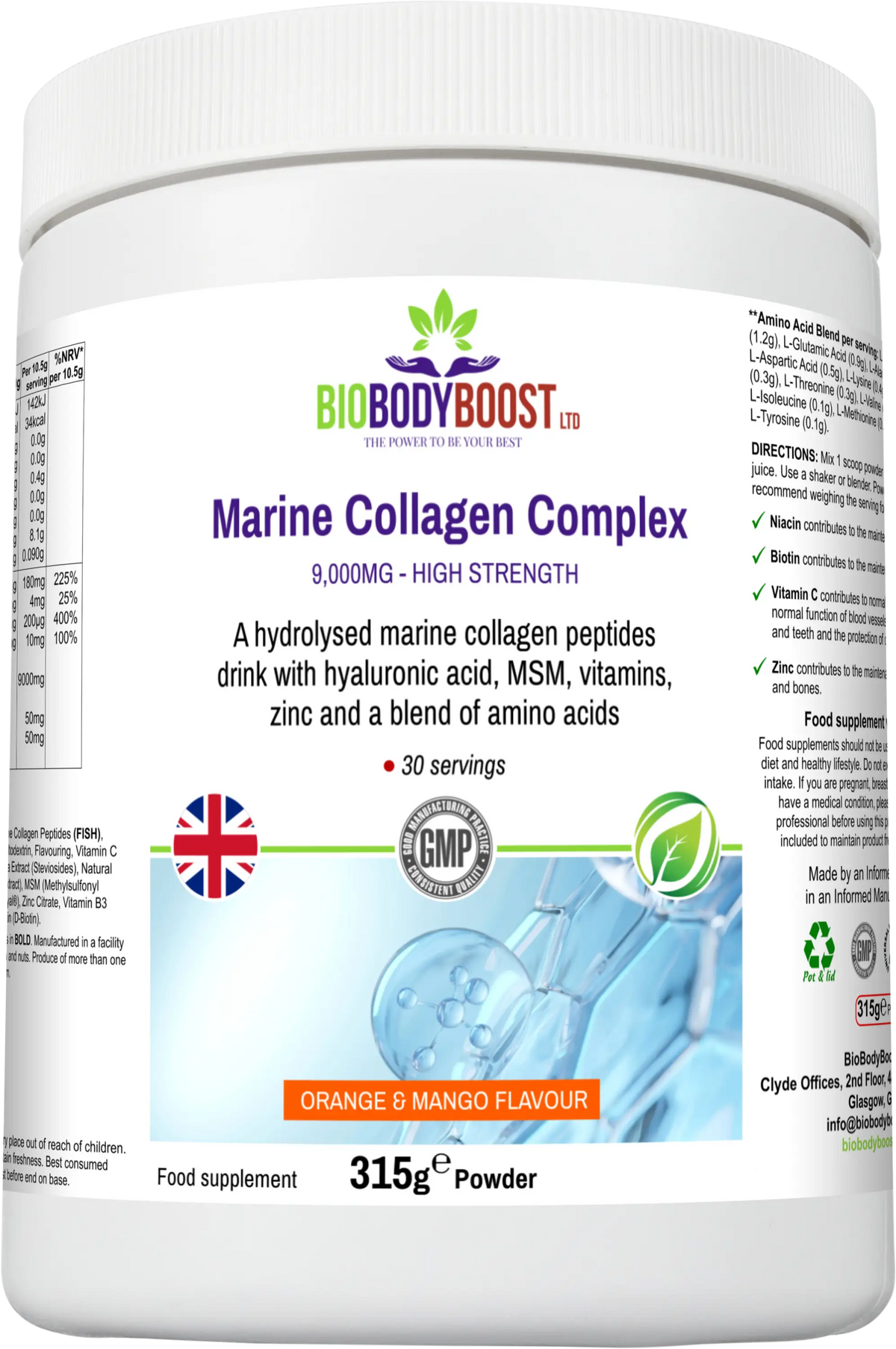
Marine Collagen Nourish by BioBodyBoost delivers 9,000mg hydrolysed Type I marine collagen per serving alongside ActiHyal® hyaluronic acid, 50mg MSM, 180mg vitamin C (225% NRV) and biotin (400% NRV) — 315g, 30 servings, roughly £1.00 per serving. Made by an Informed Manufacturer in an Informed Manufacturer facility, halal approved across the full supply chain, UK GMP manufactured. Browse the beauty supplements range.
BioBodyBoost — Halal Certified UK Supplements
Use code HALAL10 for 10% off your first order — halal approved under UHA Certificate Ref. 24623, vegan, UK made. Shop the full range →