Perimenopause symptoms require medical assessment. The NHS recommends speaking to your GP about perimenopause to discuss treatment options including HRT. Supplements are adjunctive support — not replacements for medical management of significant symptoms.
Quick answer: perimenopause is the 4–10 year hormonal transition preceding menopause, beginning typically in the mid-to-late 40s. Oestrogen fluctuation (unpredictable rises and falls rather than a straight decline) drives the symptoms: hot flashes, night sweats, sleep disruption, brain fog, mood changes, joint discomfort, skin and hair changes, weight gain tendency. The supplements with the most consistent evidence for perimenopause symptoms are: ashwagandha KSM-66 (cortisol and sleep), magnesium (sleep and mood), vitamin D (bone protection during oestrogen decline), maca root (hot flashes and mood in post/perimenopausal women), and omega-3 EPA (mood and inflammation). All halal certified.
What perimenopause actually does physiologically
In perimenopause, the ovaries become increasingly irregular in oestrogen output — production oscillates unpredictably rather than declining linearly. This hormonal instability drives the vasomotor symptoms (hot flashes, night sweats) via hypothalamic thermoregulatory dysfunction when oestrogen withdrawal triggers the thermoregulatory set point to narrow. Sleep disruption follows from both night sweats and the cortisol-melatonin dysregulation that accompanies oestrogen instability. Brain fog reflects oestrogen’s role in supporting hippocampal neuronal function. Joint discomfort reflects oestrogen’s anti-inflammatory role in connective tissue.
1. Ashwagandha KSM-66 — cortisol, sleep and stress
Perimenopausal women face a double cortisol burden: the natural HPA axis dysregulation of perimenopause (oestrogen normally modulates cortisol) combined with the life-stage stressors typical of the 45–55 age range (career peak, dependent children or ageing parents, relationship changes). Elevated cortisol worsens hot flashes, disrupts sleep further and accelerates the mood instability of hormonal transition.
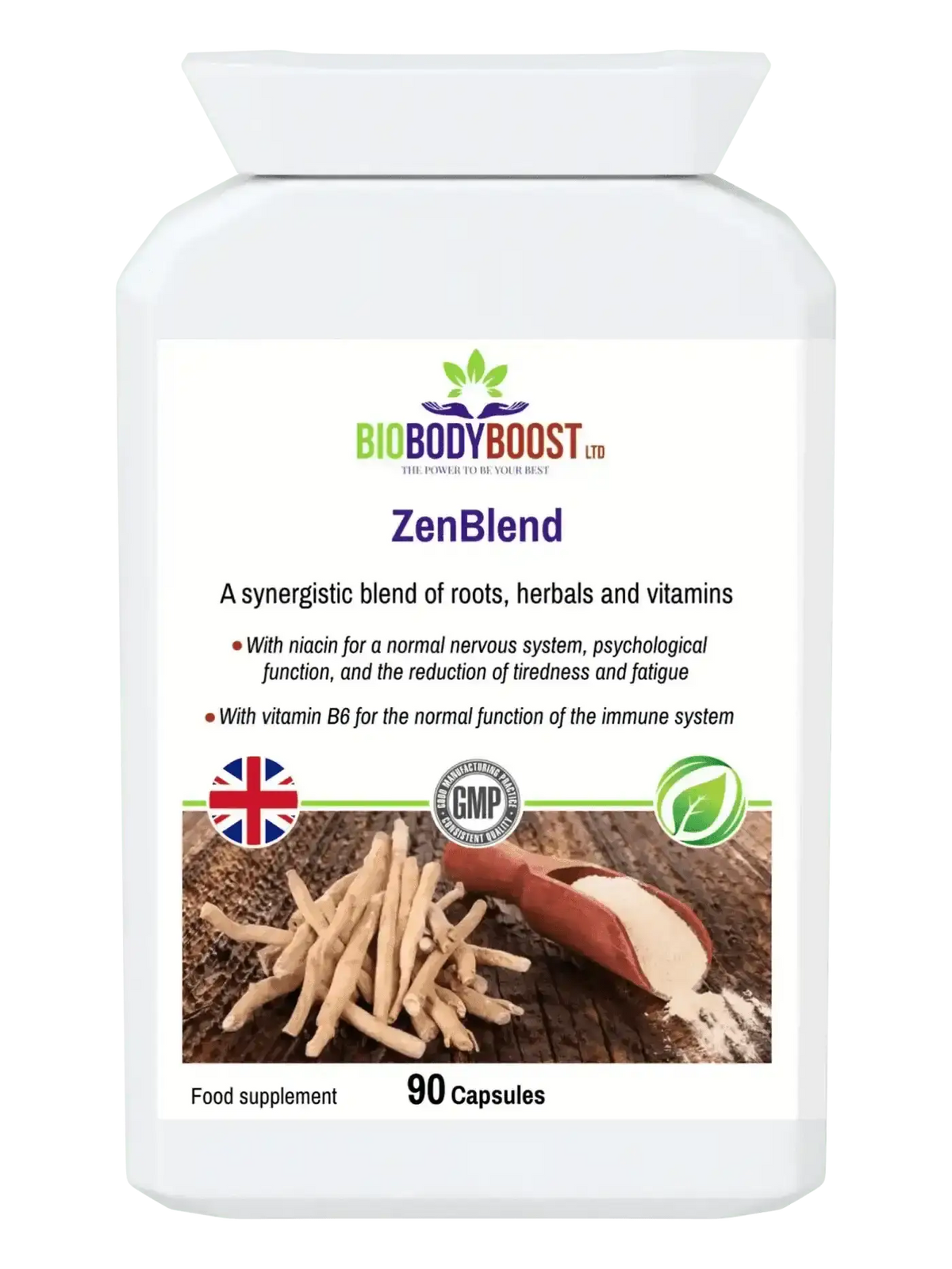
Langade et al. (2019, Medicine, RCT, n=60): KSM-66 significantly reduced cortisol by 23%, improved sleep quality and reduced anxiety scores vs placebo over 8 weeks. A dedicated 2021 Journal of Ethnopharmacology study (n=91 perimenopausal women) found KSM-66 significantly improved hot flash frequency, sleep quality, anxiety and overall menopausal symptom scores vs placebo. ZenBlend — KSM-66 600mg equiv + rhodiola + L-theanine + niacin. Halal certified, vegan.
2. Magnesium glycinate — sleep and muscle symptoms
Oestrogen maintains magnesium homeostasis in cells — as oestrogen declines, magnesium is progressively displaced from cells, worsening the already-prevalent UK magnesium insufficiency (70% of UK adults below RNI). Perimenopausal magnesium depletion compounds sleep disruption (NMDA overactivation, reduced melatonin synthesis), mood instability, muscle cramps and tension headaches. Abbasi 2012 RCT confirmed magnesium significantly improves sleep efficiency and onset latency in adults with insomnia. Magnesium 3 Complex — 300mg elemental glycinate + malate + taurate, zinc, B6. Halal certified.
3. Vitamin D + K2 — bone protection
Oestrogen directly stimulates osteoblast (bone-building cell) activity and inhibits osteoclast (bone-resorbing cell) activity. As oestrogen declines in perimenopause, bone density begins falling at 1–2% per year — accelerating to 3–5% in the first 2–3 years post-menopause. The NHS identifies postmenopausal women as the highest-risk group for osteoporosis. Starting vitamin D + K2 in perimenopause — before significant bone loss occurs — is the window for most effective intervention. Knapen 2013 (3-year RCT, n=244 postmenopausal women) confirmed MK-7 significantly reduced bone loss. Lipovita D3+K2 — 4,000 IU algae D3 + 100mcg MK-7. Halal certified, vegan.
4. Maca root — hot flashes and mood
Maca’s macamide compounds modulate the hypothalamic-pituitary axis via the endocannabinoid system without affecting oestrogen, progesterone, LH or FSH levels (Gonzales 2009 confirmed no hormone change despite libido improvement). The hypothalamic effect is particularly relevant for hot flashes — which originate in hypothalamic thermoregulatory dysfunction.
A 2006 Menopause RCT (n=14 postmenopausal women) found maca significantly reduced hot flash frequency and severity vs placebo. A 2008 International Journal of Biomedical Science RCT found maca significantly improved depression, sexual dysfunction and blood pressure in perimenopausal women vs placebo — without affecting hormone levels. Maca Me Happy — 3,000mg + zinc + Korean ginseng. Halal certified.
5. Omega-3 EPA — mood and inflammation
Oestrogen has anti-inflammatory properties — its decline in perimenopause is associated with rising systemic inflammatory markers. The joint discomfort, dry skin and mood changes of perimenopause have an inflammatory component alongside the hormonal one. EPA’s anti-inflammatory mechanism (prostaglandin and leukotriene pathway modulation) and the direct antidepressant evidence (Liao 2019 meta-analysis, 26 RCTs) make omega-3 a relevant addition to the perimenopause stack. OmegaBalance — omega 3-6-9, HPMC capsule, halal certified.
The halal perimenopause supplement stack
| Supplement | Perimenopause mechanism | Primary symptoms addressed |
|---|---|---|
| ZenBlend (KSM-66) | HPA axis normalisation, cortisol ↓ | Sleep, hot flashes, anxiety, mood |
| Magnesium 3 Complex | NMDA calming, melatonin synthesis | Sleep, cramps, tension, mood |
| Lipovita D3+K2 | Bone density protection pre-menopause | Bone health, immune function |
| Maca Me Happy | Hypothalamic thermoregulation (endocannabinoid) | Hot flashes, libido, mood |
| OmegaBalance | EPA anti-inflammatory, neurotrophin support | Mood, joints, skin, cognitive |
| Marine Collagen | Collagen density (oestrogen drops → skin/joint collagen falls) | Skin, joint support |
What helps perimenopause symptoms naturally UK?
The most evidence-supported natural approaches: (1) KSM-66 ashwagandha — 2021 RCT (n=91 perimenopausal women) significantly improved hot flash frequency, sleep and anxiety; (2) maca root — 2006 Menopause RCT and 2008 IJBS RCT confirmed reduced hot flashes and improved mood; (3) magnesium glycinate — corrects the oestrogen-decline-driven magnesium depletion that worsens sleep and mood; (4) vitamin D + K2 — bone protection during the critical pre-menopausal window; (5) omega-3 EPA — anti-inflammatory for joint, mood and skin symptoms. The NHS recommends discussing perimenopause symptoms with your GP to assess whether HRT is appropriate alongside or instead of nutritional support.