Short answer: take digestive enzymes with the first few bites of a meal. Enzymes only work on food that is in your gut at the same time, so taking them as you start eating gives them the best chance to mix with your meal. Taking them long before or well after eating, or on an empty stomach, makes less sense.
Key takeaways
- Digestive enzymes act on food, so the timing that matters is the meal, not the time of day.
- The usual advice is with the first mouthful, the same principle the NHS uses for prescription enzymes.
- Many people only take them with larger or richer meals, rather than every meal.
- Most enzyme products use pancreatin from pigs; plant or microbial enzymes avoid this.
- Bloating that lasts more than 3 weeks needs a GP check, not a new supplement.
In this guide
Why timing matters with enzymes
Your body makes its own digestive enzymes in the mouth, stomach, pancreas and small intestine. Each type breaks down a different part of food: amylase works on starches, protease on proteins and lipase on fats.
A supplement adds extra enzymes to that process. But an enzyme can only work on something. With no food in the gut, there is nothing for it to act on.
That's why prescription enzyme medicines, used by people whose pancreas doesn't make enough, are taken with meals and snacks. NHS guidance for these medicines (pancreatin, such as Creon) is to take them with food, usually with the first mouthful. Over-the-counter enzyme supplements are different products, but the same logic about timing applies.
Think of it like this: the enzyme needs to travel with your food. Swallow it as the meal begins and it moves through your stomach alongside what you're eating.
Before, during or after: compared
| When you take it | How well it fits | Why |
|---|---|---|
| With the first few bites | Best fit | Enzyme and food enter the stomach together |
| Halfway through a long meal | Reasonable | Some prefer to split 2 capsules: one at the start, one midway |
| 30+ minutes before eating | Less useful | The capsule may move on before the food arrives |
| An hour or more after eating | Less useful | Much of the meal has already left the stomach |
| On an empty stomach | Not recommended | No food to work on; some formulas can irritate an empty stomach |
Every meal or just big ones?
You don't have to take enzymes at every meal. Many people only use them with larger, richer or later meals, the ones they notice most afterwards.
Examples include a big family dinner, a celebration meal, a takeaway, or a late iftar after a long fast. We look at heavy South Asian meals in our guide to feeling bloated after curry, roti and rice.
A food diary helps. Note what you ate, when you took the enzyme, and how you felt. After two or three weeks you'll see whether it makes a difference for you.

Practical tips
- Keep them where you eat, such as by the table or in your bag, so you remember at the start of the meal.
- Swallow with a little water rather than opening the capsule onto hot food.
- Follow the label dose. More capsules isn't automatically better.
- Eat slowly and chew well. Digestion starts in the mouth, and rushing a big meal is a common cause of discomfort.
- Give it a fair trial of a few weeks before deciding.
- Enzymes and probiotics are different. If you take both, see our guide to probiotics vs digestive enzymes.
Check the source: the pancreatin issue
Many enzyme products use pancreatin, which comes from pig pancreas. That rules them out for anyone eating halal, kosher, vegetarian or vegan. The ingredient list may simply say “pancreatin” without naming the animal.
Plant-derived and microbial enzymes, such as those from fungi, bromelain from pineapple and papain from papaya, avoid this problem. Our digestive enzymes guide explains who they suit and how to read activity units.
If you have been prescribed pancreatin by your doctor, don't stop or swap it for a supplement. Speak to your GP or specialist about any concerns.

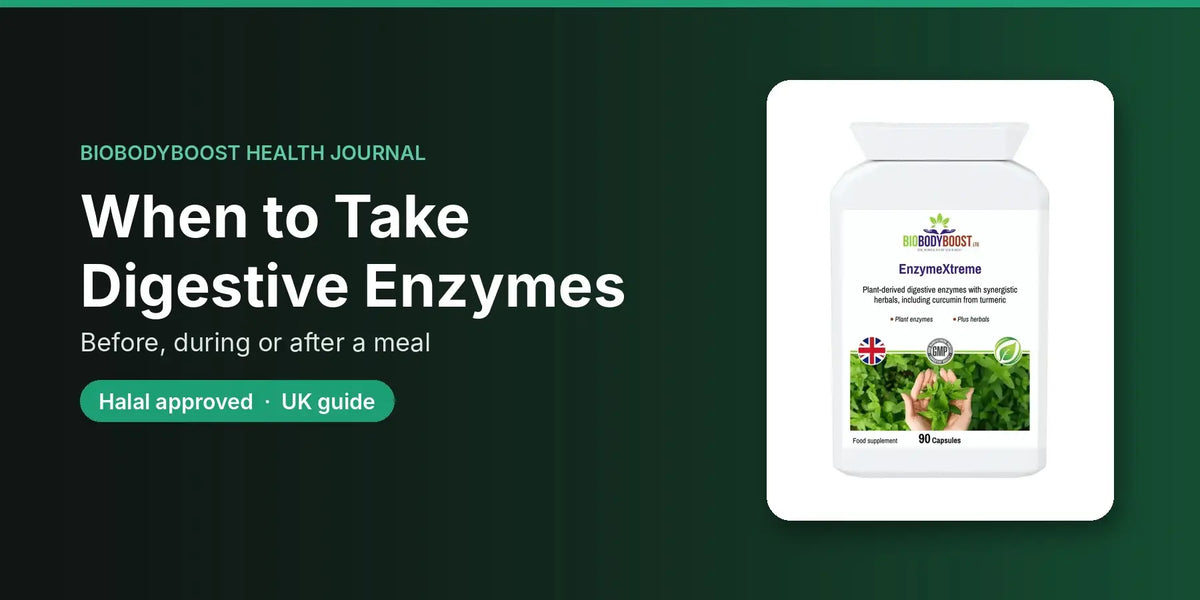
Plant-derived · halal approved · vegan
EnzymeXtreme Digestive Enzymes
- No pancreatin: every enzyme is plant or microbially derived
- Amylase, protease and lipase with activity units declared
- Fennel, caraway and peppermint, traditionally used in digestive blends
HALAL10 10% off your first order
Shop EnzymeXtreme →The label directions are 1 or 2 capsules with each main meal. EnzymeXtreme also contains betaine hydrochloride and turmeric, so read the safety notes below.
When to see your GP
The NHS advises seeing a GP if bloating keeps coming back, lasts more than 3 weeks, or comes with weight loss you can't explain, blood in your poo, a lump in your tummy, or a change in your bowel habits. Don't keep trying supplements to cover persistent symptoms.
Also check with your GP or pharmacist before taking enzyme supplements if you: are pregnant or breastfeeding; are under 18; take medicine to reduce stomach acid or have a stomach ulcer (betaine hydrochloride); take blood thinners or other prescribed medication; or have a diagnosed digestive or pancreatic condition.
Questions people ask
Should I take digestive enzymes before or after food?
With food, ideally with the first few bites. Taking them well before or long after a meal means less of the enzyme meets your food.
Can I take digestive enzymes on an empty stomach?
It isn't recommended. Digestive enzymes work on food, so with nothing to act on there is little point, and some formulas can irritate an empty stomach.
Can I take digestive enzymes at night?
Yes, if that's when you eat your main meal. Time of day doesn't matter; taking them with the meal does.
Can I take digestive enzymes with probiotics?
Yes. They do different jobs. Enzymes help break down food, while probiotics are live bacteria. Many people take both with breakfast or their main meal.
How do I take digestive enzymes when fasting in Ramadan?
Take them with the first proper meal at iftar, or with suhoor, not during the fasting hours. Breaking the fast gently, then eating the main meal, also helps many people feel more comfortable.
Sources: NHS: bloating · NHS Highland: pancreatin formulary · GB NHC register
This article is general information, not medical advice. Food supplements should not replace a varied, balanced diet and healthy lifestyle. Digestive enzyme supplements are not a treatment for any medical condition. Speak to your GP if you have ongoing digestive symptoms.