Quick answer: most healthy adults with normal digestion do not need digestive enzyme supplements — the body produces adequate enzymes naturally. The people who benefit most are those with lactose intolerance (lactase), legume/cruciferous bloating (alpha-galactosidase), exocrine pancreatic insufficiency (prescription-strength enzymes), IBD with brush border damage, post-bariatric surgery, and some older adults with declining pancreatic output.
The main digestive enzymes and what each breaks down
| Enzyme | Substrate | Activity unit | Most relevant for |
|---|---|---|---|
| Amylase | Starch, complex carbohydrates | DU or SKB | Carbohydrate heaviness post-meal |
| Protease | Proteins | HUT or PC | Protein-heavy meals, post-workout recovery |
| Lipase | Triglycerides (dietary fats) | FIP or LU | Fat-heavy meals, greasy food discomfort |
| Lactase | Lactose (milk sugar) | ALU | Lactose intolerance — strongest evidence |
| Alpha-galactosidase | Oligosaccharides in legumes and cruciferous veg | GaIU | Bean/dal/chickpea/broccoli gas and bloating |
| Cellulase | Cellulose (plant cell walls) | CU | Plant-heavy diets, high-vegetable meals |
| Bromelain / Papain | Proteins (from pineapple / papaya) | GDU / PU | Post-meal anti-inflammatory; protein digestion |
Critical labelling point: enzyme potency is measured in activity units, not milligrams. A label stating "250mg amylase" tells you nothing about how much enzyme activity is present. Look for products that declare activity (e.g. "10,000 DU amylase", "3,000 ALU lactase"). Products listing only mg cannot be compared or assessed for potency.
Who actually benefits: matched to condition
Lactose intolerance — very strong evidence, clearest indication
Lactase enzyme supplements are the most evidence-backed digestive enzyme application. Lactose intolerance affects approximately 65% of the global adult population and is significantly more prevalent in South Asian, East Asian, African and Middle Eastern descent populations — making it particularly relevant for UK Muslim communities. A 2018 Cochrane review confirmed oral lactase taken immediately before dairy significantly prevents lactose intolerance symptoms in the vast majority of people.
Effective dose: 3,000–9,000 ALU per dairy serving. Take with or immediately before dairy-containing food. Higher fat dairy (cheese, cream) digests more slowly and may require higher doses than low-fat dairy.
Legume and cruciferous vegetable bloating — good targeted evidence
Alpha-galactosidase breaks down the galacto-oligosaccharides (GOS) in beans, lentils, chickpeas, kidney beans and cruciferous vegetables that humans cannot digest natively. These pass undigested to the colon where bacteria ferment them and produce gas. A 2007 study in the American Journal of Gastroenterology found alpha-galactosidase taken with a bean-containing meal significantly reduced flatulence and bloating vs placebo. This is particularly relevant for South Asian dietary patterns high in dal, rajma and chickpea dishes.
Timing: take at the start of the legume-containing meal, not after. The enzyme must be present in the small intestine as the food is being digested.
Exocrine pancreatic insufficiency (EPI) — essential, requires prescription
EPI occurs when the pancreas cannot produce sufficient digestive enzymes — typically following pancreatitis, cystic fibrosis, pancreatic surgery or chronic alcohol use. OTC digestive enzyme supplements do not contain sufficient activity for EPI — this condition requires prescription pancreatic enzyme replacement therapy (PERT) such as Creon. Symptoms requiring GP assessment: pale, oily, floating stools (steatorrhoea); significant unexplained weight loss; fat-soluble vitamin deficiency (vitamins A, D, E, K).
IBD and Crohn’s disease — moderate evidence
Inflammation in IBD damages the intestinal brush border where lactase and other enzymes are produced, creating secondary enzyme deficiency. Broad-spectrum digestive enzyme supplements during active disease may improve nutrient absorption and reduce digestive symptoms. Discuss with a gastroenterologist — not all enzyme products are appropriate during active flares.
Post-bariatric surgery — important practical need
Gastric bypass and sleeve gastrectomy alter the anatomical relationship between food, stomach acid and pancreatic enzyme secretion, reducing fat digestion efficiency. Digestive enzyme supplementation is frequently recommended by bariatric surgeons. Fat-soluble vitamin malabsorption is a significant risk post-surgery — ensure any enzyme supplement includes sufficient lipase.
Older adults — modest benefit in some
Pancreatic enzyme output declines with age. Adults over 65 with new-onset digestive symptoms (bloating, increased gas, poorer appetite) may benefit from broad-spectrum enzymes, though the evidence base is less conclusive than for the above populations. A clinical assessment to rule out other causes first is appropriate.
Who does NOT need digestive enzyme supplements
- Healthy adults with no digestive symptoms and normal weight maintenance
- People whose bloating is from FODMAP intolerance or IBS — different mechanisms requiring different interventions (low-FODMAP diet, probiotics, peppermint oil)
- People hoping enzymes will help with weight loss — no evidence for this application
- People with SIBO (small intestinal bacterial overgrowth) — enzymes alone are insufficient; bacterial overgrowth needs specific treatment
Halal sourcing: the most overlooked issue in enzyme supplements
Digestive enzymes are frequently derived from porcine pancreas — this is the pharmaceutical standard and is used in prescription Creon. Consumer OTC digestive enzyme supplements commonly use porcine, bovine or mixed animal sources without clear labelling.
Halal-compliant alternatives: plant-derived enzymes (from Aspergillus oryzae, Rhizopus oryzae — fungal fermentation sources) and microbial enzymes provide equivalent amylase, protease and lipase activity without animal sources. Always check: enzyme source specifically (not just capsule material), halal certification of the manufacturing process, and the full allergen statement.
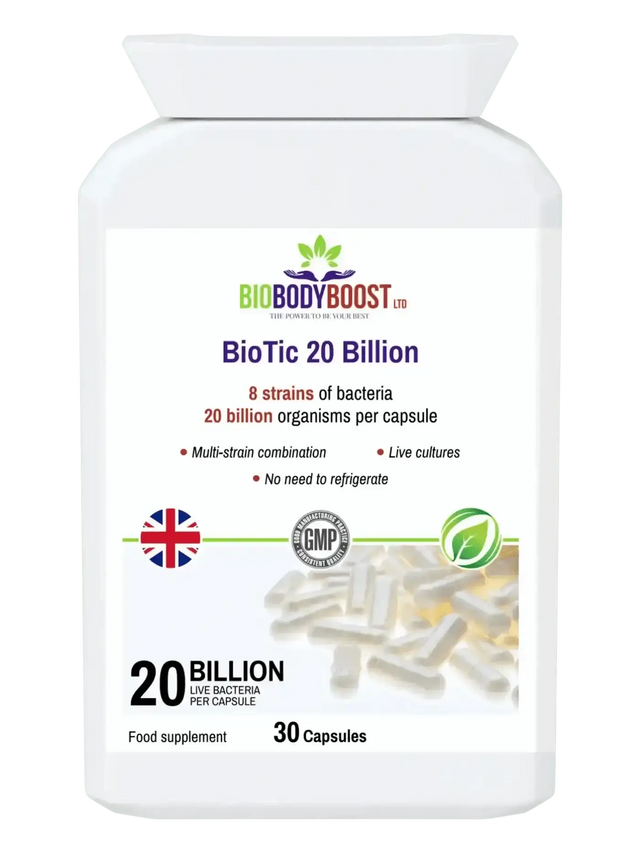
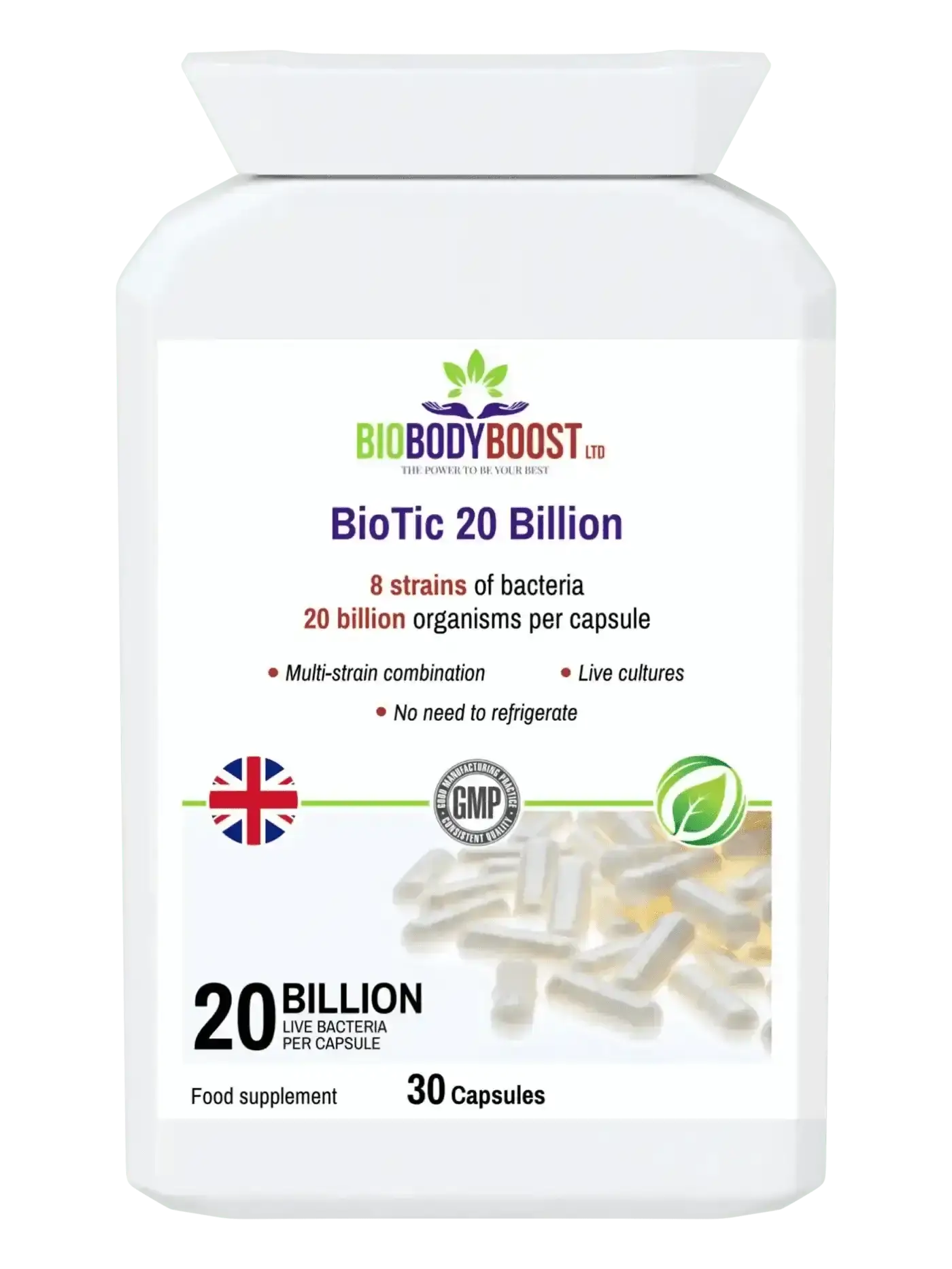
Our BioTic 20 Billion supports gut microbiome health and brush border enzyme production. L-Glutamine Boost supports gut epithelial integrity. Both halal certified, UK GMP. Browse the Gut Health UK collection.
Do digestive enzymes help with bloating?
For specific types of bloating, yes. Alpha-galactosidase significantly reduces gas and bloating from beans, lentils, chickpeas and cruciferous vegetables — a 2007 AJOG study confirmed significant benefit vs placebo taken with a bean-containing meal. Lactase prevents lactose intolerance symptoms (which include bloating) in people who are lactase-deficient. For bloating not related to these specific foods — ongoing throughout-the-day bloating, bloating after stress or antibiotics — probiotics are more likely to be effective. Digestive enzymes address food breakdown problems, not gut microbiome imbalances.
Should I take digestive enzymes before or after meals?
Before or at the start of the meal — never after. Digestive enzymes need to be present in the small intestine as food arrives to act on it. Taking enzymes after eating means the food has already begun fermentation before the enzyme reaches it. For lactase specifically: take immediately before or with the first bite of dairy. For alpha-galactosidase: take at the start of the bean or cruciferous vegetable-containing meal. For broad-spectrum enzymes: take 5–10 minutes before the meal or with the first bite.
Can I take digestive enzymes every day long term?
For most people, yes — OTC digestive enzyme supplements at labelled doses are generally safe for daily long-term use. The body does not reduce its own enzyme production in response to supplemental enzymes (unlike some concerns raised about digestive enzyme dependency, which have not been clinically supported). The main risks are: ensuring the source is halal if relevant; checking for allergen risks (some enzyme products are produced in facilities handling soy, dairy or wheat); and ruling out a medical cause of enzyme deficiency (EPI, IBD) if symptoms are severe, as these require medical treatment rather than OTC supplements.
Are digestive enzyme supplements halal?
Many are not — porcine pancreatic enzymes are the standard pharmaceutical source and are commonly used in OTC digestive enzyme supplements without clear labelling. Look specifically for: plant-derived or fungal-derived enzymes (Aspergillus oryzae, Rhizopus oryzae sources are halal), halal certification of both the enzyme source and the manufacturing environment, and HPMC (plant-derived) capsule rather than standard gelatine. The enzyme source is more important than the capsule — a gelatine-free capsule containing porcine enzymes is still not halal. Always check the full ingredient declaration and halal certification documentation.