Quick answer: for post-antibiotic probiotic recovery, choose a product containing Lactobacillus rhamnosus GG (LGG) or Saccharomyces boulardii — these have the strongest direct evidence for antibiotic-associated diarrhoea prevention. Start within 2 days of beginning the antibiotic course. Take at least 2 hours away from each antibiotic dose. Continue for 2–4 weeks after finishing the course — this post-course period matters more than during the course itself.
Why antibiotics disrupt the gut
Antibiotics do not selectively target pathogens. Broad-spectrum antibiotics (amoxicillin, ciprofloxacin, co-amoxiclav, clindamycin) significantly reduce the total diversity of the gut microbiome, depleting Lactobacillus, Bifidobacterium and other beneficial species while sometimes promoting overgrowth of Clostridioides difficile (C. diff) and other opportunistic organisms. A 2019 meta-analysis in BMJ (Suez et al.) found gut microbiome recovery to baseline composition after antibiotics took 3–6 months without intervention. With appropriate probiotic support, recovery accelerated to 4–8 weeks.
Antibiotic-associated diarrhoea (AAD) affects approximately 5–30% of people taking antibiotics, depending on the antibiotic class. C. diff-associated diarrhoea (a more serious complication) affects 1–3% of antibiotic courses and is responsible for approximately 13,000 deaths per year in the UK.
The strains with the strongest evidence for antibiotic recovery
Lactobacillus rhamnosus GG (LGG)
LGG is the most studied probiotic strain globally for antibiotic-associated diarrhoea.
What research supports: A 2012 Cochrane review (Allen et al., 63 RCTs) found probiotics reduced antibiotic-associated diarrhoea risk by 42% across all trials, with LGG showing particularly consistent benefit. A separate 2012 meta-analysis in JAMA found LGG reduced C. diff-associated diarrhoea risk by 66% when started within 2 days of antibiotics. Effective dose in trials: 10–20 billion CFU LGG per day.
Saccharomyces boulardii
S. boulardii is a yeast probiotic — and its yeast nature is its key advantage in antibiotic contexts. Antibiotics that kill bacteria do not affect S. boulardii. It can be taken simultaneously with antibiotic doses without the timing concern that applies to bacterial probiotics.
What research supports: A 2010 Cochrane review (Szajewska and Kołodziej, 21 trials) found S. boulardii significantly reduced antibiotic-associated diarrhoea across all populations, with risk reduction of approximately 57% vs placebo. It is particularly effective for C. diff-associated diarrhoea prevention — a 2006 meta-analysis in Alimentary Pharmacology and Therapeutics found S. boulardii reduced C. diff recurrence by 59% vs placebo in people who had already had one episode.
Practical advantage: unlike bacterial strains, S. boulardii does not need to be separated from antibiotic doses by 2 hours. It can be taken at the same time. This is the most practical probiotic for people who find the timing separation difficult to maintain.
Bifidobacterium longum and Lactobacillus acidophilus
These strains support broader microbiome restoration after the course is complete. Less direct evidence for C. diff prevention specifically, but strong evidence for general gut barrier restoration, IBS-type symptom reduction and microbiome diversity recovery post-antibiotic. A 2014 study in PLoS ONE found B. longum supplementation significantly accelerated restoration of microbiome diversity after amoxicillin-clavulanate in healthy adults.
Critical timing rules
- Start within 2 days of beginning the antibiotic course — the JAMA meta-analysis showing 66% C. diff risk reduction with LGG specified this timing requirement. Starting probiotics after completing the antibiotics misses the protective window for AAD prevention.
- Separate bacterial probiotics from antibiotics by at least 2 hours — antibiotics kill probiotic bacteria as readily as pathogens if taken simultaneously. Take the probiotic at the midpoint between antibiotic doses (e.g. if antibiotics at 8am and 8pm, take probiotic around 2pm). Exception: Saccharomyces boulardii can be taken simultaneously.
- Continue for 2–4 weeks after completing the antibiotic course — this is the most important period for microbiome restoration. Most people stop when the antibiotics finish; continuing the probiotic for the following weeks produces significantly better microbiome recovery outcomes.
CFU dose: what the evidence supports
- During antibiotics (AAD prevention): 10–20 billion CFU/day — the dose range used in the LGG Cochrane review RCTs
- Post-antibiotic microbiome restoration: 10–20 billion CFU/day for 2–4 weeks post-course
- Gentle maintenance after recovery: 4–8 billion CFU/day from named strains is sufficient once acute recovery is complete
Label checks: what to look for
- Named strains with species AND strain designation — e.g. “Lactobacillus rhamnosus GG” not just “Lactobacillus rhamnosus”. Different strains of the same species have different properties. The trial evidence is strain-specific.
- CFU guaranteed at end of shelf life — not just at manufacture. Probiotic viability declines during storage. End-of-shelf-life guarantee is the meaningful standard.
- HPMC capsule — halal and vegan-compliant; standard gelatine capsules are usually porcine
- No unnecessary prebiotic fibres during acute antibiotic recovery — prebiotic fibres (inulin, FOS) can exacerbate bloating in an already disrupted gut. Start with a probiotic-only product and add prebiotic fibre support after completing the antibiotic course.
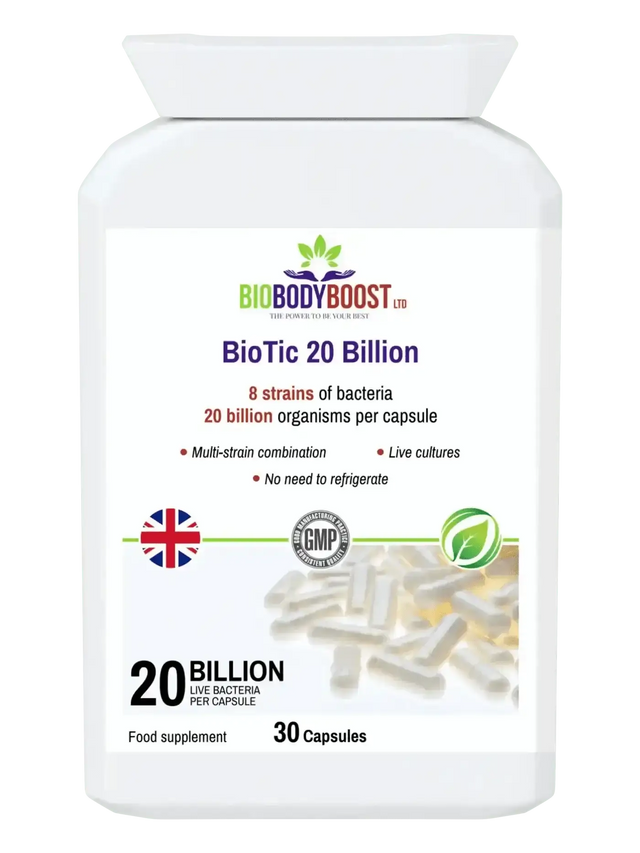
Our BioTic 20 Billion contains 8 named strains including L. rhamnosus, B. longum and L. acidophilus at 20 billion CFU/day — HPMC capsules, halal certified, vegan. For additional support: how to start probiotics without side effects for a full adjustment guide.
When should I start taking probiotics with antibiotics?
Within 2 days of starting the antibiotic course. This timing was specified in the JAMA meta-analysis showing LGG reduced C. diff-associated diarrhoea risk by 66% — the protective effect was found when probiotics were started close to the beginning of the antibiotic course. Waiting until you notice diarrhoea to start is less effective than starting prophylactically. Take bacterial probiotics at least 2 hours away from each antibiotic dose. Saccharomyces boulardii can be taken at the same time as antibiotics since, as a yeast, it is not killed by antibacterial antibiotics.
How long should I take probiotics after antibiotics?
At least 2–4 weeks after completing the course. A 2019 BMJ meta-analysis found gut microbiome recovery took 3–6 months without probiotics post-antibiotics; with probiotic support, recovery accelerated significantly. Most people stop probiotics when the antibiotics end — the post-course period is actually the most critical window for microbiome restoration. Continue at 10–20 billion CFU/day for 2–4 weeks after completing antibiotics, then reduce to a maintenance dose of 4–8 billion CFU/day if continuing for general gut health.
Can I take any probiotic with antibiotics or does the strain matter?
Strain matters significantly. LGG (Lactobacillus rhamnosus GG) has the strongest direct evidence for antibiotic-associated diarrhoea prevention — a 2012 Cochrane review of 63 RCTs confirmed 42% risk reduction. Saccharomyces boulardii has a 57% AAD risk reduction in Cochrane review and has the additional advantage of being unaffected by antibiotics (it is a yeast). Generic “Lactobacillus acidophilus” without strain specification may provide some benefit but cannot be directly tied to the clinical trial evidence. Always choose products that name the strain (not just the genus and species) and declare CFU count guaranteed at end of shelf life.
Are probiotics during antibiotics safe?
Yes for healthy adults. There is one important exception: immunocompromised individuals (people with severe immune deficiency, HIV/AIDS not well-controlled, organ transplant recipients on immunosuppressants, or patients with central venous catheters) should not use probiotics without medical supervision, as rare cases of probiotic-related bacteraemia and fungaemia have been reported in severely immunocompromised patients. For the vast majority of healthy adults completing a standard antibiotic course, probiotics are safe, well-tolerated and evidence-based.