Turmeric is a root spice that contains 2–5% curcumin by weight. Curcumin is the polyphenol compound responsible for virtually all of turmeric's documented anti-inflammatory and antioxidant effects. Most turmeric supplements sold in the UK are ground turmeric root, not curcumin extract — they are fundamentally different products at fundamentally different active compound concentrations. This distinction explains why many people take turmeric for months and notice nothing.
What Is Turmeric?
Turmeric (Curcuma longa) is a rhizomatous plant in the ginger family, native to South Asia. It has been used in Ayurvedic and traditional Chinese medicine for over 4,000 years, primarily for digestive health and inflammation management. The root is dried and ground into the bright yellow-orange powder used in cooking and supplements. Turmeric contains over 300 compounds, but the primary bioactive group responsible for its medicinal properties are the curcuminoids — three related polyphenols of which curcumin is the most abundant (approximately 80% of total curcuminoids).
What Is Curcumin?
Curcumin (diferuloylmethane) is the principal polyphenol in turmeric. It is the compound that clinical researchers isolate, standardise and test in controlled trials. When a published study shows turmeric reduces joint pain, suppresses NF-kB inflammation pathways, or improves cognitive function — that study is using curcumin extract standardised to a specific percentage, not ground turmeric root powder.
Why Most Turmeric Supplements Don't Work
Ground turmeric root contains approximately 2–5% curcumin by weight. A typical 500mg turmeric capsule therefore contains 10–25mg of actual curcumin. The clinical trials demonstrating anti-inflammatory effects use 500–1,500mg of curcumin — not turmeric. To get the same curcumin dose from a ground turmeric capsule, you would need to take 20–60 capsules per day. Standard turmeric capsules are clinically underdosed by a factor of 20–60x relative to the evidence base.
What Is a 95% Curcuminoid Extract?
Curcuminoid extraction concentrates the three active curcuminoid compounds from turmeric root — curcumin (approximately 80%), bisdemethoxycurcumin (approximately 15%) and demethoxycurcumin (approximately 5%) — into a standardised extract. A product standardised to “95% curcuminoids” means that 95% of the extract's weight is the active curcuminoid compounds. A 500mg capsule of 95% curcuminoid extract contains approximately 475mg of active curcuminoids — compared to 10–25mg in a 500mg turmeric capsule. The concentrations are not comparable.
What Is Piperine and Why Does It Matter?
Curcumin has poor bioavailability on its own — it is rapidly metabolised and excreted by the liver through a process called glucuronidation before meaningful amounts reach the bloodstream. Research published in Planta Medica found that piperine (the active compound in black pepper) inhibits glucuronidation, increasing curcumin bioavailability by up to 2,000% in human subjects. This is not a marketing claim — it is a documented pharmacokinetic mechanism. Without piperine or another bioavailability enhancer, even high-dose curcumin extract has limited systemic effect.
Certified Organic: Does It Matter for Curcumin?
Yes — more than for most supplements. Conventional turmeric crops are among the most heavily pesticide-treated root crops globally. When turmeric is concentrated into a 95% extract, any pesticide residues are concentrated along with the curcuminoids. Certified organic sourcing ensures the concentrated extract is free from pesticide residues at the higher concentrations. For a supplement taken daily at therapeutic doses, this matters.
Turmeric vs Curcumin: Which Should You Buy?
| Product type | Curcumin content per 500mg capsule | Effective dose per day | Value for anti-inflammatory use |
|---|---|---|---|
| Ground turmeric root | 10–25mg | Would need 20–60 capsules | Poor — clinically underdosed |
| Turmeric extract (standardised to curcuminoids) | Depends on % — check label | Depends on % — check label | Variable — check standardisation |
| 95% curcuminoid extract + piperine | ~475mg | 1–2 capsules (500–1,000mg curcuminoids) | Clinical dose in 1–2 capsules |
What Does the Evidence Show Curcumin Does?
At the clinical dose (500–1,500mg curcuminoids + piperine daily):
- Joint inflammation — Multiple RCTs confirm significant reduction in osteoarthritis pain scores, with effects comparable to NSAIDs in some studies without GI side effects. Mechanism: NF-kB inhibition reducing COX-2 expression.
- Systemic inflammation markers — Consistent reductions in CRP (C-reactive protein) across multiple trials.
- Cognitive and neuroprotective effects — Curcumin crosses the blood-brain barrier and inhibits neuroinflammation pathways. Studied for Alzheimer's risk reduction in observational research.
- Digestive comfort — Turmeric's traditional use for digestion has some clinical support; curcumin reduces gut inflammation and has been studied for IBS.
What Curcumin Does Not Do
- It is not a fast-acting painkiller — effects build over 4–8 weeks of consistent use
- It is not a substitute for medical treatment of severe osteoarthritis or inflammatory conditions
- Blood-thinning interactions: curcumin has mild antiplatelet effects. People on anticoagulants (warfarin) should consult their GP before use.
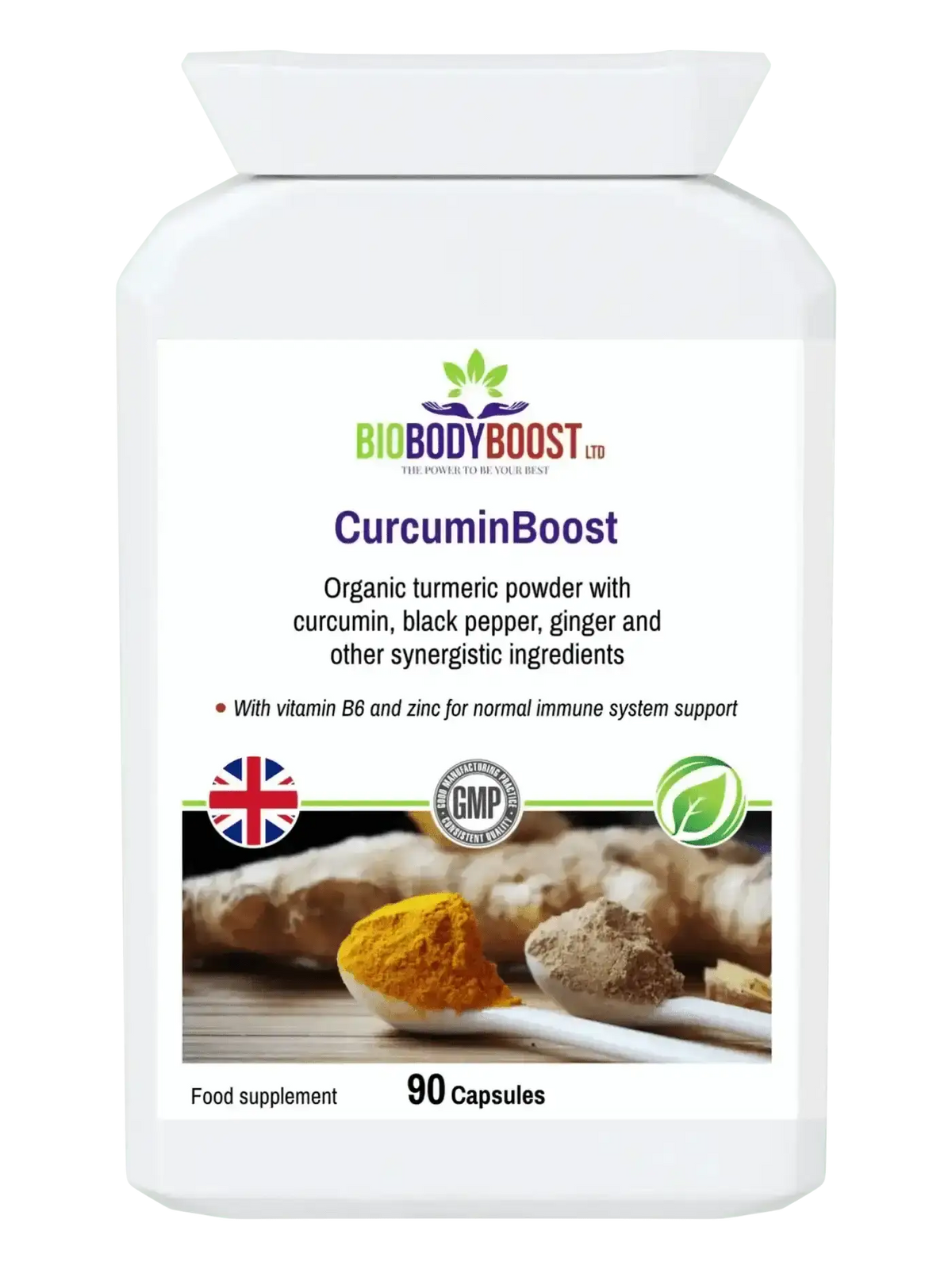
CurcuminBoost by BioBodyBoost uses 95% standardised curcuminoid extract from certified organic turmeric with piperine and organic ginger — the complete formulation used in clinical research. Halal certified, vegan, UK GMP manufactured. Browse the joints and flexibility range.