For Muslim parents, finding children’s vitamins with genuine halal certification requires more attention than the label suggests. The word “halal” on a children’s supplement box without a named certification body is unverifiable. Many of the most popular children’s supplements — gummy vitamins in particular — use gelatine as the gummy base, which is typically porcine without disclosure. This guide covers what to check, which supplement types are inherently compliant and which need careful verification, and which UK products are genuinely certified.
The gelatine problem in children’s gummies
Gummy vitamins are the most popular children’s supplement format in the UK. The gummy texture is almost always created by gelatine — a protein derived from animal connective tissue. UK food labelling does not require disclosure of the animal source of gelatine. A gummy vitamin that says simply “gelatine” on the ingredient list is likely to be porcine (pig-derived) — the cheapest and most widely used gelatine source in commercial confectionery and gummy products.
Porcine gelatine is haram. A children’s gummy vitamin using undisclosed gelatine may be haram regardless of how it is marketed. This is not a theoretical concern — consumer investigations have repeatedly found undisclosed porcine gelatine in mainstream UK gummy supplement products.
The solution: pectin-based gummies (from fruit) or HPMC capsule format. BioBodyBoost Multivitamin Gummies use a halal-certified pectin-based gummy base — no gelatine. This is disclosed on the label and confirmed by third-party halal certification. BioBodyBoost Halal Gummy Multivitamins — 12 nutrients, strawberry flavour, halal approved, vegan.
Vitamin D — the non-negotiable for UK children
The NHS recommends all children from birth to 4 years take daily vitamin D supplements (8.5–10mcg/day), and all children 5–17 years take 10mcg/day if they do not get adequate sun exposure. For UK South Asian children, this recommendation applies year-round — higher melanin content significantly reduces cutaneous vitamin D synthesis in UK sunlight conditions.
Vitamin D3 (cholecalciferol) sources: lanolin-derived (from sheep wool, halal but requires certification) or lichen-derived (plant-derived, unambiguously halal and vegan). Most children’s vitamin D supplements do not disclose the D3 source. Lipovita D3+K2 drops use lichen-derived D3 — drop format, halal certified, appropriate for children (check dosing with your GP or pharmacist for age-appropriate amounts).
Probiotics for children — the halal check
Children’s probiotics have two potential halal compliance issues: (1) the growth media used to culture the bacterial strains (can include dairy or animal-derived peptones), and (2) the carrier format (gelatine capsules in some products). The classification “KOSHER MILKY” on some probiotic products indicates dairy growth media — these should not be consumed with meat meals and their halal status requires specific certification of the dairy source.
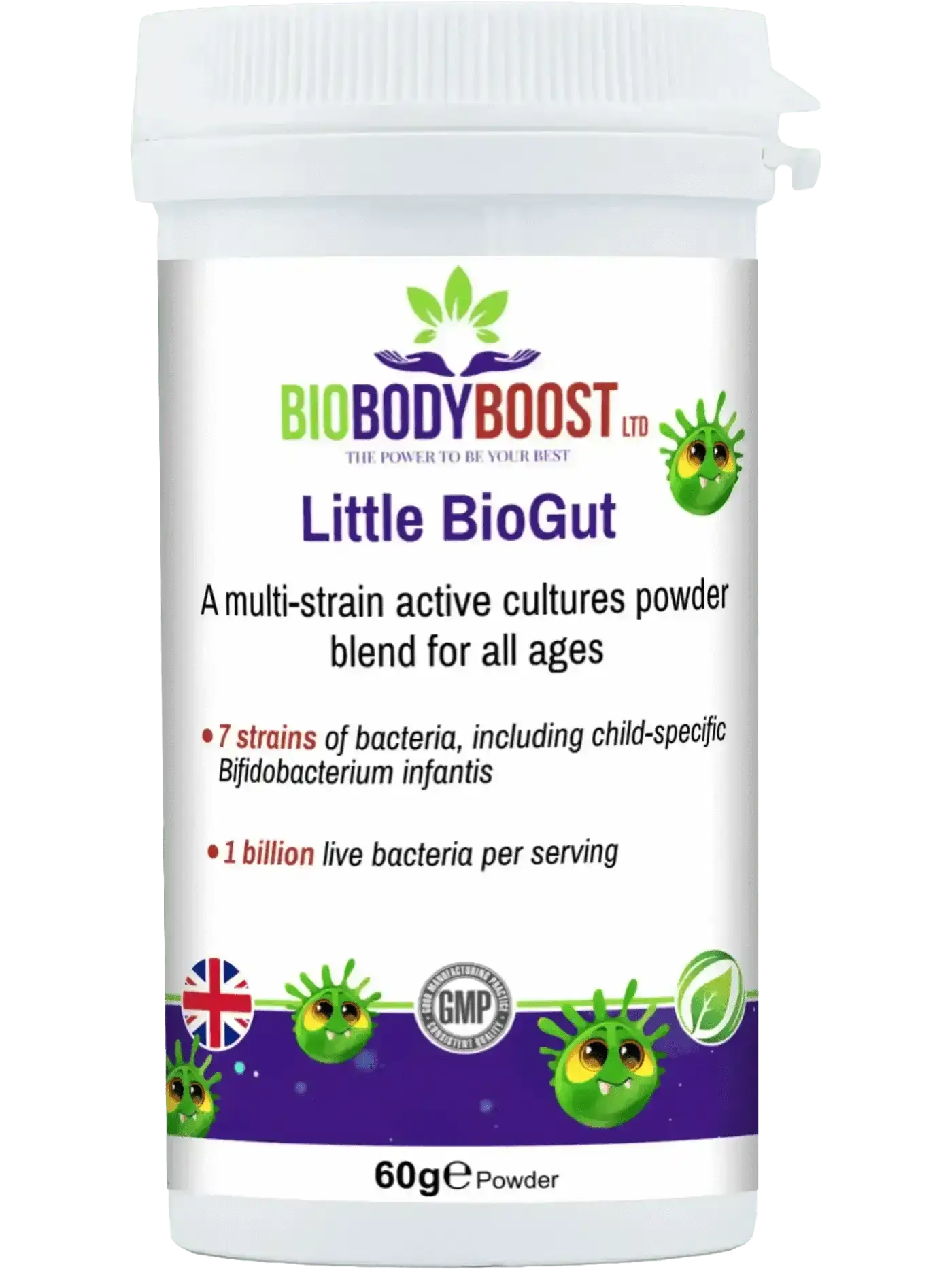
Little BioGut — vegan probiotic powder suitable from birth. 7 strains, 1 billion CFU, no gelatine, no dairy growth media, halal approved. Powder format mixes easily into water, milk or food. One of the very few UK children’s probiotics with confirmed halal certification and vegan-verified growth media.
What mainstream children’s supplements to check carefully
| Product type | Halal risk | What to check |
|---|---|---|
| Gummy vitamins | High | Gelatine source or pectin-based? Named halal certification? |
| Probiotic drops/powders | Medium | Growth media halal certified? Dairy or non-dairy strains? |
| Vitamin D drops (liquid) | Medium | D3 source — lanolin (animal) or lichen (plant)? Carrier oil halal? |
| Fish oil for kids | Medium | Fish species halal? Capsule shell (gelatine source)? |
| Vitamin C tablets/chewables | Low | Ascorbic acid is plant/fermentation-derived. Check excipients. |
| Iron drops (liquid) | Low | Ferrous forms are mineral-derived. Check carrier/excipients. |
Browse the Halal Vitamins UK collection for the full certified range.
Are children’s gummy vitamins halal?
Most are not. Standard gummy vitamins use gelatine as the gummy base, typically from porcine sources without disclosure. UK labelling does not require species disclosure for gelatine. A gummy vitamin labelled simply “gelatine” should be assumed porcine (haram) unless a named halal certification body has audited and certified the product. Pectin-based gummies (using fruit-derived pectin rather than gelatine) are the halal-compliant alternative. BioBodyBoost Multivitamin Gummies use a halal-certified pectin base — one of the very few UK children’s gummy vitamins with confirmed halal certification disclosing the gummy base ingredient source.
What vitamins does the NHS recommend for children UK?
The NHS recommends vitamin D for all children from birth through 4 years (8.5–10mcg/day) and for older children who get limited sun exposure. Vitamins A, C and D are recommended for all children aged 6 months to 5 years via the Healthy Start programme. For South Asian children specifically, year-round vitamin D supplementation is recommended due to reduced cutaneous synthesis from higher melanin. Iron supplementation may be indicated in exclusively breastfed infants from 6 months — discuss with your health visitor or GP.