Quick answer: the brain supplements with the strongest clinical evidence for healthy adults are bacopa monnieri (memory consolidation at 300mg/day, effects at 8–12 weeks), lion’s mane mushroom (nerve growth factor stimulation at 750mg+ whole fruiting body, 8–16 weeks), omega-3 DHA (structural brain health, ongoing maintenance), magnesium in glycinate or threonate form (synaptic plasticity and NMDA function), and L-theanine for acute focused calm (100–400mg, effects within 40 minutes). Everything else requires more selective evidence or works primarily in deficient or cognitively impaired populations.
Why most brain supplements don’t deliver what they promise
The nootropics category has a significant credibility problem. Most products are either underdosed, use inferior forms, or cite research from animal models or cognitively impaired populations that does not translate to healthy adults with normal cognitive function. A compound that slows cognitive decline in Alzheimer’s patients does not necessarily improve memory in a healthy 35-year-old. The distinction matters for setting realistic expectations. Genuine cognitive support supplements work via specific, measurable mechanisms at established doses over defined timelines.
Tier 1: strongest evidence for healthy adults
Bacopa monnieri — memory consolidation
Bacopa monnieri is the most clinically validated natural nootropic for memory specifically in healthy adults. The active compounds (bacosides A and B) enhance dendritic branching and synaptic density in the hippocampus — the brain’s memory consolidation centre.
What research supports: A 2014 meta-analysis in the Journal of Ethnopharmacology (9 RCTs) confirmed significant improvements in memory free recall in healthy adults — not only in cognitively impaired populations. A 2012 double-blind RCT in Evidence-Based Complementary and Alternative Medicine (n=46 healthy adults) found bacopa at 300mg/day for 12 weeks significantly improved verbal learning rate, memory consolidation and speed of visual information processing vs placebo. A 2001 RCT (Roodenrys et al.) confirmed significant improvements in retention of new information at 12 weeks.
Dose: 300mg standardised extract (45% bacosides) daily. Timeline: 8–12 weeks of consistent daily use minimum — this is the most important caveat. Bacopa does not produce acute same-day effects. People who try it for 2 weeks and notice nothing have not run a fair trial.
Honest limit: bacopa can cause GI discomfort (nausea, loose stools) in some people, particularly on an empty stomach. Take with food. May cause drowsiness in some — taking in the evening avoids this. Drug interaction: may potentiate some thyroid medications.
Omega-3 DHA — structural brain health
DHA (docosahexaenoic acid) is not a stimulant nootropic — it is a structural nutrient. Approximately 60% of brain dry weight is fat; DHA comprises 40% of the polyunsaturated fatty acids in neuronal cell membranes and is the dominant fatty acid in synaptic terminals. Adequate DHA is required for neuronal membrane fluidity, which affects signal transmission efficiency.
What research supports: A 2012 meta-analysis in Prostaglandins, Leukotrienes and Essential Fatty Acids (15 RCTs) found DHA supplementation significantly improved memory and reaction time in healthy young adults with low baseline DHA. A 2021 meta-analysis in Nutrients (33 studies) found omega-3 supplementation significantly improved cognitive performance across multiple domains, with stronger effects in populations with low dietary omega-3. Low DHA is associated with reduced brain volume, accelerated cognitive decline and depression in multiple prospective cohort studies.
Dose: 500mg–1,000mg DHA daily. Best taken with a fat-containing meal (54% absorption improvement per 2019 EJCN study). Our OmegaBalance — halal certified.
Magnesium (glycinate or threonate form) — synaptic plasticity
Magnesium regulates NMDA receptors — the glutamate receptors responsible for long-term potentiation (LTP), the cellular mechanism of memory formation and learning. Low magnesium reduces synaptic density and impairs LTP. Magnesium deficiency is estimated to affect approximately 70% of UK adults based on dietary survey data.
What research supports: A 2010 study in Neuron (Slutsky et al.) found magnesium-L-threonate significantly increased synaptic density and improved both short-term and long-term memory in aged rats — the first compound to achieve this. Human trials with magnesium-L-threonate are emerging. A 2022 RCT in Nutrients (n=109 adults aged 18–27) found magnesium-L-threonate supplementation significantly improved processing speed and executive function over 30 days. UK adults correcting magnesium deficiency via well-absorbed glycinate form also report improvements in mental clarity and reduced brain fog — consistent with magnesium’s role in neurotransmitter synthesis (serotonin, dopamine) and NMDA function.
Dose: 300–400mg elemental magnesium as glycinate daily. Our Magnesium 3 Complex — glycinate + malate + taurate, halal approved.
Tier 2: good evidence with important caveats
Lion’s mane mushroom — neurogenesis and nerve maintenance
Lion’s mane (Hericium erinaceus) uniquely stimulates Nerve Growth Factor (NGF) synthesis via hericenones and erinacines — compounds that cross the blood-brain barrier and upregulate NGF production. NGF is responsible for neuron growth, maintenance and survival. No other common supplement has this specific mechanism.
What research supports: A 2009 landmark RCT (Mori et al., n=30, Phytotherapy Research) found lion’s mane at 750mg whole fruiting body three times daily for 16 weeks significantly improved cognitive function scores in adults with mild cognitive impairment vs placebo — and scores declined after stopping. A 2019 RCT in Biomedical Research (n=41) found lion’s mane significantly reduced depression and anxiety scores in a sample of healthy adults over 4 weeks. NGF effects in healthy younger adults without cognitive impairment are less studied but mechanistically supported.
Critical product note: whole fruiting body extract is essential. Mycelium-on-grain products (common in the US market) contain mostly grain starch with low active compound content — beta-glucan content should be declared (>25% minimum for quality). Our BioBrain uses whole fruiting body extract.
L-theanine — acute focused calm
L-theanine is one of the few supplements with reliable acute same-day cognitive effects. It increases alpha brain wave activity (associated with relaxed alertness) within 40 minutes and modulates GABA, dopamine and serotonin without sedation.
What research supports: A 2004 study in Trends in Food Science and Technology (Nobre et al.) confirmed dose-dependent alpha-wave increases within 40 minutes at 50–200mg L-theanine. A 2012 RCT (Kimura et al., n=16) found L-theanine at 200mg significantly reduced anxiety and attenuated cortisol response during a high-stress task vs placebo. L-theanine combined with caffeine (100–200mg L-theanine + 100mg caffeine) consistently improves attention switching accuracy and speed more than either alone in multiple trials.
Dose: 100–400mg. For acute focus: 200mg 30–45 minutes before needed. For daily calm: 100–200mg/day.
Ginkgo biloba — cerebral blood flow
Ginkgo biloba increases cerebral microcirculation via vasodilation and has platelet-activating factor antagonism. A 1997 JAMA study (LeBars et al., n=309) found ginkgo extract at 120mg/day significantly improved cognitive performance and social functioning in Alzheimer’s patients. Evidence in healthy younger adults shows modest but consistent improvements in attention and processing speed at 120–240mg/day standardised extract.
Honest limit: ginkgo significantly increases bleeding risk with anticoagulants (warfarin, apixaban) and antiplatelet drugs (aspirin, clopidogrel). Stop 2 weeks before surgery. Evidence in healthy adults is less robust than in cognitively impaired populations.
B vitamins (B12, B6, folate) — homocysteine and neurotransmitter synthesis
B12, B6 and folate are required for homocysteine metabolism. Elevated homocysteine is one of the strongest modifiable risk factors for cognitive decline and dementia — associated with accelerated brain atrophy in prospective cohort studies. In people with elevated homocysteine or B vitamin deficiency (common in UK adults, particularly vegans for B12), supplementation significantly reduces homocysteine and slows brain atrophy. A 2010 RCT (Smith et al., PLOS ONE) found high-dose B vitamins significantly reduced brain atrophy rate in people with mild cognitive impairment and elevated homocysteine.
Tier 3: popular but limited evidence in healthy adults
- Phosphatidylserine: positive evidence in older adults with cognitive decline; limited evidence in healthy adults. FDA allows a qualified health claim with the caveat that evidence is “limited and not conclusive.”
- Caffeine alone: acutely improves alertness and working memory — well-established. Tolerance develops rapidly; rebound worsens cognitive performance below baseline. Not a sustainable cognitive enhancer without regular breaks.
- Ashwagandha for cognition: primarily evidenced for stress/cortisol reduction. Cognitive improvements in trials may be secondary to reduced stress rather than direct nootropic effect.
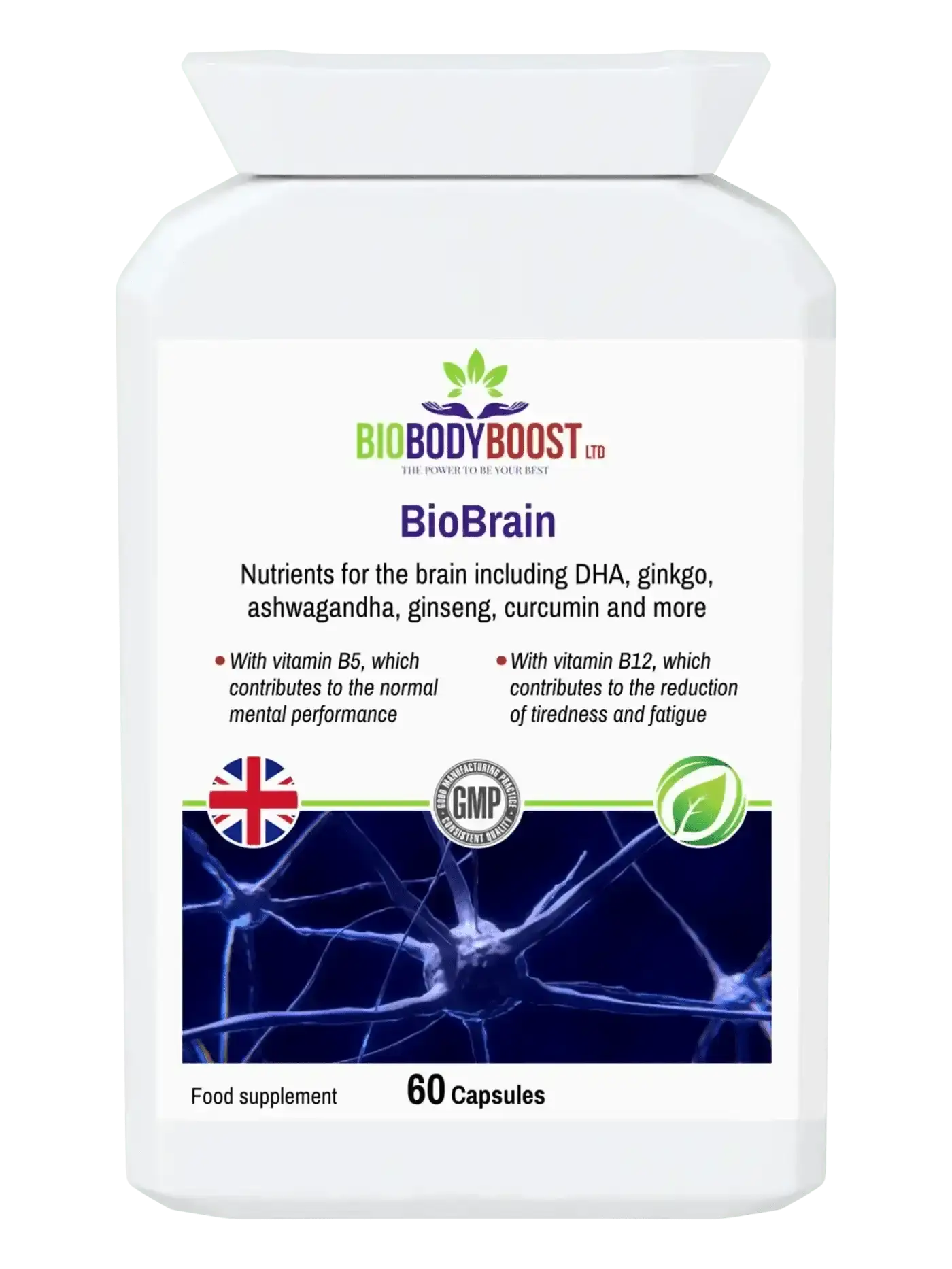
Our BioBrain combines bacopa monnieri, lion’s mane, ginkgo, L-theanine, ashwagandha and B12 — halal certified, vegan, UK GMP. Browse the Energy and Focus collection.
What is the best supplement for memory and focus?
For memory specifically, bacopa monnieri at 300mg standardised extract daily is the most clinically validated natural option for healthy adults — a 2014 meta-analysis of 9 RCTs confirmed significant improvements in memory free recall. It requires 8–12 weeks of consistent daily use. For acute focus within the same day, L-theanine at 200mg (particularly combined with 100mg caffeine) produces measurable improvements in attention switching accuracy within 40 minutes. These address different cognitive goals and can be combined safely. Lion’s mane addresses long-term neuroplasticity via NGF stimulation over 8–16 weeks.
How long do brain supplements take to work?
It depends entirely on the supplement and mechanism. L-theanine: alpha-wave effects within 40 minutes of dosing. Bacopa monnieri: significant memory improvements in RCTs measured at 12 weeks; some improvement from 4–6 weeks. Lion’s mane: the key RCT (Mori 2009) measured outcomes at 16 weeks; effects begin accumulating from 4–8 weeks. Omega-3 DHA: effects on brain structure are ongoing and cumulative; no acute effect. Magnesium: correction of deficiency-driven brain fog typically noticeable within 2–4 weeks. B vitamins: neurotransmitter effects from 2–4 weeks in deficient people. The most common reason brain supplements “don’t work” is stopping before the relevant mechanism has had sufficient time.
Are nootropic supplements safe long term?
For the main evidence-based options: bacopa monnieri has been used safely in Ayurvedic medicine for centuries and clinical trials run up to 12 months without significant adverse events. Lion’s mane is a food mushroom with an excellent safety profile. L-theanine has no established upper safe limit and is generally considered extremely safe. Omega-3 DHA and magnesium are essential nutrients with well-established long-term safety profiles. The main caveat for ginkgo: increased bleeding risk with anticoagulants and stop before surgery. None of the above are addictive or cause rebound cognitive impairment when stopped.
Do brain supplements work for ADHD or concentration difficulties?
Brain supplements are not treatments for ADHD and should not be used in place of clinical assessment and medical management. However, some supplements may support concentration in people with suboptimal nutritional status: magnesium deficiency is associated with attention difficulties; omega-3 DHA deficiency is associated with reduced reading ability and attention in children (multiple trials); zinc deficiency may worsen attention. Iron deficiency anaemia directly impairs concentration and cognition. If concentration is a persistent concern, a blood test to rule out nutrient deficiencies is more useful than buying a nootropic stack. Bacopa and L-theanine may provide modest support for concentration in adults without ADHD, but are not substitutes for clinical treatment of attention disorders.