The supplement industry's answer to vitamin C has been simple for decades: more. 1000mg tablets as standard, effervescent megadoses, "high strength" everywhere. Nobody talks about the people this doesn't work for — those who get heartburn, nausea, cramping or loose stools from ascorbic acid, and for whom every "immune boost" comes with a stomach ache. If that's you, this is your guide.
Why Ascorbic Acid Irritates
Two mechanisms:
Acidity. Ascorbic acid is exactly that — an acid, pH around 2.5 in solution. On an empty or sensitive stomach, particularly with reflux, gastritis or IBS, that acid load can trigger burning and nausea directly.
Osmotic overload. Vitamin C absorption is transporter-limited. At doses up to ~200mg absorption is highly efficient; by 1000mg, a substantial fraction is never absorbed at all. The unabsorbed portion travels onward and draws water into the bowel — the recognised cause of the diarrhoea and gas that appear at high doses. The EFSA notes gastrointestinal effects as the limiting factor for high vitamin C intakes.
The irony: the megadose is both the cause of the symptoms and mostly wasted. Your body was never going to use the bulk of that 1000mg tablet.
The Threshold That Matters
The UK NRV is 80mg. Research on absorption kinetics shows near-complete absorption at intakes up to about 200mg, falling steeply beyond that. So the practical strategy for a sensitive stomach isn't heroic dosing — it's modest, efficient, well-tolerated doses, ideally taken with food.

The Gentle Options, Compared
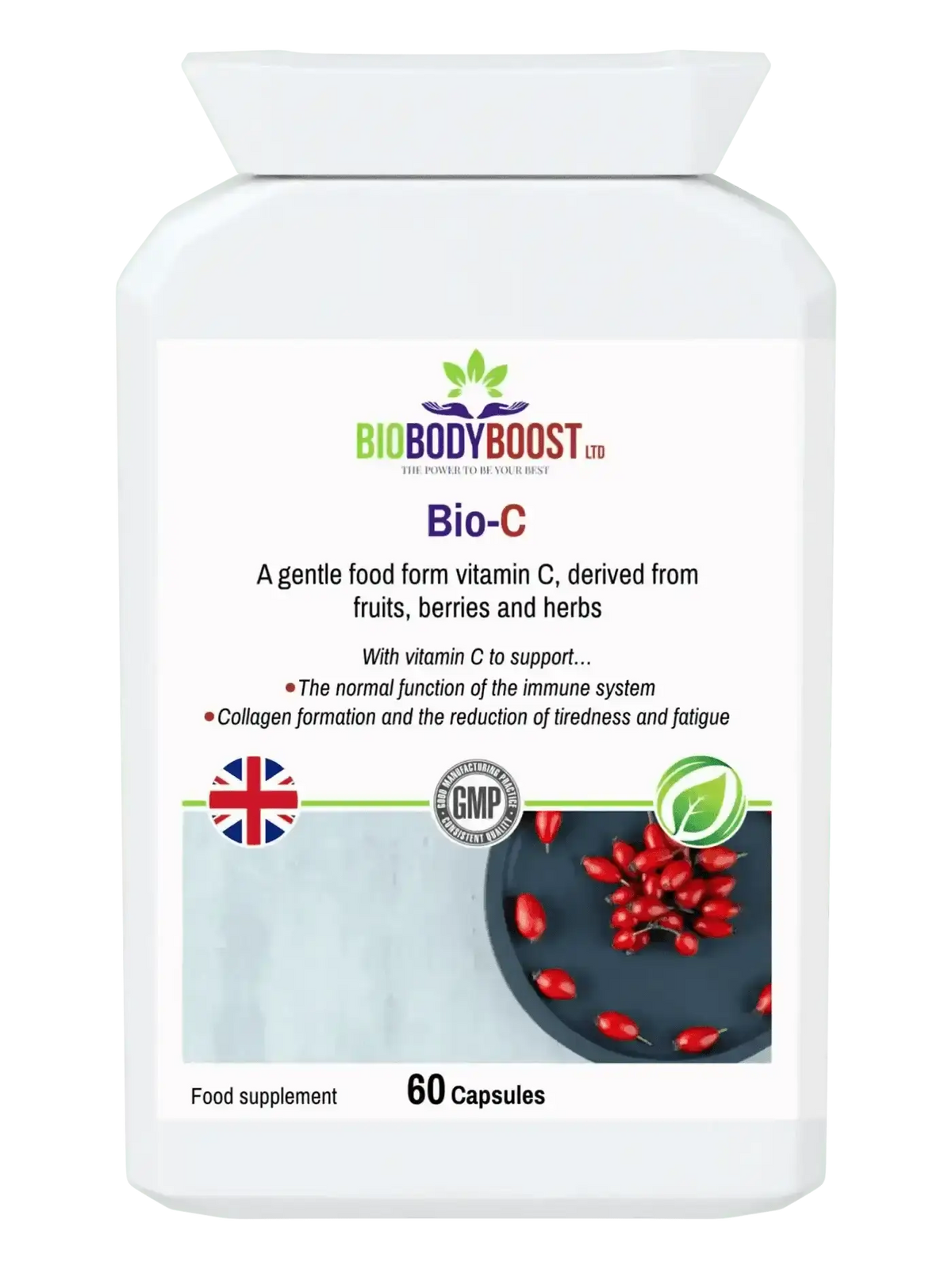
1. Food-form vitamin C. Vitamin C delivered within a whole-food matrix rather than as free ascorbic acid — naturally non-acidic and buffered by the food carrier itself. Our Bio-C provides 125mg (156% NRV) per capsule in food form: a deliberate, absorption-matched dose rather than a token one or a megadose. Vegan, halal and kosher approved.
2. Buffered vitamin C (mineral ascorbates). Ascorbic acid bound to calcium, sodium or magnesium, neutralising the acidity. Gentler than plain ascorbic acid, though megadose ascorbates can still cause osmotic symptoms — the dose problem doesn't disappear.
3. Liposomal vitamin C. Vitamin C encapsulated in phospholipids, bypassing much of the transporter bottleneck and the gut irritation with it. The premium route for higher intakes without stomach effects: our Liposomal Vitamin C, 500mg liquid. Full comparison in our liposomal vs regular guide.
4. Splitting the dose. Whatever form you take, 2× smaller doses with meals beats 1× large dose on an empty stomach — better absorption and better tolerance.
What Vitamin C Actually Does (The Authorised Claims)
Vitamin C contributes to normal immune function, normal collagen formation for the function of skin, gums, cartilage and bones, the protection of cells from oxidative stress, the reduction of tiredness and fatigue, and increases iron absorption. None of these claims requires megadosing — they're satisfied at normal dietary intakes.
FAQs
Why does vitamin C give me heartburn?
Standard vitamin C is ascorbic acid — literally an acid. On sensitive or empty stomachs it can trigger reflux-type burning. Food-form, buffered or liposomal C avoids the acid load.
Why does high-dose vitamin C cause diarrhoea?
Absorption is capped; the unabsorbed fraction draws water into the bowel osmotically. Doses within the efficient absorption range (roughly ≤200mg at a time) rarely cause it.
Is 125mg of vitamin C enough?
It's 156% of the UK NRV and sits inside the range where absorption is most efficient. For general daily support, yes. For deliberately higher intakes, liposomal delivery is the stomach-friendly route.
Should I take vitamin C with food?
If you're sensitive, always. Food buffers acidity and slows delivery, improving both comfort and uptake.
Browse the Immunity UK collection, or read our complete vitamin C guide for doses and forms in full.
Food supplements should not replace a varied diet. Persistent stomach pain, reflux or bowel changes should be reviewed by your GP — don't supplement over the top of an undiagnosed symptom.