
Magnesium is one of the most searched supplements in the UK, and one of the most confusing to buy. Walk into any pharmacy and you'll find magnesium citrate, oxide, glycinate, malate, taurate and bisglycinate — often at wildly different prices for what looks like the same mineral. The form matters more than most labels let on, because magnesium's absorption and its effect in the body depend heavily on what it's bound to.
Why Magnesium Is Bonded to Something Else
Elemental magnesium is not stable enough to survive digestion or be efficiently absorbed on its own. Manufacturers bind it to a carrier compound — an inorganic salt like oxide, or an organic compound like an amino acid or citrate. That carrier determines three things: how much elemental magnesium you actually get per capsule, how well your gut absorbs it, and whether it causes digestive side effects.
Magnesium oxide, the cheapest and most common form on UK shelves, has high elemental magnesium content by weight but poor bioavailability — a substantial fraction of the dose reaches the colon undigested, which is why it's marketed as a laxative more than a supplement. Magnesium citrate absorbs better but still carries a mild laxative effect at higher doses. The three forms in this guide — glycinate, malate and taurate — were chosen specifically to avoid that trade-off.
Magnesium Glycinate: Absorption Without the Gut Effect
Magnesium glycinate is magnesium bound to glycine, an amino acid that also acts as an inhibitory neurotransmitter in the central nervous system. This chelated form is absorbed via amino acid transporters in the small intestine rather than the slower diffusion pathway used by inorganic salts, which is the mechanism generally credited for its higher bioavailability and lower incidence of GI upset.
A randomised controlled trial in patients with fibromyalgia (Rossi et al., 2018, n=24) found magnesium glycinate supplementation over 8 weeks was well tolerated with no significant gastrointestinal side effects reported, distinguishing it from magnesium oxide and citrate in the same comparison. Because glycine itself has calming, GABA-supportive properties, glycinate is generally the form recommended for evening use or where digestive sensitivity is a concern.
Magnesium Malate: The Energy-Pathway Form
Magnesium malate binds magnesium to malic acid, a compound that plays a direct role in the Krebs cycle — the mitochondrial pathway that converts food into cellular energy (ATP). Because malic acid is already a substrate in that pathway, magnesium malate is often positioned for daytime use and for people focused on energy metabolism and muscle function rather than sleep.
Clinical interest in magnesium malate has centred on chronic fatigue and fibromyalgia populations, where impaired mitochondrial ATP production is a proposed mechanism of symptoms; a combined magnesium-malic acid formulation showed improvement in tenderness scores in early trial work, though sample sizes in this literature remain small and further RCTs are needed before strong claims can be made.
Magnesium Taurate: Cardiovascular and Nervous System Support
Magnesium taurate combines magnesium with taurine, an amino sulfonic acid concentrated in cardiac and neural tissue. Taurine independently supports calcium regulation in heart muscle cells and has documented roles in nervous system signalling, which is why magnesium taurate is frequently discussed in the context of cardiovascular and nervous system supplement stacks rather than general mineral repletion.
EFSA has authorised the general claim that magnesium contributes to normal muscle function, normal functioning of the nervous system, and the maintenance of normal bone and teeth for magnesium as a nutrient (Regulation (EU) 432/2012) — this claim applies to magnesium as an element regardless of the specific bonded form, and is the basis for the "normal muscle function" and "nervous system" language used on UK magnesium labels.
Why Combine All Three?
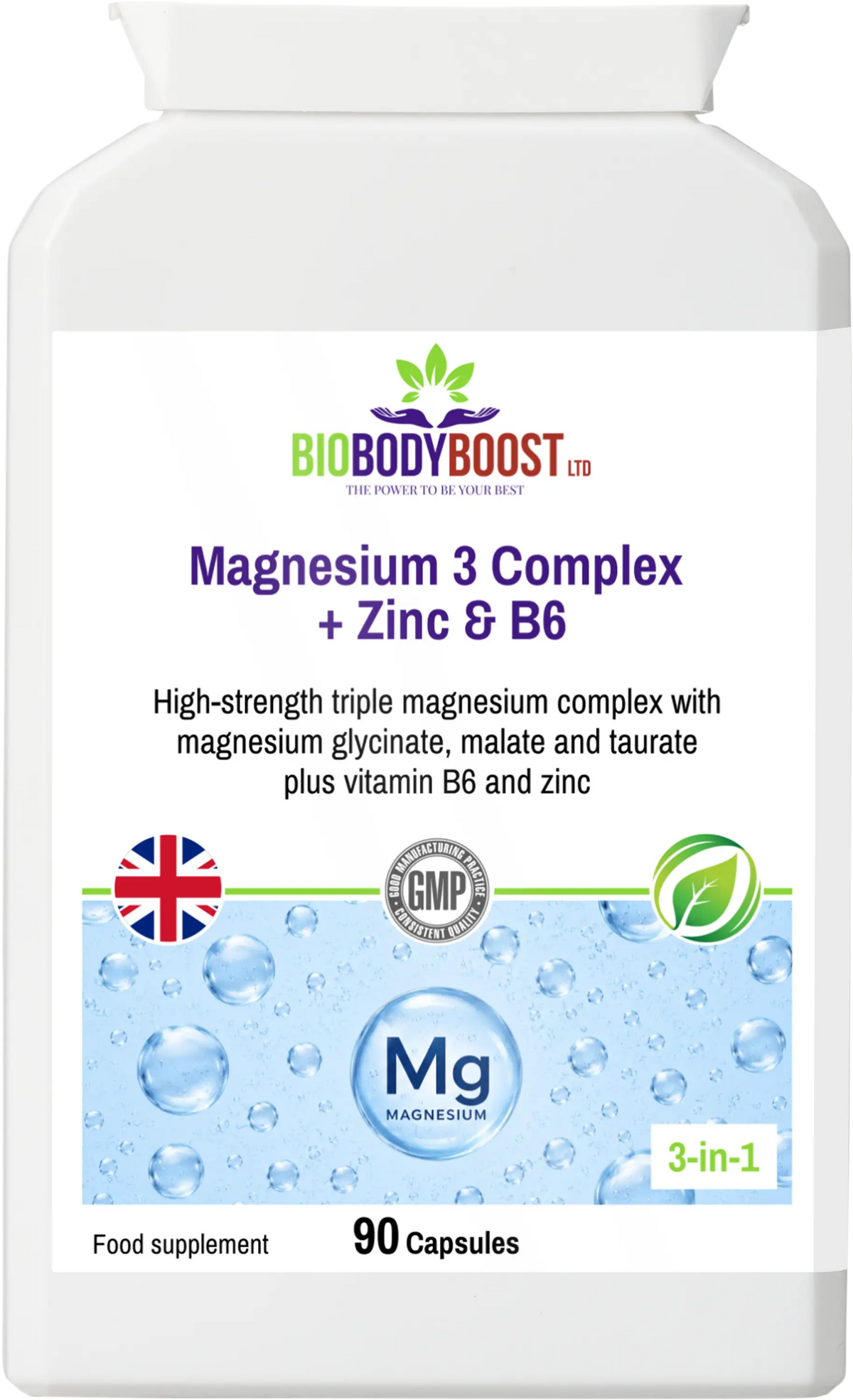
Single-form magnesium supplements optimise for one property — bioavailability, energy pathway support, or cardiovascular relevance — at the expense of the others. A triple-complex formula combining glycinate, malate and taurate is designed to cover absorption, energy metabolism and cardiovascular/nervous system support in one capsule, rather than requiring three separate purchases. This is the rationale behind our own Magnesium 3 Complex with Zinc & B6, which pairs the three chelated forms with zinc and vitamin B6 — both of which have EFSA-authorised claims relating to normal cognitive and immune function and to the regulation of hormonal activity.

The back-label breakdown: 387mg elemental magnesium per 3 capsules, split across all three chelated forms.
Halal and Vegan Status
All three chelated forms — glycinate, malate and taurate — used in our Magnesium 3 Complex are manufactured from non-animal, fermentation and mineral-salt sources, making the product suitable for vegans, vegetarians and halal-observant consumers. This distinguishes it from magnesium formulas bound to gelatin capsules or animal-derived excipients, which some UK brands still use without clear labelling.
Frequently Asked Questions
Which magnesium form is best for sleep?
Magnesium glycinate is generally the preferred form for evening use, owing to glycine's calming neurotransmitter activity alongside magnesium's role in nervous system function.
Can I take magnesium glycinate, malate and taurate together?
Yes — this is the basis of a triple-complex formula. Taking the three chelated forms together in one capsule is standard practice and doesn't create absorption conflicts, since they share the same elemental mineral and differ only in their carrier compound.
Is magnesium citrate or magnesium glycinate better?
Magnesium citrate is well-absorbed but more likely to cause a mild laxative effect at higher doses due to its osmotic activity in the gut. Magnesium glycinate is absorbed via a different pathway and is generally better tolerated for people who experience GI upset with citrate or oxide.
Is magnesium 3 complex halal and vegan?
Yes. Our Magnesium 3 Complex uses fermentation and mineral-derived chelated magnesium with no animal-derived excipients, and is halal approved under our UHA certification (Ref 24623).
How much elemental magnesium should I take daily?
The UK Reference Nutrient Intake (RNI) for magnesium is 300mg/day for men and 270mg/day for women. Always check the elemental magnesium content per serving on the label, since this varies significantly between chelated forms.
This article is for general information and does not constitute medical advice. Speak to a healthcare professional before starting any new supplement, particularly if you are pregnant, breastfeeding, or taking prescription medication.