
Quick answer: every ATP molecule in the human body must be chelated with a magnesium ion (Mg²⁺) to be biologically active. Without magnesium, ATP cannot be used by enzymes, cannot power muscle contraction, cannot drive ion pumps, cannot fuel any cellular process. Magnesium is also a required cofactor for the enzymes of the Krebs cycle — the mitochondrial pathway that converts food into NADH, which then drives the electron transport chain. Approximately 70% of UK adults consume below the Reference Nutrient Intake for magnesium. This is not a marginal deficiency issue. It is a widespread functional impairment of mitochondrial energy production that directly manifests as fatigue, poor recovery and cognitive fog.
Why Mg-ATP is not optional
ATP is synthesised by ATP synthase (Complex V of the electron transport chain) in its free form — but free ATP4⁻ is chemically unstable and cannot be recognised by the ATP-binding sites of most enzymes. Mg²⁺ ions bind to ATP’s phosphate groups, forming Mg-ATP2⁻ — the stable, enzyme-recognisable form. Virtually every kinase (enzyme that uses ATP to phosphorylate a substrate) requires Mg-ATP, not free ATP. This includes hexokinase (glucose entry into glycolysis), all Krebs cycle kinases, creatine kinase (phosphocreatine synthesis), ATPase ion pumps (Na+/K+ ATPase in every cell membrane, Ca2+ ATPase in muscle relaxation) and RNA polymerase (gene expression).
The implication is stark: magnesium deficiency does not merely reduce energy levels in a vague sense. It impairs the usability of ATP that has already been produced — the mitochondria may be generating ATP, but without sufficient magnesium that ATP cannot be efficiently deployed to the cellular processes that need it.
Magnesium in the Krebs cycle
The Krebs cycle (citric acid cycle) runs inside the mitochondrial matrix and is the central hub of aerobic metabolism — it oxidises acetyl-CoA from carbohydrates, fats and proteins to produce NADH and FADH2, which then feed the electron transport chain. Three of the eight Krebs cycle enzymes require magnesium as a direct cofactor: isocitrate dehydrogenase, α-ketoglutarate dehydrogenase and succinyl-CoA synthetase. When magnesium is insufficient, Krebs cycle flux slows, NADH production falls and ETC activity is substrate-limited.
What research shows: A 2011 study in the American Journal of Therapeutics (Barbagallo and Dominguez) reviewed magnesium’s role in cellular energy metabolism and confirmed that even subclinical magnesium deficiency measurably impairs mitochondrial ATP production and increases systemic oxidative stress. UK NDNS 2019 data shows mean magnesium intake in UK adults is significantly below the RNI of 270–300mg/day — with the lowest intakes in the 19–64 age group that also experiences the highest rates of fatigue-related health complaints.
Why magnesium deficiency worsens with age
Several age-related changes compound the deficiency risk after 45:
- Reduced intestinal absorption: magnesium absorption in the gut declines with age due to reduced active transport capacity. A 2017 Nutrients review found intestinal magnesium absorption efficiency falls progressively from middle age.
- Increased renal excretion: declining kidney function increases urinary magnesium losses. Diuretic medications (commonly prescribed for hypertension and heart failure — conditions that increase with age) dramatically increase urinary magnesium excretion.
- Higher stress cortisol: cortisol increases renal magnesium excretion. Elevated chronic stress — common in midlife — depletes magnesium faster, while simultaneously requiring more magnesium for adrenal cortisol synthesis and NMDA receptor modulation.
- Reduced dietary variety: processed food displacement of magnesium-rich wholegrains, nuts, seeds and legumes contributes to lower dietary intake across all ages but is particularly pronounced in time-pressured midlife adults.
Magnesium and the NMDA receptor — cognitive energy
Beyond mitochondrial biochemistry, magnesium ions physiologically block NMDA (N-methyl-D-aspartate) glutamate receptors at resting membrane potentials. This block prevents excessive neuronal excitation — the mechanism behind the “wired but tired” state characteristic of magnesium deficiency. Low magnesium removes this inhibitory block, increasing baseline neuronal excitability and cortisol reactivity. The result is heightened stress response, impaired sleep quality and reduced cognitive clarity despite normal — or even elevated — neurological arousal. This cognitive fatigue component is distinct from the mitochondrial energy mechanism and explains why magnesium’s effects on mental clarity are so pronounced.
Why form matters: the glycinate advantage
Magnesium oxide — the most common form in cheap supplements — has approximately 4% bioavailability. At 400mg elemental oxide per tablet, you absorb approximately 16mg elemental magnesium — less than 6% of the RNI. The rest stays in the gut as an osmotic laxative. Magnesium glycinate, where magnesium is chelated to glycine, has approximately 40–60% bioavailability and does not cause laxative effects at therapeutic doses. A 2003 Magnesium Research study confirmed citrate produced 4x higher serum magnesium than oxide at equivalent elemental doses; glycinate is comparable or superior to citrate in bioavailability with better tolerability.
The Magnesium 3 Complex formula
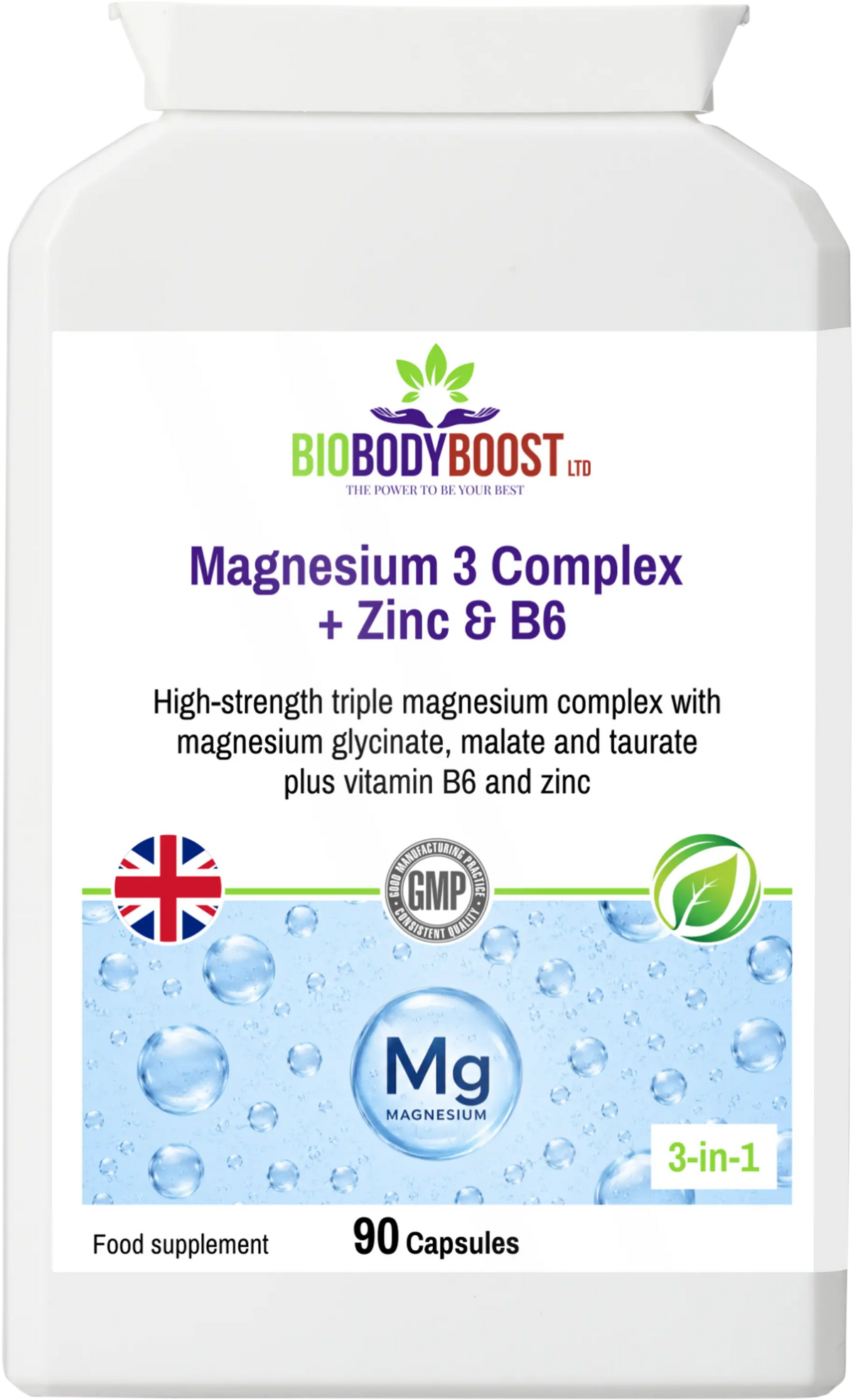
Magnesium 3 Complex provides 300mg elemental magnesium across three forms: glycinate (sleep, NMDA, anxiety), malate (Krebs cycle — malic acid is a direct Krebs cycle substrate alongside magnesium), and taurate (cardiovascular — taurine is concentrated in cardiac and brain tissue). The three-form combination addresses the mitochondrial, neurological and cardiovascular dimensions of magnesium function simultaneously. Also includes zinc 10mg (cofactor for 300+ enzymes including insulin receptor signalling and testosterone synthesis) and B6 5mg (cofactor for over 100 enzymatic reactions including neurotransmitter synthesis). HPMC capsule, halal certified, vegan, kosher.
Return to the complete mitochondria and aging guide for the full longevity stack.
Why is magnesium called the energy mineral?
Because every ATP molecule — the universal energy currency of all cellular processes — must be chelated with magnesium (Mg-ATP) to be biologically active. Without sufficient magnesium, already-produced ATP cannot be efficiently used by the enzymes that power muscle contraction, nerve signalling, protein synthesis and cellular repair. Magnesium is also a direct cofactor for three of the eight enzymes in the Krebs cycle — the mitochondrial pathway that generates NADH to drive the electron transport chain. UK NDNS data shows approximately 70% of UK adults consume below the RNI for magnesium, meaning the majority of the population is operating with functionally impaired ATP utilisation and mitochondrial energy production.
What is the best form of magnesium for energy and mitochondria?
Magnesium malate is the most directly mitochondria-targeted form — malic acid is a Krebs cycle intermediate, so magnesium malate delivers the mineral directly to the mitochondrial matrix with its cycle substrate. Magnesium glycinate has the best overall bioavailability and tolerability for raising cellular magnesium levels without laxative effects. The combination of malate (mitochondrial energy), glycinate (bioavailability, sleep, NMDA) and taurate (cardiovascular) addresses all three primary magnesium functions simultaneously — which is the rationale behind the Magnesium 3 Complex formula. Avoid magnesium oxide for any therapeutic purpose — its approximately 4% bioavailability makes it near-useless for raising tissue magnesium levels.
How much magnesium do adults over 45 need?
UK RNI: 270mg/day (women) and 300mg/day (men). These represent the minimum for the general population — requirements are higher with stress (cortisol increases renal excretion), regular exercise (sweat losses), diuretic medication use, alcohol consumption and digestive conditions reducing absorption. For adults over 45 with any of these factors, 300–400mg elemental magnesium from a well-absorbed form (glycinate, malate or citrate) is appropriate daily. Check elemental content on the label, not compound weight: 500mg magnesium citrate provides approximately 80mg elemental magnesium; 500mg magnesium oxide provides approximately 300mg elemental but with only 4% absorption.