
Quick answer: choose lichen-derived vitamin D3 (cholecalciferol, not D2/ergocalciferol) with vitamin K2 as MK-7 (menaquinone-7, not MK-4). Lichen D3 is unambiguously vegan and halal. MK-7 has significantly longer half-life in the body than MK-4 — once daily dosing is effective. Take with a fat-containing meal. PHE recommends 10μg (400 IU) D3 for all UK adults October to March; adults with confirmed deficiency or darker skin tones typically need 1,000–2,000 IU/day.
D3 vs D2: why the form matters
Two forms of vitamin D are used in supplements:
- Vitamin D3 (cholecalciferol): the form produced by human skin in response to UV-B. Significantly more effective than D2 at raising and maintaining serum 25-OH vitamin D levels. A 1998 comparison study in the American Journal of Clinical Nutrition (Trang et al.) found D3 raised serum 25-OH vitamin D approximately 87% more effectively per IU than D2. Commonly derived from lanolin (sheep wool wax) — the source relevant for halal and vegan compliance.
- Vitamin D2 (ergocalciferol): plant-derived (from yeast or fungi exposed to UV light). Historically used in vegan products because it avoids lanolin. Less effective than D3 at comparable doses. Shorter half-life — serum levels decline faster between doses.
The vegan and halal solution: lichen-derived D3. Lichen is a symbiotic organism (algae + fungi) that naturally produces vitamin D3 when exposed to UV light — making it the only plant-origin source of D3. Lichen D3 is chemically identical to lanolin D3 (same molecule) but derived entirely from plant-kingdom organisms. It is unambiguously vegan and unambiguously halal across all scholarly positions. Our Lipovita D3+K2 uses lichen-derived D3.
K2 forms: MK-7 vs MK-4
Vitamin K2 (menaquinone) exists in multiple chain lengths. The two most relevant for supplements:
- MK-7 (menaquinone-7): naturally derived from natto (fermented soybeans) or via fermentation. Has a plasma half-life of approximately 72 hours — meaning a single daily dose maintains active K2 levels around the clock. Better studied for bone and cardiovascular outcomes. Most evidence for D3+K2 supplementation is in MK-7 form.
- MK-4 (menaquinone-4): synthesised in the body from K1, or produced synthetically for supplements. Has a plasma half-life of approximately 1–2 hours — requires multiple daily doses or high single doses to maintain levels. Used in Japanese pharmaceutical bone density trials at very high doses (45mg/day — far above supplement levels). The evidence base for MK-4 at supplement doses is less robust than MK-7.
For daily supplementation, MK-7 is the preferred form — longer half-life, better suited to once-daily dosing and the form with more human trial evidence at supplement-range doses.
Why D3 and K2 should be taken together
Vitamin D3 significantly increases intestinal calcium absorption — this is its primary bone health mechanism. But without vitamin K2, that additional absorbed calcium may not be appropriately directed to bone. K2 activates two key calcium-routing proteins:
- Osteocalcin (vitamin K2-dependent): draws calcium into bone matrix, increasing bone density
- Matrix Gla protein (MGP) (vitamin K2-dependent): prevents calcium depositing in arterial walls (soft tissue calcification)
What research supports: A 2015 meta-analysis in Nutrients (Maresz, 7 RCTs) confirmed MK-7 supplementation significantly improved lumbar spine bone mineral density in postmenopausal women. A 2017 study in Thrombosis and Haemostasis found MK-7 at 180mcg/day for 3 years significantly improved carboxylation of MGP — the protein preventing arterial calcification. This is the scientific basis for the recommendation to combine D3 with K2 rather than D3 alone.
Dose: what the evidence supports
Vitamin D3:
- PHE recommendation: 10μg (400 IU) for all UK adults October to March
- Maintenance for adults with adequate baseline: 400–1,000 IU/day
- People with confirmed deficiency (25-OH vitamin D below 25 nmol/L): 1,000–4,000 IU/day to restore levels. A 2011 meta-analysis in the American Journal of Clinical Nutrition (Autier and Gandini) found 400 IU/day insufficient to restore adequate levels in many deficient adults; 1,000 IU was the minimum effective maintenance dose.
- Darker skin tones and those who cover up outdoors year-round: 1,000–2,000 IU/day year-round
- EU safe upper level: 100μg (4,000 IU)/day from supplements. Toxicity (hypercalcaemia) is extremely rare below 10,000 IU/day in healthy adults.
Vitamin K2 MK-7:
- EU NRV: 75μg/day
- RCT doses for bone outcomes: 90–200mcg/day MK-7
- MGP carboxylation benefit (arterial calcium): 180mcg/day MK-7 (Thrombosis and Haemostasis 2017)
- No established upper safe limit for K2 MK-7; doses up to 360mcg/day have not shown adverse effects in trials
- Caution with warfarin: K2 counteracts warfarin’s mechanism. People on anticoagulants must discuss K2 supplementation with their GP or anticoagulant clinic before starting.
Fat-soluble absorption: the most important practical note
Both D3 and K2 are fat-soluble — they require dietary fat for absorption via micelle formation in the gut. A 2010 RCT (Mulligan and Bhatt, JBMR, n=17) found vitamin D3 absorption improved by 56% when taken with the largest fat-containing meal of the day vs fasted. Liposomal formulations (like our Lipovita D3+K2) encapsulate the nutrients in phospholipid spheres, bypassing the dietary fat requirement and producing higher plasma levels without needing to coordinate with a fat-containing meal.
Practical guidance: take D3+K2 with breakfast including eggs, nut butter, avocado or full-fat dairy; or with dinner containing oily fish, olive oil or nuts; or use a liposomal format that removes the fat requirement. Do not take on a completely empty stomach.
Halal and vegan compliance summary
- D3 source: lichen-derived (unambiguously vegan and halal) vs lanolin-derived (permissible under majority UK scholarly positions but some prefer lichen)
- K2 MK-7 source: typically from natto fermentation or synthetic — both vegan and halal. Check manufacturing environment certification.
- Capsule/delivery: HPMC capsule or liquid format — avoid standard gelatine capsules
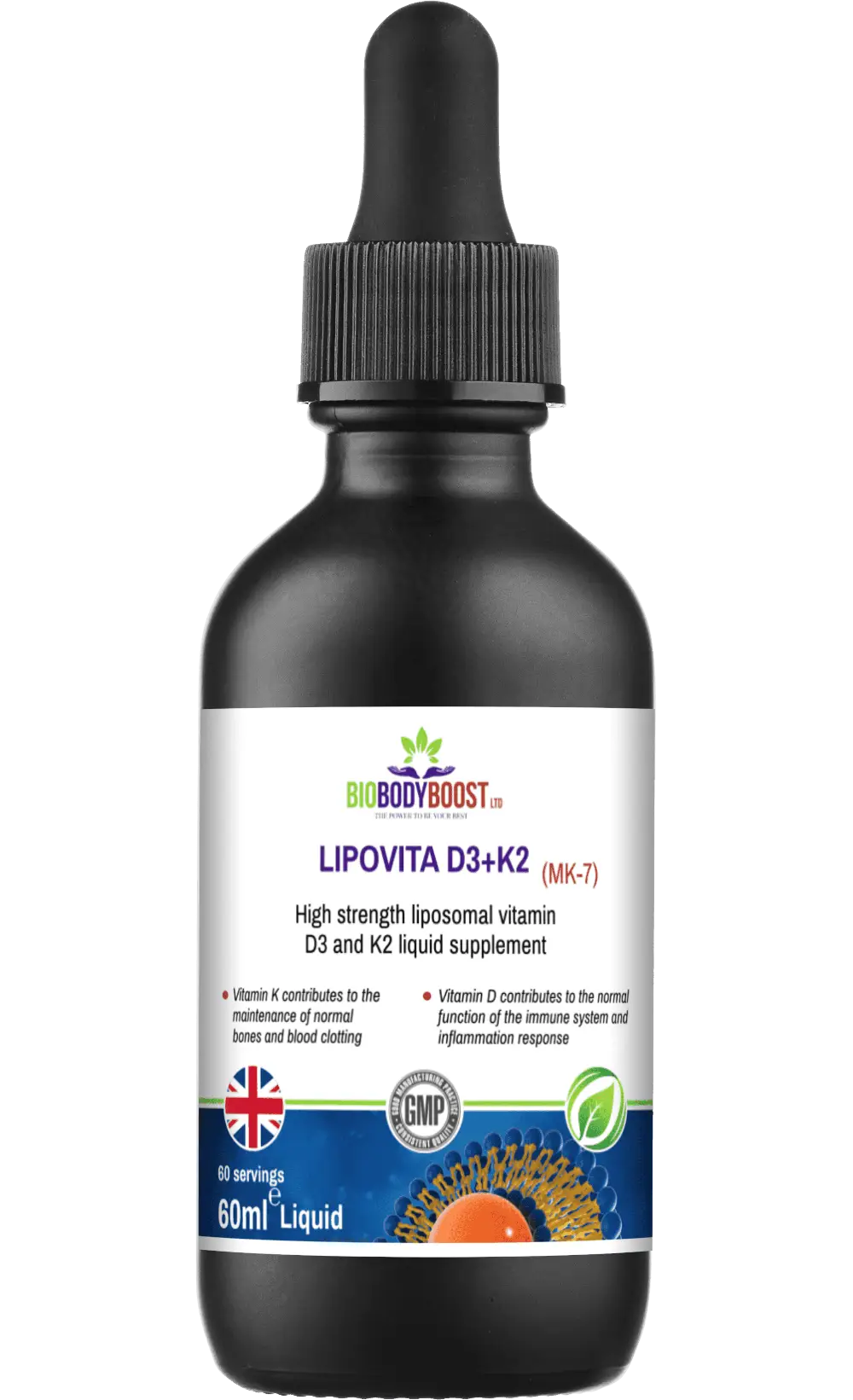
Our Lipovita D3+K2 — 4,000 IU lichen-derived D3 + 100mcg MK-7 K2, liposomal liquid, fully halal certified, vegan, kosher. Three drops daily directly or into food.
What is the difference between lanolin D3 and lichen D3?
Both provide cholecalciferol — the same molecule, identical in chemical structure and biological activity. The difference is source only. Lanolin D3 is extracted from lanolin (sheep wool wax), a byproduct of wool processing that does not involve slaughter. The majority UK scholarly position is that lanolin D3 is permissible. Some scholars take a more cautious view. Lichen D3 is derived from lichens (symbiotic algae + fungi) exposed to UV light — completely plant-kingdom sourced, unambiguously vegan and unambiguously halal across all scholarly positions. For strict vegans or those who prefer to remove any doubt, lichen D3 is the appropriate choice.
What dose of vitamin D3 do I need?
For general maintenance (UK adults, October to March): PHE recommends 10μg (400 IU)/day. For adults with darker skin, those who cover up outdoors, or anyone who spends most time indoors: 1,000–2,000 IU/day year-round. For confirmed deficiency (25-OH vitamin D below 25 nmol/L): 1,000–4,000 IU/day to restore levels — a 2011 AJCN meta-analysis found 400 IU insufficient to restore adequate levels in many deficient adults. The EU safe upper level is 4,000 IU/day from supplements. If in doubt, get a serum 25-OH vitamin D blood test to know your actual baseline before deciding on dose.
Can I take vitamin K2 if I am on warfarin?
Only with GP or anticoagulant clinic approval and monitoring. Vitamin K counteracts warfarin’s mechanism — warfarin works by blocking vitamin K-dependent clotting factor synthesis. Adding vitamin K2 can alter INR (clotting time) and require warfarin dose adjustment. Some anticoagulation clinics now recommend consistent low-dose K2 supplementation in warfarin patients to stabilise K2 intake (fluctuations in dietary K are a common cause of erratic INR) — but this must be managed medically. Never start K2 supplementation without telling your anticoagulation team.
Does vitamin D3 work better with K2?
Yes, for calcium routing specifically. D3 increases calcium absorption; K2 (specifically MK-7) activates osteocalcin (draws calcium into bone) and matrix Gla protein (prevents calcium depositing in arteries). A 2015 meta-analysis in Nutrients confirmed K2 supplementation significantly improved lumbar spine bone mineral density; a 2017 Thrombosis and Haemostasis study confirmed K2 at 180mcg/day significantly improved MGP carboxylation. For bone density and cardiovascular safety of D3 supplementation, combining with MK-7 K2 is the evidence-appropriate approach.


