Lutein and zeaxanthin are the only two carotenoids found in the macula — the central region of the retina responsible for high-acuity and colour vision. They act as a natural blue light filter and antioxidant shield for photoreceptor cells. Their levels in the eye depend on dietary and supplemental intake — the body cannot synthesise them. In a world where UK adults average 9–11 hours of daily screen time, their role in long-term visual health is one of the most clinically relevant emerging areas in nutrition.
What Do Lutein and Zeaxanthin Do in the Eye?
Lutein and zeaxanthin accumulate in the macula as macular pigment. This pigment performs two functions:
- Blue light filtration — the macular pigment absorbs high-energy blue light (400–500nm wavelength) before it reaches photoreceptors. Digital screens, LED lighting and smartphones emit high amounts of blue light. The macular pigment acts as an intraocular sunscreen.
- Antioxidant protection — photoreceptor cells generate oxidative stress during the conversion of light to neural signals. Lutein and zeaxanthin quench the singlet oxygen and free radicals generated in this process, protecting photoreceptor cells from cumulative oxidative damage.
The Link Between Macular Pigment and Screen Use
Macular pigment optical density (MPOD) is measurable and directly influenced by lutein and zeaxanthin intake. Low MPOD is associated with:
- Increased glare sensitivity
- Reduced contrast sensitivity
- Higher risk of age-related macular degeneration (AMD)
- Greater visual fatigue from blue-light-heavy environments
UK adults spend approximately 9–11 hours per day looking at screens — more than any previous generation in history. The cumulative blue light exposure and oxidative stress this represents is a legitimate long-term visual health consideration. Supplemental lutein and zeaxanthin directly increase MPOD — this is documented in multiple clinical trials.
What Does the Clinical Evidence Show?
Age-related macular degeneration — very strong evidence
The AREDS2 study — the largest nutritional eye health trial ever conducted (n=4,203 participants) — found that supplementation with lutein (10mg) and zeaxanthin (2mg) reduced the risk of advanced AMD progression by 25% in people at high risk. This is now a standard recommendation in ophthalmology guidelines for people with intermediate AMD.
Macular pigment density — strong evidence
Multiple RCTs confirm that lutein supplementation (10mg daily for 12 weeks or more) significantly increases MPOD — the direct measure of macular protection. Meso-zeaxanthin (a related carotenoid) shows even stronger MPOD increases in some trials.
Visual performance under screen conditions — moderate evidence
Trials specifically in young adults with high screen use (computer workers) show significant improvements in contrast sensitivity, glare recovery time and visual comfort with lutein+zeaxanthin supplementation at 10mg+2mg daily over 6–12 months.
What Other Nutrients Support Eye Health?
- Bilberry (Vaccinium myrtillus) — contains anthocyanins that support rhodopsin regeneration (dim-light vision) and retinal blood flow. Evidence for night vision and reduced eye fatigue.
- Vitamin C — aqueous humor of the eye has one of the highest vitamin C concentrations in the body; antioxidant protection for lens and cornea.
- Zinc — required for vitamin A metabolism in the retina and for rhodopsin synthesis. Zinc deficiency impairs night vision.
- Omega-3 DHA — DHA makes up 40% of the polyunsaturated fat in the retina; essential for photoreceptor membrane function.
- Vitamin A — the direct precursor for retinal, the visual pigment component of rhodopsin.
Who Should Consider Eye Health Supplementation?
- Adults spending more than 6 hours daily on screens
- Anyone with a family history of AMD
- People with low consumption of leafy green vegetables (the primary dietary lutein source)
- Smokers — who have significantly elevated AMD risk and lower macular pigment density
- Adults over 40 — macular pigment density declines with age
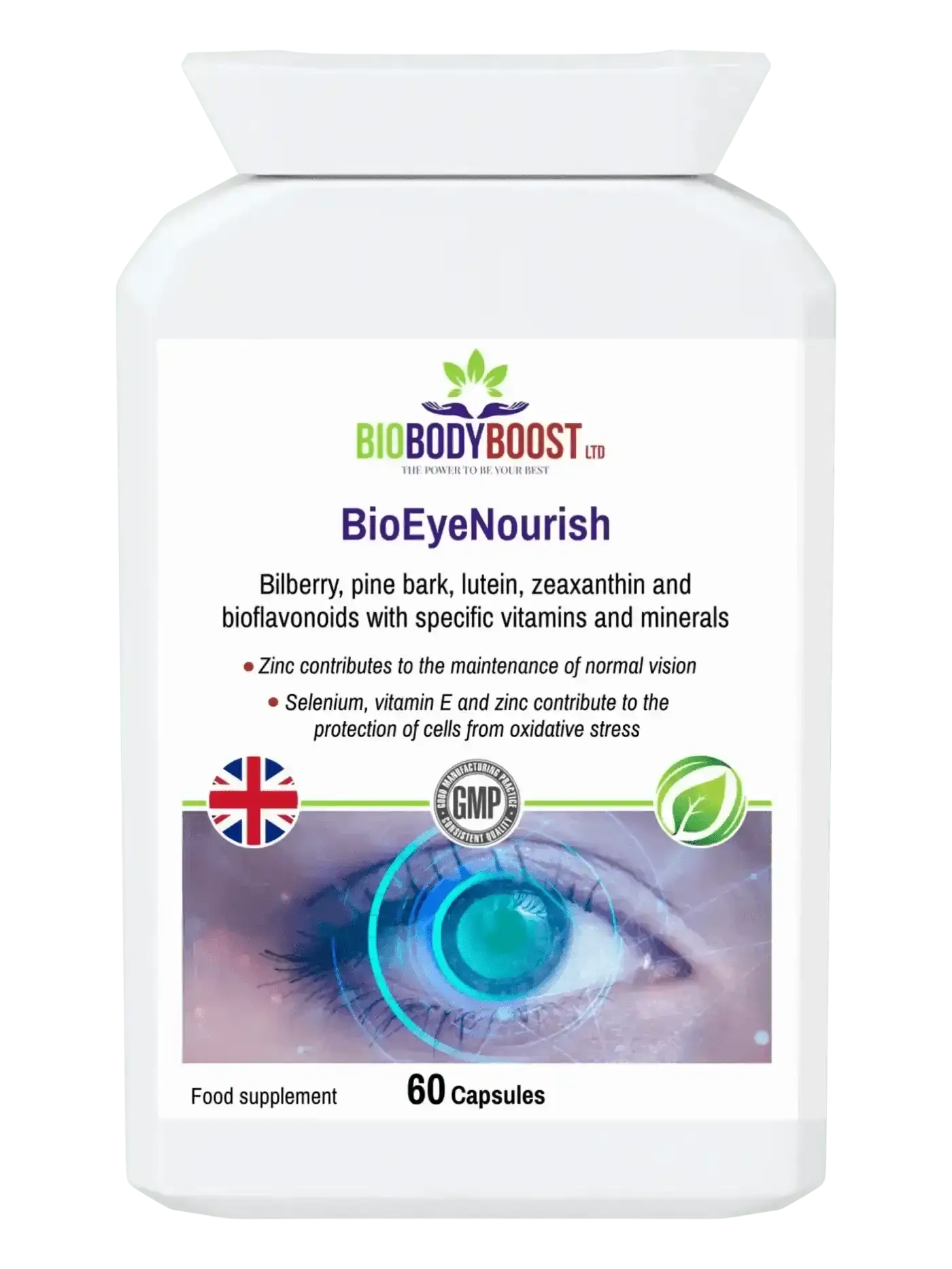
BioEyeNourish by BioBodyBoost combines lutein, zeaxanthin, bilberry extract, zinc and vitamins C and E — a comprehensive eye health formula targeting every documented nutrient pathway for visual protection. Halal certified, UK GMP manufactured. Browse the full range.