
Quick answer: creatine monohydrate is one of the most evidence-backed supplements available — and most of the evidence applies equally to women. It improves strength, power output and recovery, supports bone mineral density, and has emerging evidence for cognitive function and mood. Women start with lower baseline muscle creatine stores than men, which means the performance gains from supplementation are proportionally similar or greater. The dose is the same: 3–5g daily. It is not a bodybuilding supplement. It is a foundational supplement that happens to have been studied mostly in men until recently.
Why creatine became a women’s health topic in 2026
Creatine has been mainstream in male sports nutrition for 30+ years. Its crossover into women’s wellness is recent — driven by a combination of better research, social media education (particularly on TikTok, where “creatine for women” searches grew over 123% year-on-year in 2025–2026) and a broader shift in how women approach strength training and supplementation.
The research catching up with the mainstream is significant. Most early creatine trials used male participants. Recent trials specifically in women have confirmed the same performance benefits — and identified some additional benefits in menopausal and perimenopausal women that have no male equivalent.
1. Strength and power — the primary established benefit
Creatine works by increasing phosphocreatine stores in muscle. Phosphocreatine is the energy currency for short, explosive efforts — the first 10–30 seconds of maximal exertion (lifting, sprinting, HIIT). More phosphocreatine means more ATP regenerated per effort, which translates to more reps at a given weight, faster recovery between sets and greater training volume over time.
What research supports in women specifically: A 2003 Journal of Strength and Conditioning Research study (Vandenberghe et al.) found creatine supplementation in previously untrained women produced significantly greater strength gains than placebo at 10 weeks, with 20–25% greater improvements in upper and lower body strength. A 2021 meta-analysis in Nutrients (Gualano et al., 22 trials including female participants) confirmed creatine significantly improved strength and power in women across resistance training protocols.
Honest limit: absolute strength gains are lower in women than men (reflecting lower absolute muscle mass), but percentage improvements are equivalent or greater. Creatine does not produce the same hypertrophy response in women as in men — it will not make you “bulky.” It supports the strength and lean mass retention that most women training with weights are actually trying to achieve.
2. Bone mineral density — the underreported benefit
This is the most clinically significant benefit for women that has no equivalent male focus. Oestrogen plays a critical role in maintaining bone mineral density. At perimenopause and menopause, oestrogen decline accelerates bone resorption. UK NDNS data shows one in two women over 50 will have an osteoporosis-related fracture in their lifetime.
What research supports: A 2005 RCT in Medicine and Science in Sports and Exercise (Chilibeck et al., n=33 postmenopausal women) found creatine supplementation combined with resistance training significantly improved bone mineral density at the femoral neck vs resistance training alone. A 2015 systematic review in the Journal of Nutrition found creatine supplementation attenuated bone loss during resistance training in older populations, with female-specific effects driven by the interaction between creatine’s role in ATP synthesis and the energy demands of bone remodelling cells (osteoblasts).
For Muslim women with higher vitamin D deficiency rates, lower bone density baselines, and lower oily fish intake — all of which are established in UK South Asian communities — a supplement that supports bone density alongside resistance training is particularly relevant.
3. Cognitive function and mood — emerging evidence
Creatine is not only stored in muscle. Approximately 5% of total body creatine is in the brain, where it supports neuronal energy metabolism. Brain creatine is relevant for cognitive performance, mood regulation and neuroprotection — and women may have specific benefits here.
What research supports: A 2022 meta-analysis in Nutrients (Dolan et al., 13 trials) found creatine supplementation significantly improved memory and processing speed, with effects most pronounced in sleep-deprived conditions and in populations with lower baseline brain creatine (which includes vegans and vegetarians). A 2021 study in Behavioural Brain Research found creatine supplementation in women specifically significantly reduced depressive symptoms in a pilot RCT — the mechanism linked to creatine’s role in replenishing ATP in serotonergic neurons.
Women have lower baseline brain creatine than men on average. This means the relative improvement from supplementation may be greater. Emerging research is investigating creatine specifically in perimenopausal women for cognitive support during hormonal transition — a promising area with trials ongoing.
4. Recovery and fatigue reduction
Creatine reduces post-exercise muscle damage markers (creatine kinase, lactate dehydrogenase) in multiple trials, accelerating recovery between sessions. For women managing training alongside work, family and Ramadan fasting schedules, faster inter-session recovery means more consistent training progression over time.
A 2004 study in the Journal of Strength and Conditioning Research found creatine supplementation significantly reduced post-exercise markers of muscle damage after repeated sprint sessions. A 2021 study specifically in women found creatine reduced muscle soreness and improved recovery quality at 48 hours post-training vs placebo.
Does creatine cause water retention and weight gain in women?
Yes — and the mechanism matters for setting expectations. Creatine draws water into muscle cells osmotically. This is intramuscular water, not subcutaneous “puffiness.” The initial weight increase is typically 0.5–1.5kg in the first 1–2 weeks and reflects better-hydrated muscle tissue, not fat. This intramuscular water is part of why creatine works — hydrated muscle fibres function more efficiently and recover faster.
The “creatine makes you look puffy” concern is a myth about subcutaneous fluid retention that does not match the physiology. Women in the trials showing strength and bone density benefits did not report changes in body composition aesthetics beyond lean mass improvement.
Is creatine halal and vegan?
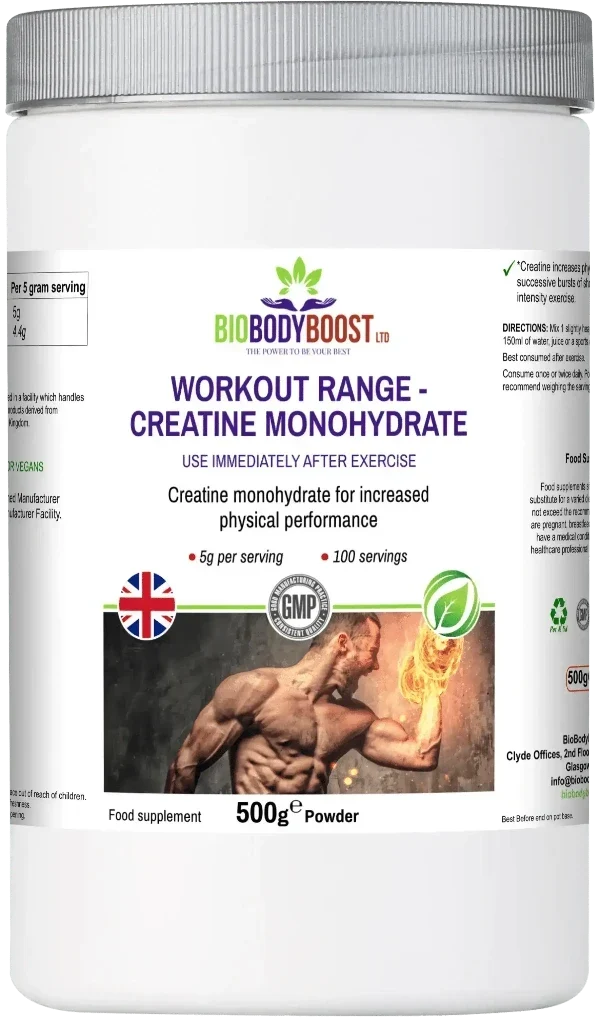
Yes to both. Creatine monohydrate is produced synthetically from sarcosine and cyanamide — no animal involvement. It is inherently vegan by ingredient. Halal certification of the finished product confirms the manufacturing process, environment and all excipients also meet halal standards. BioBodyBoost Creatine Monohydrate is 100% pure synthetic creatine, halal approved, vegan, kosher — HPMC capsule, UK GMP manufactured. For the full halal status breakdown: is creatine halal UK guide.
How to take creatine: dose and timing for women
- Dose: 3–5g daily — the same as for men. There is no evidence that women need a different dose. Smaller body weight does not require proportional dose reduction — muscle creatine saturation follows total muscular volume, not body weight linearly.
- Loading phase: optional. 20g/day split into 4×5g doses for 5–7 days saturates stores faster. Not necessary — 3g/day for 3–4 weeks achieves the same endpoint. Loading is more likely to cause GI discomfort in the first week.
- Timing: largely irrelevant. Consistency matters more than meal proximity. Take at whatever time you remember daily — Suhoor or Iftar during Ramadan removes any timing ambiguity.
- With carbohydrate: insulin stimulates creatine uptake. Taking with a carbohydrate-containing meal improves uptake slightly vs fasted. No need to plan around this specifically — just take with food.
- Minimum commitment: 4–6 weeks before assessing strength changes. Bone density benefits require 12+ weeks of combined creatine + resistance training.
BioBodyBoost Creatine Monohydrate — 100% pure, halal approved, vegan, no fillers. Browse the full Sports Nutrition UK collection.
Is creatine safe for women to take daily?
Yes — creatine monohydrate has an excellent long-term safety record for both men and women. A 2021 systematic review in the Journal of Strength and Conditioning Research found no adverse renal effects from long-term creatine supplementation in healthy adults. The most common early side effect is mild GI discomfort, which resolves by taking it with food and avoiding the loading phase. Women who are pregnant or breastfeeding should discuss with their GP before supplementing — not because of established harm, but because no specific pregnancy safety trials have been completed. For healthy non-pregnant women, 3–5g/day is supported by 30+ years of safety data.
Will creatine make women bulky or gain weight?
Not in the way most people fear. The initial 0.5–1.5kg increase in the first 1–2 weeks is intramuscular water (creatine is osmotically active), not fat or subcutaneous fluid. This is part of the mechanism — better-hydrated muscle fibres function more efficiently. Long-term, creatine combined with resistance training supports lean muscle retention and strength rather than mass gain in the bodybuilder sense. Women do not produce the same testosterone-driven hypertrophy response as men — creatine amplifies the training adaptations you are already working toward, it does not override your hormonal environment.
Should perimenopausal women take creatine?
There is a strong mechanistic case, and emerging clinical evidence. Oestrogen decline at perimenopause accelerates bone resorption and reduces muscle protein synthesis efficiency. Creatine has been shown to significantly improve bone mineral density at the femoral neck in postmenopausal women (Chilibeck 2005, MSSE) when combined with resistance training, and to support lean mass retention during hormonal transition. Emerging trials are also investigating creatine for cognitive support during perimenopause given its brain energy role. For perimenopausal women already doing resistance training, adding 3–5g creatine daily is one of the most evidence-supported supplement additions available. See our full Women’s Wellness UK collection.
Is creatine halal for Muslim women?
Yes — creatine monohydrate is synthetically produced from sarcosine and cyanamide with no animal involvement. It is inherently vegan by ingredient and halal by source. BioBodyBoost Creatine Monohydrate carries third-party halal certification covering the manufacturing process, environment and excipients. It dissolves completely in water, making it easy to take at Suhoor or Iftar during Ramadan without any timing or fasting concerns. Full detail: is creatine halal UK guide.
How long does creatine take to work in women?
Without a loading phase: 3–4 weeks of 3–5g daily to fully saturate muscle creatine stores, with performance improvements typically noticeable from week 4 onward. With a loading phase (20g/day for 5–7 days): saturation in 5–7 days, with strength improvements in the second week. Bone density benefits require 12+ weeks of consistent creatine alongside resistance training. Cognitive benefits (memory, processing speed) have been measured at 4–6 weeks in trials. Women with lower baseline muscle creatine — particularly vegans and vegetarians — typically see stronger and faster responses than omnivores.


