Quick answer: dietary nitrates from beetroot are reduced to nitric oxide (NO) in the body via the nitrate-nitrite-NO pathway. NO is a powerful regulator of cytochrome c oxidase — Complex IV of the mitochondrial electron transport chain. By modulating Complex IV activity, NO reduces the amount of oxygen required to produce the same quantity of ATP. This means more energy from less oxygen — which directly improves exercise efficiency, reduces perceived effort at a given workload and extends time to exhaustion. This is not a performance trick. It is a mechanistically characterised improvement in mitochondrial efficiency with over a decade of human trial evidence.
The nitrate-nitrite-NO pathway: how beetroot becomes mitochondrial medicine
When you consume dietary nitrate (NO₃⁻), approximately 25% is actively taken up by the salivary glands and concentrated in saliva. Oral bacteria reduce salivary nitrate to nitrite (NO₂⁻). This nitrite is swallowed, enters the circulation, and is further reduced to nitric oxide (NO) in tissues — particularly in hypoxic (low-oxygen) conditions such as working muscle. The entire pathway takes approximately 2–3 hours from ingestion to peak plasma nitrite, which is why pre-exercise beetroot timing matters.
Nitric oxide was the 1998 Nobel Prize in Physiology or Medicine subject (Furchgott, Ignarro and Murad) — specifically for its role in cardiovascular signalling. Its mitochondrial role has been characterised in detail since then.
How NO modulates Complex IV
Cytochrome c oxidase (Complex IV) is the terminal enzyme of the electron transport chain — it receives electrons from cytochrome c and transfers them to oxygen, completing the ETC and maintaining the proton gradient that drives ATP synthase. NO reversibly inhibits Complex IV at the oxygen-binding site — but paradoxically, this partial inhibition increases overall ETC efficiency. The mechanism: by competing with oxygen at Complex IV, NO forces the ETC to operate in a more oxygen-efficient mode, reducing the “slip” in proton pumping (electrons that do not generate proton pumping) and reducing the oxygen cost per ATP synthesised.
What research shows: A landmark 2009 study in the Journal of Applied Physiology (Bailey et al., n=8) found dietary nitrate supplementation from beetroot juice significantly reduced the oxygen cost of submaximal cycling by approximately 19% — a previously unprecedented effect size from a dietary intervention. A 2011 Journal of Applied Physiology study (Lansley et al., n=9) confirmed beetroot juice supplementation reduced oxygen cost of exercise by 3–5% and significantly improved 4km and 16.1km time trial performance. A 2014 review by Jones (Journal of Applied Physiology) synthesised over 30 studies confirming the nitrate-oxygen efficiency relationship is mechanistically robust and reproducible across exercise modalities.
Why this matters specifically over 45
Two compounding factors make beetroot nitrates particularly valuable for mitochondrial support in older adults:
- VO2 max declines approximately 1% per year after age 45 in sedentary adults. VO2 max is the maximum rate of oxygen consumption during exercise — the ceiling of aerobic energy production. Reducing the oxygen cost of sub-maximal exercise (which beetroot nitrates do) means you can achieve the same aerobic output at a smaller fraction of your declining VO2 max. The same effort produces less physiological strain.
- Endothelial nitric oxide production declines with age. Healthy arteries produce NO endogenously via eNOS (endothelial nitric oxide synthase). With age, eNOS activity declines and oxidative stress degrades circulating NO. Dietary nitrate provides an eNOS-independent NO source via the nitrate-nitrite-NO pathway — effectively bypassing the age-related decline in endothelial NO production.
Blood pressure: the cardiovascular dimension
Beyond mitochondrial efficiency, NO is the primary endogenous vasodilator — it relaxes vascular smooth muscle, reducing arterial resistance and blood pressure. A 2013 meta-analysis (Siervo et al., Hypertension) confirmed dietary nitrate supplementation reduced systolic BP by 4.4mmHg and diastolic by 1.1mmHg across multiple trials — equivalent to the effect of a low-dose antihypertensive medication and clinically meaningful for cardiovascular risk reduction in middle-aged and older adults.
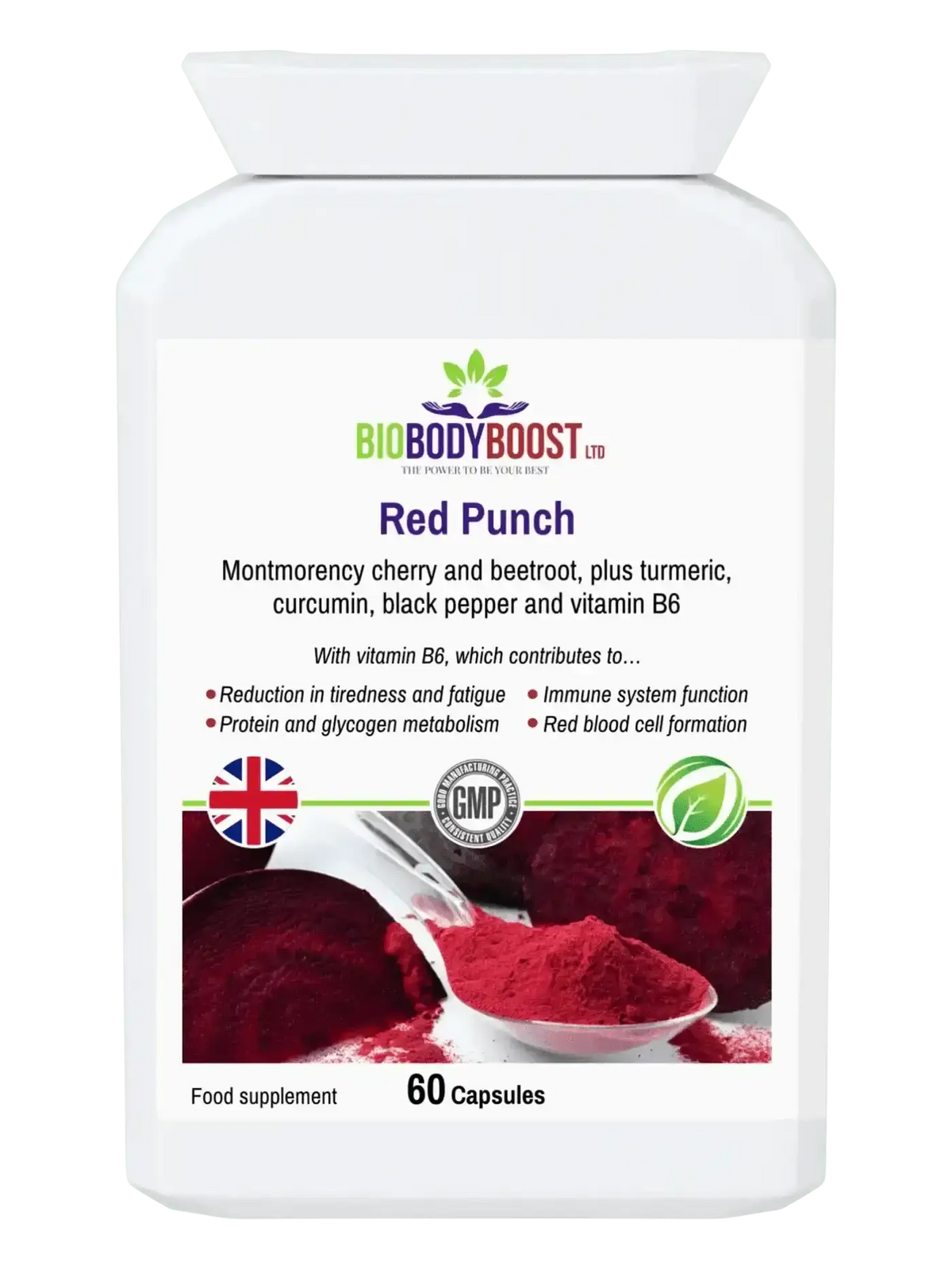
Red Punch: 4,500mg of beetroot and Montmorency cherry
Red Punch provides 2,250mg beetroot equivalent (Beta vulgaris — one of the richest natural dietary nitrate sources) plus 2,250mg Montmorency tart cherry (anthocyanins for additional anti-inflammatory and recovery support), with turmeric, black pepper (piperine) and vitamin B6 carrying the EU-authorised claims for energy metabolism and tiredness reduction. Halal approved, kosher approved, vegan, HPMC capsule, UK manufactured.
The Montmorency cherry addition is specifically relevant for the over-45 audience: a 2010 study in the Scandinavian Journal of Medicine and Science in Sports found Montmorency cherry supplementation significantly reduced muscle soreness and markers of muscle damage after intense exercise in middle-aged recreational athletes — the recovery application that complements the mitochondrial efficiency angle.
Return to the full mitochondria and aging guide.
How do beetroot supplements improve energy?
Beetroot’s dietary nitrates are converted to nitric oxide in the body via the nitrate-nitrite-NO pathway. NO modulates cytochrome c oxidase (Complex IV of the mitochondrial electron transport chain), reducing the oxygen cost of ATP production — meaning the same energy output requires less mitochondrial oxygen consumption. A 2009 Journal of Applied Physiology study found this reduced oxygen cost of exercise by approximately 19% in trained cyclists. This is not a stimulant effect — it is a genuine improvement in mitochondrial efficiency. Separately, NO is the primary endogenous vasodilator, improving blood flow and oxygen delivery to working muscle and heart tissue.
When should I take beetroot supplements for mitochondrial benefits?
For exercise performance: 2–3 hours before exercise, which matches the time for nitrate-nitrite-NO conversion to reach peak plasma nitrite. For general cardiovascular and mitochondrial support: any consistent daily time. The 2013 Hypertension meta-analysis showing blood pressure reductions used regular daily supplementation regardless of exercise timing. Red Punch provides 2,250mg beetroot equivalent per capsule — 1–3 capsules daily as required. Athletes may take closer to exercise; non-athletes benefit from consistent daily intake.
Is beetroot supplement as effective as beetroot juice?
Quality concentrated beetroot extract in capsules can deliver equivalent nitrate content to beetroot shots — the active compound (dietary nitrate) is the same regardless of format. The key variable is the declared nitrate content or equivalent weight. Red Punch provides 2,250mg beetroot equivalent as extract per capsule, which is consistent with meaningful dietary nitrate delivery at 1–3 capsules/day. Beetroot shots (e.g. Beet It Sport) provide a measured nitrate dose in liquid — effective but require drinking and have a strong taste. Capsule format is more consistent and convenient for daily use.