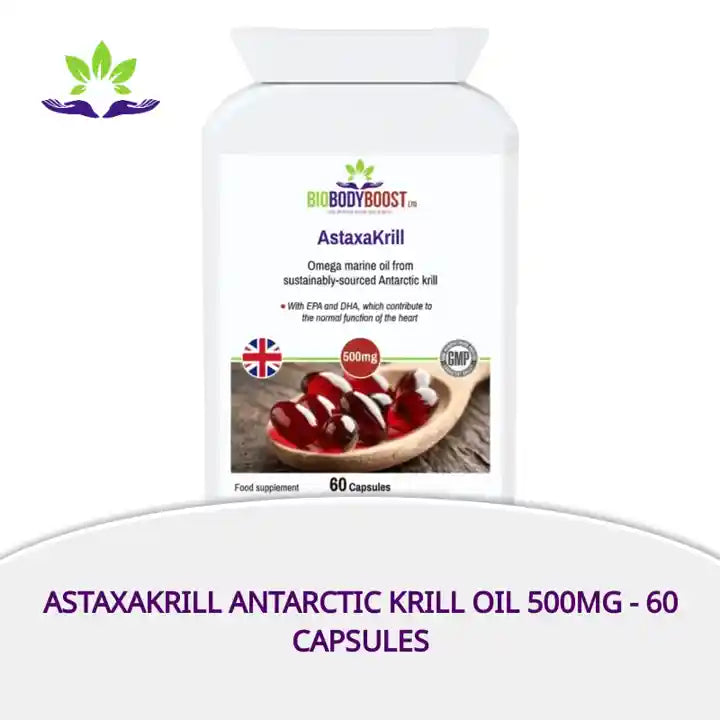
Most omega-3 supplements are fish oil in triglyceride form. Triglyceride omega-3 is effective — it's well-absorbed when taken with dietary fat and has a robust evidence base for cardiovascular, brain and eye health across decades of clinical research. But it's not the form your cell membranes use. Phospholipids are. Krill oil delivers EPA and DHA pre-attached to a phospholipid backbone — structurally identical to the way omega-3 exists in every cell in your body. AstaxaKrill provides 500mg of sustainably sourced Antarctic krill oil per capsule, with natural astaxanthin included as the antioxidant that both protects the oil and the retina.
Please note: AstaxaKrill contains Antarctic krill (crustacean shellfish). It is not suitable for vegans, vegetarians, those with shellfish allergies, or halal diets. Suitable for pescatarians.
The Case for Phospholipid Omega-3
The absorption debate between krill and fish oil is genuinely unresolved — some studies show higher tissue levels from phospholipid omega-3 at equivalent doses; others show comparable results when fish oil is taken with fat. What isn't debated: krill oil naturally contains astaxanthin (fish oil does not), and krill oil's phospholipid choline content adds a co-benefit for liver and brain function. The EU-authorised DHA brain function and vision claims apply to both sources at adequate doses, making the choice one of form preference and tolerance.
Research published in Lipids found krill oil provided equivalent omega-3 tissue incorporation to fish oil at lower doses — a finding supporting the phospholipid bioavailability advantage, though subsequent research has shown mixed results depending on meal fat content.
Why Competitors Fall Short
Pharmepa Restore (fish oil) — triglyceride form, no astaxanthin. A high-quality EPA-concentrated fish oil but in triglyceride form without the natural astaxanthin that krill provides. No phospholipid choline content. For those specifically wanting the phospholipid form, fish oil is structurally different regardless of quality.
Costco Krill Oil — lower astaxanthin disclosure, no EU health claims cited. Costco's private-label krill oil provides a reasonable formula but with limited transparency on astaxanthin content and standardisation, and doesn't present the EU-authorised DHA health claims prominently in its UK marketing.
Seven Seas Krill Oil — lower dose, no astaxanthin specification. Seven Seas' krill product provides lower EPA+DHA per capsule and doesn't specify astaxanthin content, meaning you may be getting minimal antioxidant protection of the omega-3 alongside.
What's in Every Capsule
EU-authorised health claims (at adequate dose):
-
DHA — EU authorised claim: contributes to maintenance of normal brain function · docosahexaenoic acid makes up 60% of the brain’s fat content · essential structural component of neuronal cell membranes
-
DHA — EU authorised claim: contributes to maintenance of normal vision · DHA makes up 40% of the polyunsaturated fat in the retina · essential for photoreceptor function
-
EPA + DHA — EU authorised claim: contribute to normal function of the heart · cardiovascular protective omega-3 fatty acids
Krill oil complex:
-
Antarctic krill oil — 500mg · Euphausia superba · sustainably harvested under CCAMLR regulations · EPA and DHA in phospholipid form · phospholipid backbone identical to human cell membrane structure
-
Natural astaxanthin — from krill · carotenoid antioxidant · naturally present in Antarctic krill giving their characteristic red-pink colour · protects omega-3 phospholipids from oxidation · antioxidant ORAC value many times that of vitamin E · accumulates in the retina and skin
-
Phospholipid choline — naturally present · choline is the head group of phosphatidylcholine · essential for liver fat metabolism and brain neurotransmitter synthesis · not naturally present in fish oil triglycerides
60 softgel capsules. Packed in the UK. Not suitable for: vegans, vegetarians, shellfish allergy, halal diets.
AstaxaKrill: ✓ Phospholipid omega-3 · ✓ Natural astaxanthin · ✓ No fishy aftertaste · ✓ Sustainably sourced krill · ✓ UK packed · ⚠️ Contains shellfish · ⚠️ Not halal
AstaxaKrill vs the Competition
|
AstaxaKrill
BioBodyBoost · £17.99
|
Pharmepa Restore
~£24.99
|
Seven Seas Krill
~£14.99
|
Costco Krill
~£19
|
| Phospholipid omega-3 form |
✓ Krill |
Triglyceride ✗ |
✓ Krill |
✓ Krill |
| Natural astaxanthin included |
✓ Specified |
✗ Not present |
Not specified |
Not specified |
| Krill per capsule |
500mg ✓ |
N/A (fish) |
~200mg ✗ |
500mg |
| No fishy aftertaste |
✓ Yes |
Varies |
Varies |
Varies |
| Price for 60 caps |
£17.99 ✓ |
£24.99 ✗ |
£14.99 |
£19 |
Based on publicly available product information. Prices approximate. Always verify current specs on manufacturer websites.
How to Take It
Take 1–2 capsules daily with food containing dietary fat (omega-3 is fat-soluble and absorbs best with a meal). For brain and vision maintenance, consistent daily intake over months provides the best long-term outcomes. For cardiovascular support, EPA+DHA at the doses provided within AstaxaKrill contribute to the EU-authorised heart claim at adequate daily intake.
For those who want a halal-certified or vegan omega-3 supplement, OmegaBalance provides EPA and DHA alongside omega-6 and omega-9 in a fully halal certified, vegan-friendly formula. AstaxaKrill is specifically for pescatarians wanting the phospholipid krill format with natural astaxanthin.
Is This You?
- You're a pescatarian who wants the phospholipid krill oil format rather than standard fish oil triglycerides
- You want natural astaxanthin as part of your omega-3 supplement without needing a separate astaxanthin capsule
- You've tried fish oil and experienced repeat burping or fishy aftertaste — krill's natural stability means lower oxidation and less odour
- You want the phospholipid choline content of krill alongside your omega-3 for the liver co-benefit
Explore the full Vitamins & Minerals and Immunity UK collections, or see OmegaBalance for the halal-certified vegan omega-3 alternative.
Questions We Get Asked
Is krill oil better than fish oil?
The honest answer is: it depends on what you're comparing and for whom. Krill oil delivers omega-3 in phospholipid form (the same form as in human cell membranes), contains natural astaxanthin, and includes phospholipid choline — none of which fish oil provides. Some absorption studies show equivalent tissue levels at lower doses from krill. Other well-designed trials show comparable results between the two when fish oil is taken with dietary fat. For pescatarians who tolerate shellfish, krill offers a more complete package. For vegans, vegetarians, or halal consumers, OmegaBalance's fish and seed oils in capsule form is the appropriate choice.
What is astaxanthin?
Astaxanthin is a carotenoid pigment that occurs naturally in krill, algae, salmon and flamingos. It's the compound responsible for the red-pink colour of these organisms. As an antioxidant, it is significantly more potent than vitamin E and is unique in being able to cross both the blood-brain barrier and the blood-retinal barrier — making it relevant for brain and eye antioxidant protection alongside its role in protecting the krill oil from oxidation. Natural astaxanthin from krill is the most bioavailable form.
Is krill sustainably sourced?
Antarctic krill (Euphausia superba) is one of the most abundant biomasses on Earth, estimated at 300–500 million tonnes. Krill harvesting is regulated by CCAMLR (the Commission for the Conservation of Antarctic Marine Living Resources) which sets precautionary catch limits well below sustainable yield thresholds. AstaxaKrill uses krill oil from suppliers adhering to responsible harvesting protocols. The krill fishery is consistently rated as one of the most sustainably managed marine harvests in the world.
Can I take this with BioEyeNourish?
Yes — they complement each other well. BioEyeNourish provides lutein, zeaxanthin and zinc for macular pigment and the EU-authorised zinc vision claim. AstaxaKrill provides DHA for the retina's structural omega-3 requirement and astaxanthin for retinal antioxidant protection. Together they cover the structural, macular pigment and antioxidant dimensions of eye health nutrition.
Food supplements should not replace a varied diet or healthy lifestyle. Contains crustacean shellfish (krill). Not suitable for people with shellfish allergies, vegans, vegetarians, or halal diets. Consult your GP before use if pregnant, breastfeeding, or taking anticoagulant medication.