Adaptogens are natural compounds — primarily plant roots, mushrooms and herbs — that help the body maintain homeostasis under stress by modulating the hypothalamic-pituitary-adrenal (HPA) axis. The term was coined by Soviet pharmacologist Nikolai Lazarev in 1947 to describe compounds that increase non-specific resistance to stress without major side effects or disruption to normal function. Not every plant sold as an adaptogen meets the scientific criteria for this classification.
What Exactly Makes a Plant an Adaptogen?
To qualify as a true adaptogen, a compound must meet three criteria established in the scientific literature:
- Non-specific response — it must increase resistance to multiple types of stress (physical, chemical, biological) not just one specific stressor
- Normalising effect — it must move the body toward a state of balance regardless of the direction of imbalance — reducing excessive stress response when cortisol is high, or supporting energy when it is low
- Harmlessness — it must be safe at clinically relevant doses with minimal or no side effects
These criteria immediately exclude many plants marketed as adaptogens. Stimulants like guarana don't qualify — they only push in one direction. Sedatives don't qualify — they suppress rather than normalise. True adaptogens have bidirectional, balancing effects.
How Do Adaptogens Actually Work in the Body?
The primary mechanism of the most researched adaptogens is modulation of the HPA axis — the hormonal cascade that produces cortisol in response to stress. Chronic stress keeps this cascade overactivated, producing persistently elevated cortisol that disrupts sleep, cognitive function, immune response and energy metabolism.
Adaptogens work at multiple points in this system:
- Hypothalamus level — reducing CRH (corticotropin-releasing hormone) secretion that initiates the stress cascade
- Adrenal level — modulating cortisol and adrenaline production in response to stress signals
- Cellular level — upregulating heat shock proteins that protect cells from stress-induced damage
- Mitochondrial level — several adaptogens (notably rhodiola) enhance mitochondrial energy production, directly addressing the fatigue component of stress
Which Adaptogens Have the Strongest Clinical Evidence?
Ashwagandha (Withania somnifera) — strongest evidence
Ashwagandha has the most extensive RCT evidence of any adaptogen. A 2026 meta-analysis of 22 randomised controlled trials (n=1,391) found ashwagandha significantly reduced serum cortisol by approximately 27.9% versus placebo, and significantly improved anxiety scores, sleep quality and self-reported wellbeing. The World Federation of Societies of Biological Psychiatry (WFSBP) and the Canadian Network for Mood and Anxiety Treatments (CANMAT) have provisionally recommended it for generalised anxiety disorder. Active compounds: withanolides. Effective dose: 300–600mg standardised extract (≥5% withanolides) daily.
Rhodiola rosea — strong evidence for fatigue and mental performance
Rhodiola's primary evidence base is for mental fatigue, burnout and cognitive performance under stress rather than cortisol reduction. Multiple RCTs confirm significant improvements in mental fatigue, work performance and mood in stressed professional populations. Its mechanism involves AMPK activation (energy sensing pathway) and monoamine oxidase inhibition (serotonin and dopamine modulation). Active compounds: rosavins and salidroside. Effective dose: 200–600mg standardised extract (3% rosavins, 1% salidroside) daily.
Panax ginseng — good evidence for physical and cognitive performance
One of the most researched medicinal plants in existence. Evidence supports improvement in physical endurance, working memory and reaction time. The ginsenoside compounds support mitochondrial energy production and modulate the immune and stress response. Effective dose: 200–400mg standardised extract (5–7% ginsenosides) daily.
Maca root (Lepidium meyenii) — moderate evidence, specific effects
Maca root has reasonable evidence for energy, libido and hormonal symptom reduction in perimenopausal women, but its mechanism is less well characterised than ashwagandha or rhodiola. It is often classified as an adaptogen but some researchers consider it a nutritive tonic rather than a true adaptogen. Effective dose: 1,500–3,000mg of maca root powder or equivalent extract daily.
Lion's mane mushroom — strong evidence for cognition, different mechanism
Lion's mane is technically a functional mushroom rather than a classical adaptogen, but is often included in adaptogen formulas due to its stress-modifying effects. Its mechanism is distinct — it stimulates Nerve Growth Factor (NGF) synthesis rather than modulating the HPA axis. Strong evidence for cognitive function and mood in multiple clinical trials. Effective dose: 750mg+ whole fruiting body extract daily.
Which Adaptogens Should Be Avoided or Treated With Caution?
- Ashwagandha and thyroid conditions — ashwagandha can increase T3 and T4 thyroid hormone levels. People with hyperthyroidism or on thyroid medication should consult their GP before use.
- Ashwagandha and pregnancy — avoid during pregnancy. Some withanolides have uterine stimulant effects at high doses.
- Licorice root — sometimes marketed as an adaptogen but does not meet scientific criteria, and high doses raise blood pressure.
- Eleuthero (Siberian ginseng) — less evidence than Panax ginseng; frequently substituted in lower-quality products.
Can You Take Multiple Adaptogens Together?
Yes — and this is actually the rationale behind multi-adaptogen formulas. Ashwagandha and rhodiola target different aspects of the stress response (HPA axis cortisol vs mitochondrial energy and monoamine modulation) and have complementary rather than competing mechanisms. Clinical evidence supports their concurrent use. The combination addresses both the hormonal stress response and the cognitive/fatigue dimension simultaneously.
How Long Do Adaptogens Take to Work?
Adaptogens are not acutely acting supplements — they work through gradual rebalancing of the HPA axis and cellular stress response. Realistic timelines: initial effects (sleep, muscle tension) 2–4 weeks; primary stress and cortisol effects 4–8 weeks; peak cognitive and energy benefits 8–12 weeks. Results require consistent daily dosing.
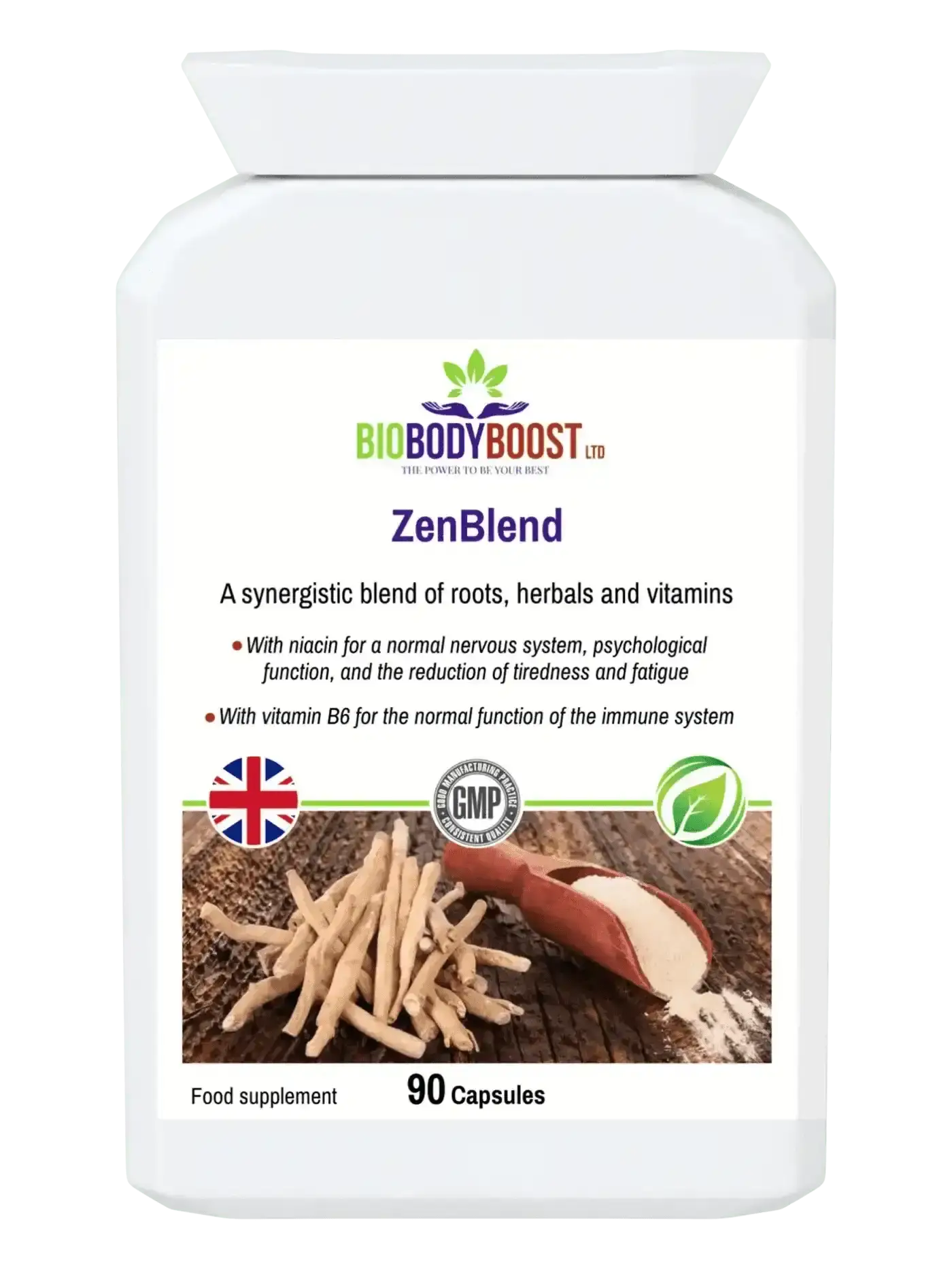
ZenBlend by BioBodyBoost combines KSM-66 ashwagandha, rhodiola rosea, panax ginseng, maca and lion's mane in one halal certified, vegan capsule — addressing the HPA axis, mitochondrial energy, cognitive NGF and hormonal balance pathways together. Browse the full range.