Rhodiola rosea searches are up +173% year-on-year in 2026 — one of the fastest-growing supplement categories globally. Used by Soviet cosmonauts, Russian athletes and Scandinavian populations for centuries, rhodiola has a longer documented research history than almost any other adaptogen. The Soviet research programme conducted in the 1960s–1980s produced over 180 studies before Western researchers took notice. Here is the complete honest guide to what the evidence shows.
What Is Rhodiola Rosea?
Rhodiola rosea (also called golden root, roseroot or Arctic root) grows in cold, high-altitude rocky regions — including Siberia, Scandinavia, Iceland, Alaska and British Columbia. The root has been used in Ayurvedic, Chinese and traditional Russian medicine for fatigue, improving work capacity, reducing altitude sickness and combating harsh environmental stress. The Soviet military and space programme conducted extensive research in the 1960s–1980s, giving rhodiola one of the longest scientific study histories of any adaptogen.
What Are Rhodiola’s Active Compounds?
The primary bioactives are two groups of compounds:
- Rosavins (rosavin, rosin, rosarin) — unique to Rhodiola rosea (not found in other Rhodiola species). Standardised extracts specify rosavin percentage — look for 3% rosavins.
- Salidroside (p-tyrosol glucoside) — found in multiple Rhodiola species. Many researchers consider salidroside the primary bioactive for cognitive and adaptogenic effects. Standardised extracts specify 1% salidroside.
Quality products are standardised to 3% rosavins and 1% salidroside — the ratio found in the root naturally and used in most clinical trials.
What Does the Clinical Evidence Show?
Mental fatigue and burnout — strongest evidence
Evidence: Very strong — multiple RCTs and systematic reviews
A landmark 2009 RCT published in the Journal of Alternative and Complementary Medicine found rhodiola extract (170mg daily for 4 weeks) significantly reduced mental fatigue, improved cognitive function and reduced cortisol response to stress in a cohort of stressed physicians. A 2012 RCT found rhodiola significantly improved burnout symptoms in people with stress-related fatigue over 12 weeks. A 2015 clinical trial comparing rhodiola to sertraline (an SSRI antidepressant) for mild-to-moderate depression found comparable efficacy on depression scores with significantly fewer side effects. A systematic review of 11 RCTs confirmed rhodiola significantly reduces mental fatigue across multiple populations.
Physical endurance and exercise performance — good evidence
Soviet sports science research documented significant improvements in endurance performance, time to exhaustion and recovery speed with rhodiola supplementation. Multiple Western trials have confirmed improvements in VO2 max, time trial performance and lactate threshold in cyclists and runners. The mechanism involves improved oxygen utilisation, reduced perceived exertion and enhanced fatty acid oxidation — sparing glycogen during endurance exercise.
Stress response (HPA axis modulation) — strong mechanistic evidence
Like ashwagandha, rhodiola modulates the hypothalamic-pituitary-adrenal (HPA) axis — reducing the cortisol response to psychological and physical stressors. However, rhodiola’s primary mechanism differs from ashwagandha: rhodiola appears to act primarily through monoamine oxidase (MAO) inhibition, increasing serotonin and dopamine availability in the brain under stress, whereas ashwagandha works more directly on cortisol suppression at the adrenal level. The two complement each other and are frequently combined in formulas.
Cognitive performance under stress — good evidence
Multiple trials in students, military recruits and night-shift workers show rhodiola significantly improves cognitive performance, attention, accuracy and working memory specifically under conditions of sleep deprivation, stress and mental fatigue — the conditions where it most distinguishes itself from placebo. Effects on baseline cognitive function in well-rested adults are less dramatic.
Rhodiola vs Ashwagandha: Different Tools for Different Situations
| Factor | Rhodiola Rosea | Ashwagandha |
|---|---|---|
| Primary mechanism | MAO inhibition, serotonin/dopamine support | Cortisol suppression via HPA axis |
| Speed of action | Faster — some acute effects within hours | Slower — cumulative over 4–8 weeks |
| Best for | Acute mental fatigue, endurance performance, night-shift workers, exam period | Chronic stress, anxiety, sleep, testosterone |
| Time of day | Morning or pre-performance — can be stimulating | Evening or anytime — calming |
| Combining both | Synergistic — addresses different stress mechanisms simultaneously | |
Is Rhodiola Halal?
Rhodiola is a plant root extract — inherently halal. The halal compliance check is the capsule (HPMC not gelatine), extraction solvents (should be water/ethanol without alcohol as a final carrier) and any excipients. Full third-party halal certification on the finished product is the cleanest solution.
Dosage and Safety
Clinical trials use 170–680mg daily of standardised extract (3% rosavins, 1% salidroside). Most effective dose: 200–400mg in the morning or 30–60 minutes before a demanding task. Take on an empty stomach or with a small meal. Avoid taking in the evening — rhodiola has mild stimulating properties that may interfere with sleep at higher doses. Rhodiola has an excellent safety profile; mild dizziness and dry mouth are occasionally reported at higher doses. Not recommended during pregnancy due to insufficient data.
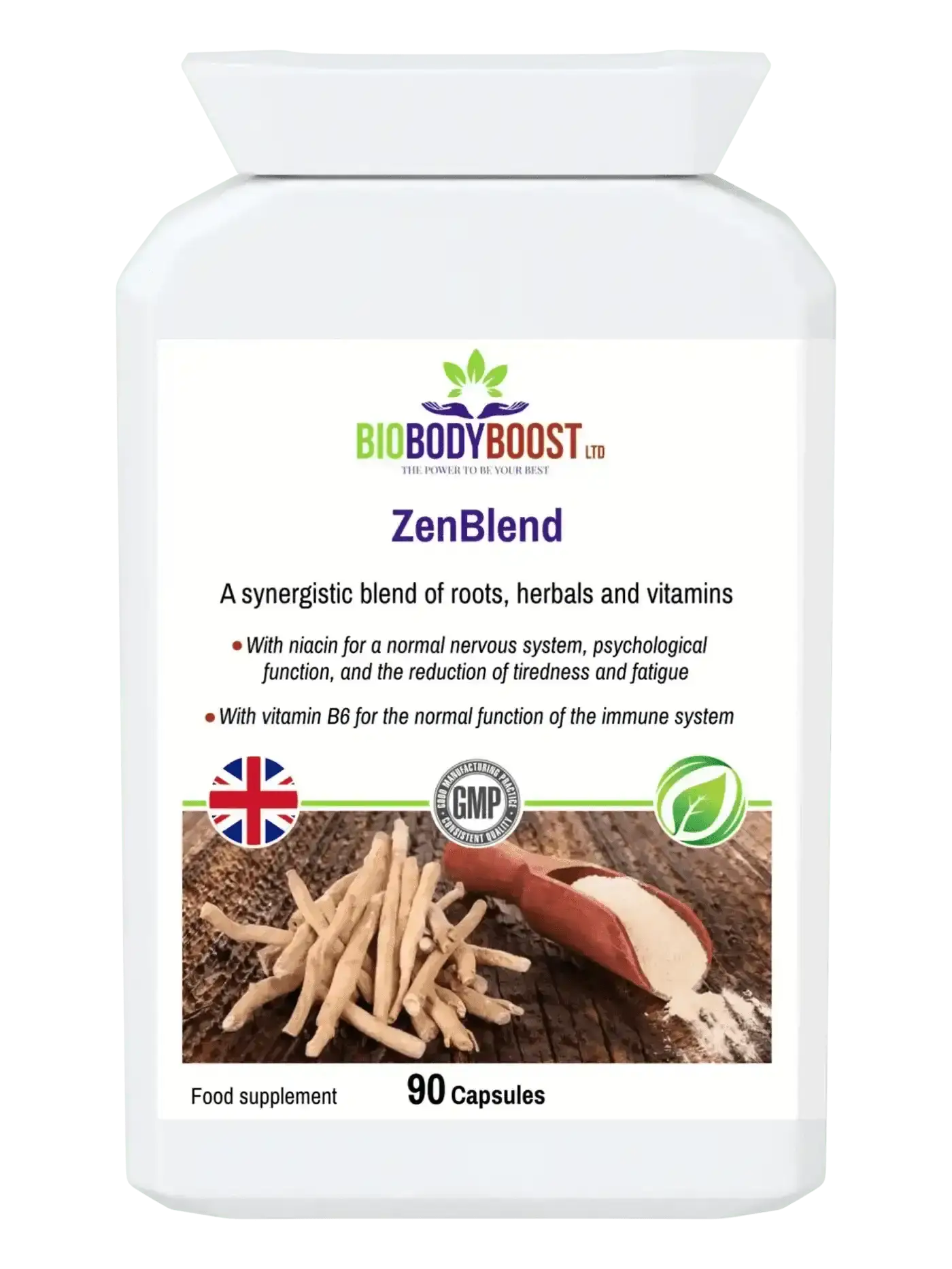
ZenBlend by BioBodyBoost combines KSM-66 ashwagandha with rhodiola rosea extract — addressing both HPA axis cortisol suppression and MAO-mediated serotonin/dopamine support simultaneously. The most complete adaptogen formula in the halal UK supplement market. Browse the full range.