Maca root (Lepidium meyenii) is a Peruvian root vegetable cultivated in the Andes at altitudes above 4,000 metres. It has genuine clinical evidence for improving energy, libido (in both sexes) and menopausal symptom scores — but limited evidence for directly modifying hormonal blood levels, which is the claim most often made for it. Understanding what maca actually does versus what it is marketed to do is essential for setting realistic expectations.
What Is Maca Root?
Maca is a brassica (related to broccoli and cabbage) grown exclusively in the Junín plateau of the Peruvian Andes. It has been cultivated for over 2,000 years as both a food crop and medicinal plant. The root is dried and ground into a flour or concentrated into extract form. Maca contains glucosinolates, benzylamine alkaloids (macamides), sterols, fatty acids and a range of macronutrients — it is nutritionally dense. The pharmacologically active compounds specific to maca (not found in other brassicas) are the macamides and macaenes, which are thought to produce its adaptogenic effects.
What Does the Evidence Show Maca Actually Does?
Libido and sexual function — strongest evidence
Multiple RCTs confirm maca supplementation significantly improves sexual desire and function in healthy adults and in people with SSRI-induced sexual dysfunction. A 2010 systematic review in BMC Complementary Medicine found consistent improvements in sexual dysfunction scores across four RCTs. Importantly, maca does not appear to work via sex hormone levels (testosterone, oestrogen) — blood hormone levels remain unchanged in most trials. The mechanism is thought to involve central nervous system neurotransmitter modulation rather than hormonal effects.
Energy and physical performance — moderate evidence
Several trials (including a 2009 study in cyclists) found maca supplementation improved endurance performance and reduced time to complete a distance trial. The mechanism involves macamide effects on monoamine oxidase (similar to adaptogens), mitochondrial function and possible AMPK activation — the same energy-sensing pathway activated by exercise and fasting.
Menopausal symptoms — good evidence, specific populations
Multiple trials in perimenopausal and postmenopausal women show maca supplementation significantly reduces psychological menopausal symptom scores (anxiety, depression, cognitive function) and some vasomotor symptoms. Crucially, this occurs without changes in oestrogen, FSH or LH levels — suggesting the mechanism is neurotransmitter-based rather than oestrogenic. This is important for women who cannot take phytoestrogens.
Bone density — emerging evidence
One trial found maca supplementation improved bone density markers in postmenopausal women — a promising finding requiring replication in larger trials.
What Maca Does NOT Do
- It does not raise testosterone — multiple trials confirm no change in testosterone levels. Claims that maca “boosts testosterone” are not supported by clinical evidence.
- It does not directly balance oestrogen — despite the widespread claim, maca does not measurably alter oestrogen, progesterone, FSH or LH in clinical trials.
- It is not a phytoestrogen — unlike soy isoflavones or red clover, maca does not bind oestrogen receptors. This is actually relevant for women who need to avoid phytoestrogens (ER+ breast cancer history).
Maca Colours: Does It Matter?
Maca is sold in three colours — yellow/cream (most common, approximately 60% of harvest), red and black. Small studies suggest different colours have subtly different effects: black maca may have the strongest effects on memory and sperm production; red maca on bone density; yellow maca on general energy and libido. Most commercial supplements use yellow maca. The clinical evidence does not yet strongly support premium pricing for specific colours.
What Is the Effective Dose?
Most clinical trials use 1,500–3,000mg of dried maca root equivalent daily. Studies typically last 8–16 weeks. Maca has an excellent safety profile — it is essentially a food crop and has been eaten in large quantities in the Andes for millennia without documented toxicity.
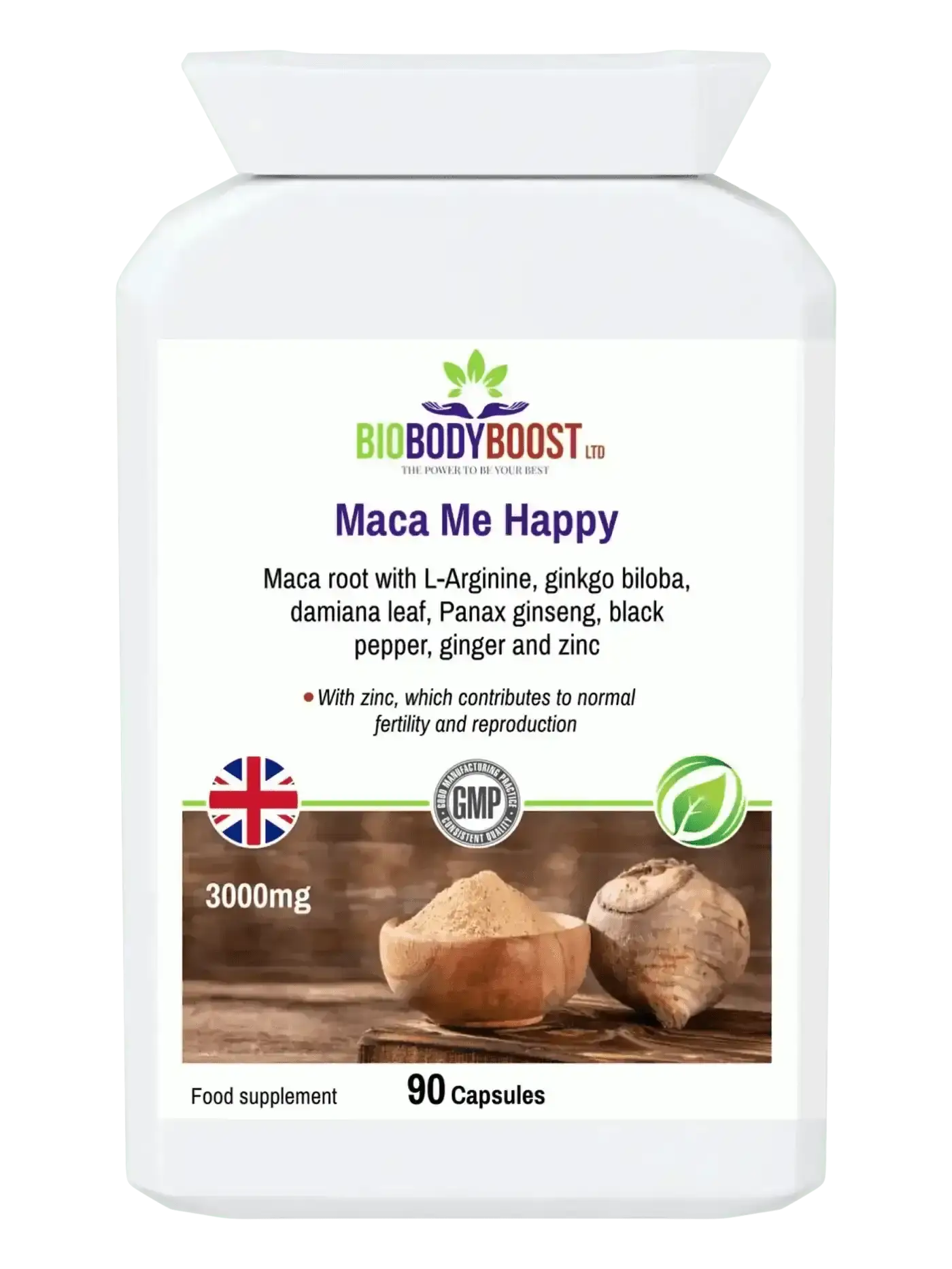
Maca Me Happy by BioBodyBoost — high-potency maca with panax ginseng and ginkgo biloba for comprehensive energy and cognitive support. Halal certified, vegan, UK GMP. BioFem combines maca with black cohosh, sage and ashwagandha for comprehensive perimenopausal support. Browse women’s wellness.