Collagen is one of the most widely asked-about supplement ingredients for halal compliance — and for good reason. Its permissibility depends entirely on source, slaughter method and processing, with different scholarly positions applying to different types. This guide covers the Islamic scholarly framework, the different collagen sources and the practical guidance for UK Muslim consumers.
Why Collagen Requires Halal Checking
Collagen is a structural protein found primarily in the connective tissue, bones, skin and tendons of animals. Unlike plant-derived supplements, collagen inherently comes from an animal source. The halal permissibility of any animal-derived ingredient depends on:
- The species of animal — permissible (halal) or impermissible (haram)
- The method of slaughter — halal (dhabihah) or non-halal
- Whether the specific tissue or compound requires slaughter (or is post-mortem derived)
- Whether processing introduces any non-halal elements
The Four Main Types of Collagen — Halal Status
Bovine collagen (from cattle) — conditionally halal
Cattle are halal animals in Islamic law. Bovine collagen is typically derived from cattle hides and bones. Halal status: conditionally permissible — only if the cattle were slaughtered according to Islamic dhabihah method and the collagen processing does not introduce haram elements.
The critical question for bovine collagen: was the source cattle slaughtered halally? Most conventional bovine collagen comes from cattle slaughtered in conventional (non-halal) abattoirs. Without specific halal certification of the source cattle, bovine collagen cannot be assumed to be halal. Many UK Muslim scholars take the position that bovine collagen from non-halally slaughtered animals is not permissible because the chemical transformation during collagen processing does not constitute complete istihalah (total transformation of substance that some scholars use to permit gelatin from haram sources).
Porcine collagen (from pigs) — haram
Pigs are explicitly prohibited in Islamic law. Porcine collagen is haram regardless of processing or transformation. No scholarly opinion permits porcine collagen as a supplement. Some collagen products do not disclose their source — “collagen” or “hydrolysed collagen” without a stated source should be assumed to potentially be porcine until confirmed otherwise.
Marine collagen (from fish) — generally halal
Halal status: permissible for most scholars — the most straightforward halal collagen option.
Marine collagen is extracted from fish skin and scales. Fish are halal without requiring specific slaughter method in the majority Sunni scholarly position — the Quran permits fish and seafood (Al-Ma’idah 5:96). Marine collagen from permitted fish species (not catfish or other species some scholars restrict) is therefore permissible for most UK Muslims. The halal certification of marine collagen products should confirm the fish species used and confirm no non-halal processing aids.
Marine collagen is predominantly Type I collagen — the same type as in human skin, tendons and bones, and the type with the most clinical evidence for skin, hair and joint benefits.
Chicken collagen — halal with certification
Chicken is a halal animal requiring dhabihah slaughter. Chicken-derived collagen (primarily Type II, found in cartilage) is permissible with halal slaughter certification. Used in some joint health supplements.
The Istihalah Debate on Bovine Collagen
Some Islamic scholars apply the principle of istihalah — that a complete chemical transformation renders a previously impermissible substance permissible (as with some applications of gelatin). Under this view, highly processed bovine collagen from any source might be considered permissible due to complete transformation of the original substance.
However, the majority contemporary UK scholars (including HFA and HMC) do not apply istihalah to bovine collagen and require halal-certified slaughter of source animals. The safest and most widely accepted position for UK Muslims is therefore: marine collagen (Type I) from permitted fish species, or bovine collagen with specific halal certification of the source animals.
What to Check on Any Collagen Product
- Source stated clearly — marine, bovine, chicken, porcine. If unstated, ask.
- For bovine — third-party halal certification of the slaughter and processing, not just the brand’s own claim
- For marine — fish species confirmed; halal certification of the full product
- Capsule shell if capsules used — should be HPMC not gelatine
- Processing aids — no alcohol-based extraction solvents
Why Marine Collagen Is the Recommended Choice for UK Muslims
Marine collagen from certified halal sources provides the best combination of permissibility confidence, clinical evidence (Type I has the most trials for skin and joint outcomes) and practical availability in the UK market. It removes the slaughter certification uncertainty that applies to bovine collagen.
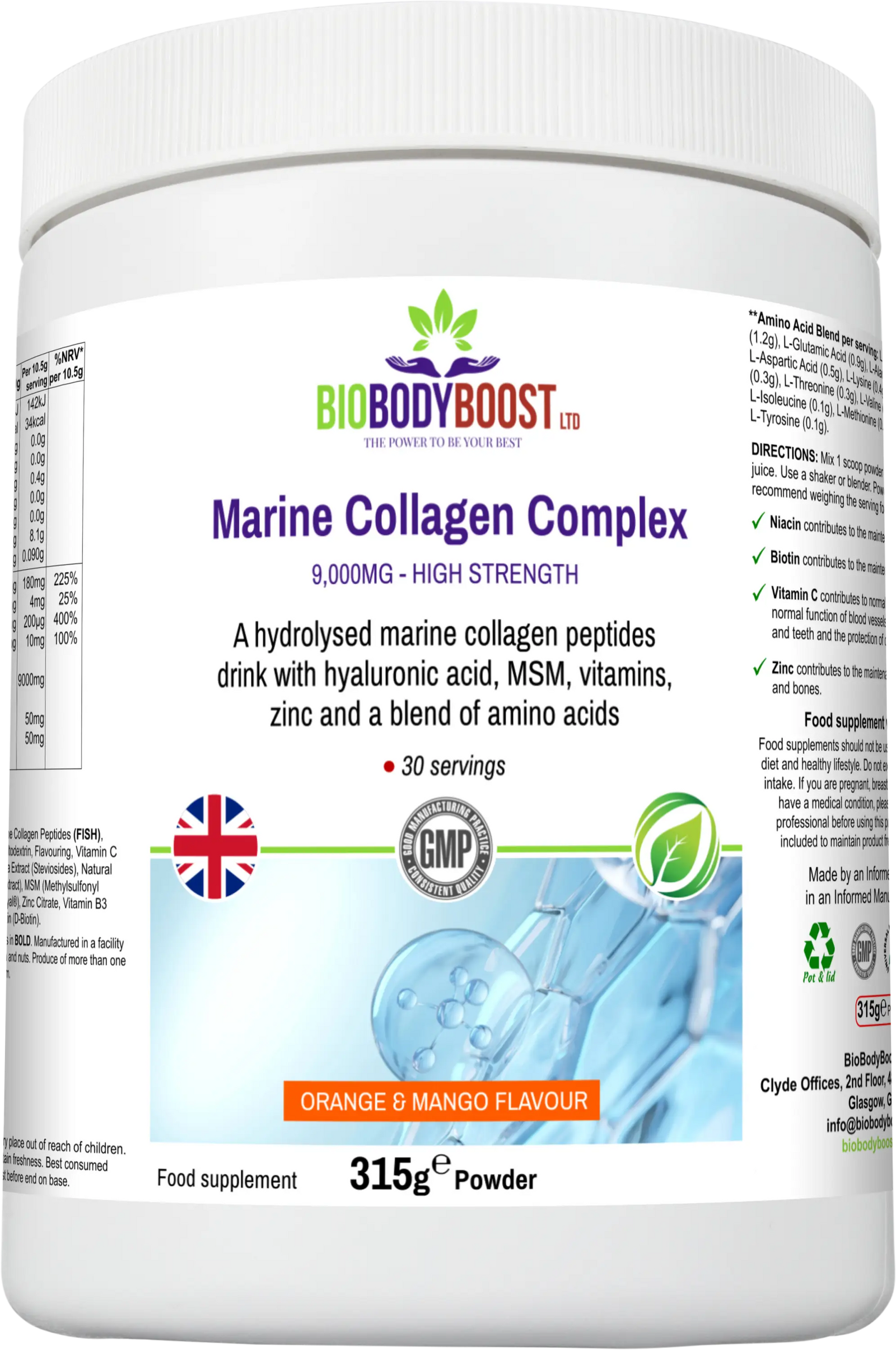
Marine Collagen Nourish by BioBodyBoost uses Type I hydrolysed marine collagen with full halal certification across the entire supply chain — fish source, processing and manufacturing. 9g per serving at the clinical dose. No bovine or porcine derivatives in any ingredient or processing stage. HPMC capsule option. Browse the beauty range.