Quick answer: iodine deficiency is re-emerging as a significant UK public health concern after decades of adequate status. The primary driver is declining dairy consumption — dairy has historically been the UK’s main dietary iodine source. Vegan and plant-based diets, dairy-free eating and reduced dairy intake have created a growing population at risk. UK South Asian communities are disproportionately affected due to lower dairy intake and higher risk of thyroid disorders. Iodine is not optional — it is the raw material for thyroid hormone synthesis. Without adequate iodine, the thyroid cannot produce T3 or T4 at all.
The UK iodine situation
Vanderpump et al. (2011, Lancet) found that UK schoolgirls had mild iodine deficiency as a population — the first evidence in decades that the UK was no longer adequately iodine-sufficient. The British Thyroid Association and the NHS identify iodine as an essential mineral for normal thyroid function, with the UK RNI at 140μg/day for adults. Pregnant women need significantly more (200μg+) due to fetal brain development requirements.
The main UK dietary iodine sources and their vulnerability:
- Dairy milk: the primary UK source — approximately 100–150μg per 500ml. As dairy consumption falls with plant-based diet growth, this source disappears entirely for dairy-free consumers.
- White fish: good iodine source (haddock, cod — approximately 100μg per 100g) but declining in regular consumption.
- Eggs: moderate source (approximately 25μg per egg). Still consumed by most.
- Plant milks: most UK plant milks are not iodine-fortified (unlike in the USA). Oat, almond, soy and rice milks typically contain near-zero iodine. A vegan replacing dairy with plant milk loses their primary iodine source with no replacement.
- Seaweed: highly variable iodine content. Brown seaweeds (kombu, wakame) can contain 1,000–45,000μg per gram — vastly exceeding safe limits. Ascophyllum nodosum (knotted wrack), standardised as a supplement, provides controlled, safe iodine delivery.
Who is most at risk in the UK
- Vegans and plant-based eaters: highest risk. No dairy, often no fish, plant milks not fortified. Without deliberate iodine supplementation, deficiency is likely.
- South Asian community: lower dairy consumption in many households, higher thyroid disease prevalence, higher rate of avoiding iodised salt (which is not widely used in UK cooking in any case).
- Pregnant and breastfeeding women: doubled iodine requirement; fetal brain development depends entirely on maternal thyroid hormone, which requires maternal iodine.
- Women of reproductive age generally: thyroid disease (particularly autoimmune hypothyroidism) is 5–10x more common in women than men. Adequate iodine is foundational.
What iodine deficiency does
Iodine is incorporated into thyroid hormones T3 (triiodothyronine) and T4 (thyroxine) — two iodine atoms in T3, four in T4. Without adequate iodine, the thyroid cannot synthesise normal amounts of these hormones. The pituitary responds by releasing more TSH (thyroid-stimulating hormone) to drive harder production — causing the thyroid to enlarge (goitre) and eventually depleting its hormone output. Even mild iodine insufficiency — below the level causing goitre — reduces T4 production, impairs conversion to T3, and produces subclinical hypothyroid symptoms: fatigue, brain fog, weight gain tendency, cold intolerance, hair thinning.
IoBio — organic seaweed iodine
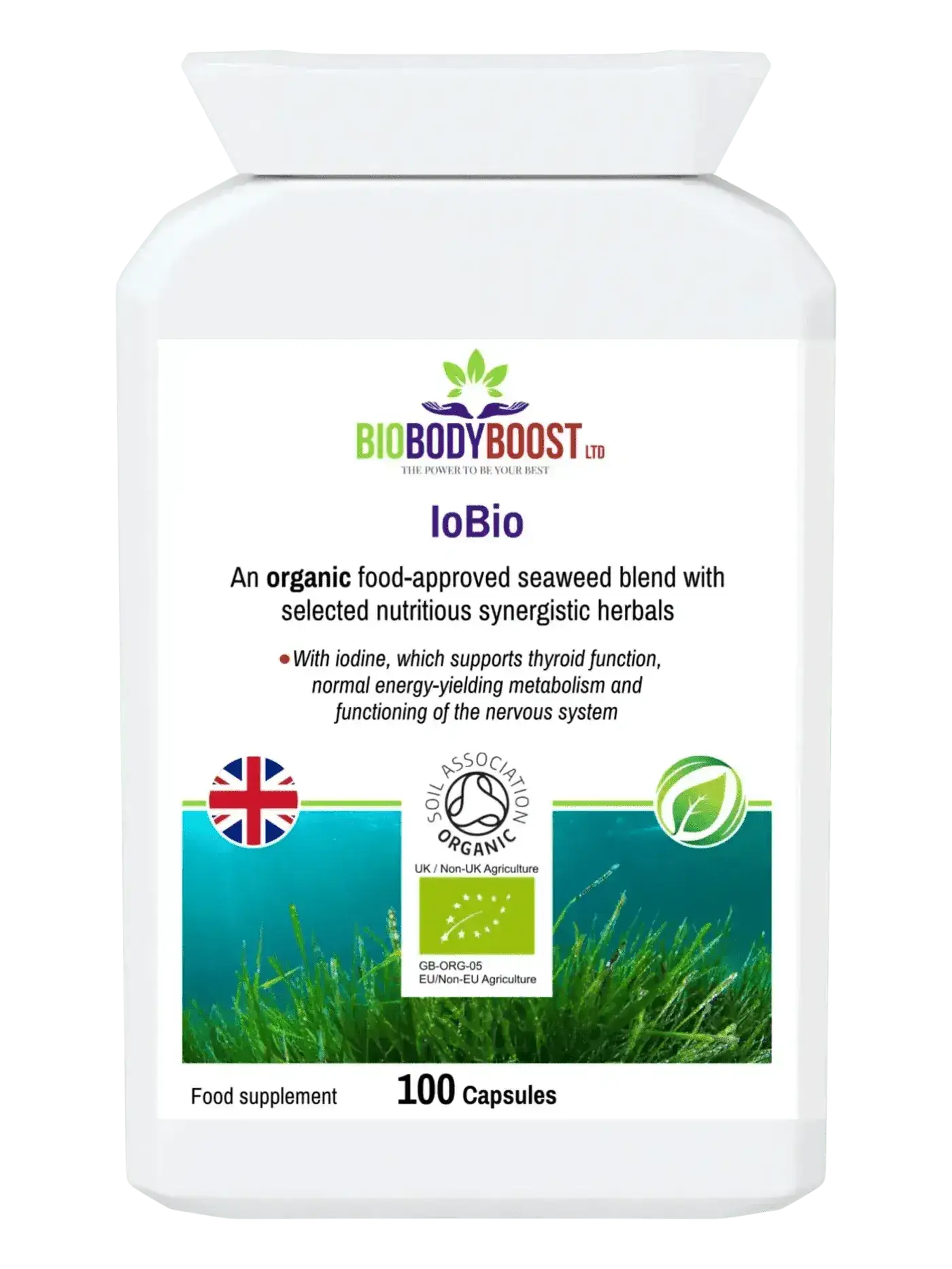
IoBio provides 192μg iodine per serving from certified organic Ascophyllum nodosum (knotted wrack seaweed) — 137% of the UK NRV for iodine. Ascophyllum nodosum is standardised for iodine content, providing a safe, controlled dose without the extreme variability of food-grade seaweed. Also contains kelp, spirulina, chlorella and herb complex. Halal certified, vegan, kosher, HPMC capsule, UK GMP manufactured.
See also: seaweed supplements UK halal guide and thyroid supplements halal UK guide.
Should vegans take iodine supplements UK?
Yes — iodine supplementation is strongly advisable for UK vegans who do not eat dairy or fish and whose plant milks are not iodine-fortified. The NHS identifies iodine as essential for normal thyroid function. Without dairy, fish or fortified plant milk, dietary iodine intake for UK vegans is likely to be well below the 140μg/day RNI. Standardised seaweed extract (Ascophyllum nodosum) providing 150–200μg/day is the most consistent vegan iodine source. Avoid high-dose random seaweed or kelp supplements with unstandardised iodine content — iodine excess (above 500μg/day sustained) can paradoxically impair thyroid function (Wolff-Chaikoff effect).
What are the symptoms of iodine deficiency UK?
Mild to moderate iodine deficiency produces: fatigue and low energy (reduced thyroid hormone), brain fog and slower thinking (T3 is required for neuronal function), weight gain tendency (reduced metabolic rate from low T3), cold intolerance, hair thinning (thyroid hormones regulate hair follicle cycling), and in significant deficiency, thyroid enlargement (goitre). These symptoms overlap with many other conditions — the NHS recommends a GP thyroid function test (TSH, free T4) if you have these symptoms rather than self-diagnosing. Iodine supplementation alongside medical assessment is the appropriate approach.