Key takeaways
- Mix the dose into a small amount of cool or room-temperature food or drink.
- Never add it to hot food or hot milk: heat can kill live cultures.
- Give it at the same time each day, and make sure it is all eaten.
- Under six months, premature, or unwell? Ask your health visitor or GP first.
In this guide
Children's probiotics come as powders, drops or chewables. Parents like powders because they have no sugar and no gelatine, and they disappear into food.
The catch: nobody tells you how to give them. Here is the practical guide.
Before you start
The NHS does not routinely recommend probiotics for healthy children. It does recommend vitamin drops with vitamins A, C and D from six months to five years, unless your child drinks more than 500ml of formula a day (NHS: vitamins for children). Cover that first.
Talk to your health visitor, GP or pharmacist first if your child is under six months, was born prematurely, has a weakened immune system, is seriously unwell, or has a central line or other medical device.
The NHS explains what is and is not known about probiotics on its probiotics page.
What to mix it into, by age
| Age | Good options | Tip |
|---|---|---|
| 6 to 12 months | Fruit or veg puree, plain yoghurt, cooled baby porridge | Mix into the first spoonful |
| 1 to 3 years | Yoghurt, smoothie, cool milk in a cup, mashed banana | Use a portion they always finish |
| 4 years and up | Water, juice, cereal with cold milk, yoghurt | Let them stir it in themselves |
The five rules that make it work
- Keep it cool. Wait until food is lukewarm or cold. Never add to a hot bottle.
- Use a small portion. One or two spoonfuls, so the whole dose goes in.
- Serve straight away. Do not leave it sitting for hours.
- Same time every day. Linking it to breakfast makes it easy.
- Follow the label dose. Use the scoop provided; do not exceed it.

Fussy eater tricks
- Choose a tasteless powder, so there is nothing to notice.
- Stir thoroughly so there are no visible specks.
- Use a food they already love, not a new one.
- Do not make a fuss. If it looks like medicine, refusal is more likely.
Travel, nursery and storage
Shelf-stable powders that need no fridge are easier for holidays, grandparents and nursery bags. Keep the lid tight, store cool and dry, and check the best-before date.
The halal and vegan check
Many children's supplements are gummies, which often contain gelatine, usually from pork or non-halal beef, plus added sugar.
Powders avoid gelatine, but still check the culture medium and added ingredients. See are probiotics halal? and halal children's vitamins.
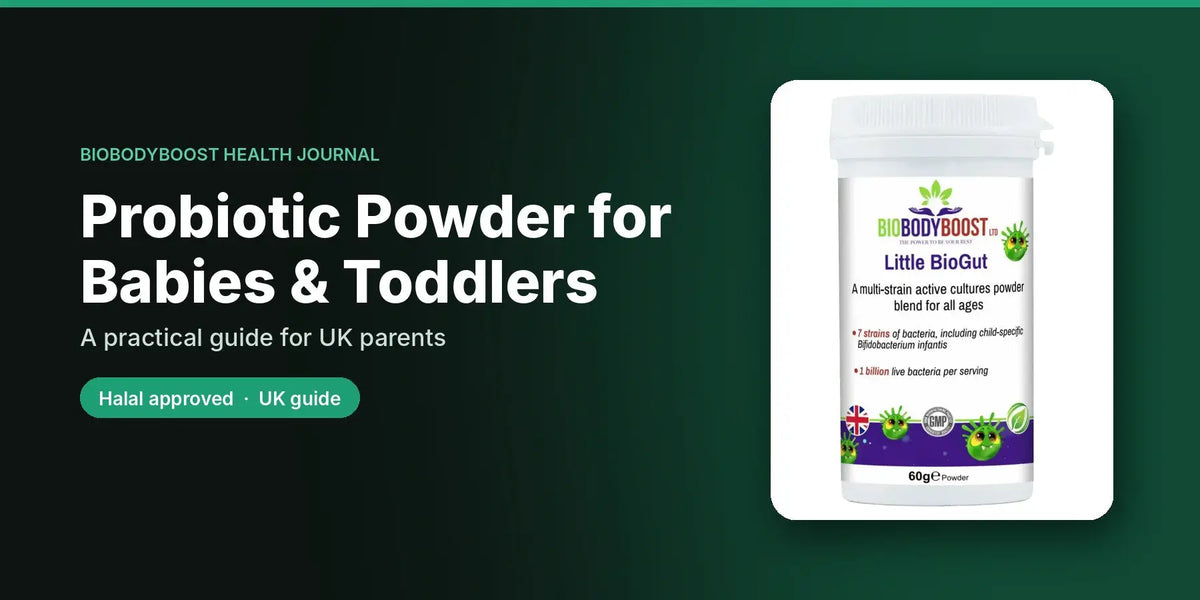
A halal approved kids' probiotic powder

Vegan · Halal & kosher approved
Little BioGut Kids Probiotic Powder
- 7 strains, 1 billion CFU per 1g, including B. infantis, plus FOS
- Tasteless, no sugar, no artificial flavours or colours
- No refrigeration needed
HALAL10 10% off your first order
Shop Little BioGut →The supplier states it is suitable from birth. As above, speak to your health visitor first for babies under six months.
Questions parents ask
Can I put probiotic powder in my baby's bottle?
Only if the milk is cool or room temperature, never hot. Mixing into a small amount first makes sure the full dose is taken.
Can I mix probiotic powder with hot food?
No. Heat can kill live cultures. Let food cool to lukewarm or cold first.
What time of day should children take probiotics?
Whatever is easiest to remember. Breakfast works for most families.
Do probiotic powders need to be kept in the fridge?
It depends on the product. Little BioGut is shelf-stable and needs no fridge.
Is Little BioGut halal?
Yes, halal and kosher approved and vegan, with no gelatine and no added sugar.
Sources: NHS: vitamins for children · NHS: probiotics
General information, not medical advice. Food supplements should not replace a varied diet and healthy lifestyle. Keep out of reach of children. Speak to your health visitor, GP or pharmacist before giving supplements to a baby or a child who is unwell or has a medical condition.