Greens powder supplements — dense blends of dried vegetables, algae, grasses, probiotics and botanicals — are one of the fastest-growing supplement categories globally. AG1 (Athletic Greens) dominates the UK market at approximately £79 per month. The honest assessment: greens powders provide real nutritional value for people with poor vegetable intake, but do not replace whole vegetables, and the clinical evidence for any specific health benefit is limited compared to their price points. Here is what they actually contain and who genuinely benefits.
\n\nWhat Do Greens Powders Typically Contain?
\nMost greens powders include some combination of:
\n- \n
- \nDried algae — spirulina and chlorella, providing protein, chlorophyll, B vitamins and antioxidant pigments (phycocyanin in spirulina) \n
- \nGrasses — wheat grass, barley grass, providing chlorophyll and trace minerals \n
- \nDried vegetables and fruit extracts — concentrating polyphenols and micronutrients \n
- \nProbiotics — typically 1–5 billion CFU of one or two bacterial strains \n
- \nDigestive enzymes — amylase, protease, lipase \n
- \nAdaptogens and botanicals — ashwagandha, rhodiola, ginseng \n
- \nVitamins and minerals — often at low doses as part of the whole-food matrix \n
What Does the Evidence Actually Show?
\nFor spirulina specifically — good evidence for its own benefits
\nSpirulina (Arthrospira platensis) has the most independent clinical evidence of any greens powder ingredient. Multiple trials confirm: reduction in LDL cholesterol and triglycerides, improvements in blood glucose management, anti-inflammatory effects and antioxidant protection. At the doses used in these trials (1–8g daily), spirulina alone is a worthwhile supplement.
\nFor greens powder blends — limited independent clinical evidence
\nFew RCTs have studied finished greens powder products rather than individual ingredients. One published trial on a greens blend found improvements in antioxidant status and blood pressure. The lack of independent (non-manufacturer-funded) clinical trials on specific products is a transparency limitation of the category.
\nFor vegetable intake equivalence — not supported
\nThe “equivalent to X servings of vegetables” claims on greens powder labels are based on fibre or phytonutrient content comparisons that do not account for the significantly different bioavailability, food matrix effects and fibre content of whole vegetables. A serving of greens powder is not nutritionally equivalent to a portion of vegetables — it is a complementary addition, not a substitute.
\n\nWho Actually Benefits From Greens Powders?
\n- \n
- People who consistently eat fewer than 3 portions of vegetables daily — the phytonutrient density is a genuine addition to a poor base diet \n
- People who want spirulina’s specific benefits (cholesterol, antioxidant) in a convenient format \n
- Athletes with high micronutrient requirements from training \n
- Travellers whose diet quality drops significantly when away from home \n
Who Does NOT Need a Greens Powder?
\n- \n
- People already eating 5+ portions of varied vegetables and fruit daily \n
- Anyone expecting greens powders to replace a poor diet — the research does not support this \n
- People whose primary goal is gut microbiome support — a dedicated probiotic and prebiotic fibre supplement has far more evidence at lower cost \n
AG1 at £79/Month vs Alternatives
\nAG1 contains 75 ingredients in a proprietary blend at an undisclosed dose per ingredient. The proprietary blend means individual ingredient doses are not disclosed. At £79/month, it is the most expensive greens powder on the UK market. Alternatives at significantly lower price points provide comparable or better ingredient transparency. The AG1 marketing is sophisticated; the formula itself is a high-quality product but not uniquely superior to well-formulated alternatives. We've ranked the best options — cheaper, halal and dose-transparent — in our full guide to AG1 alternatives UK.
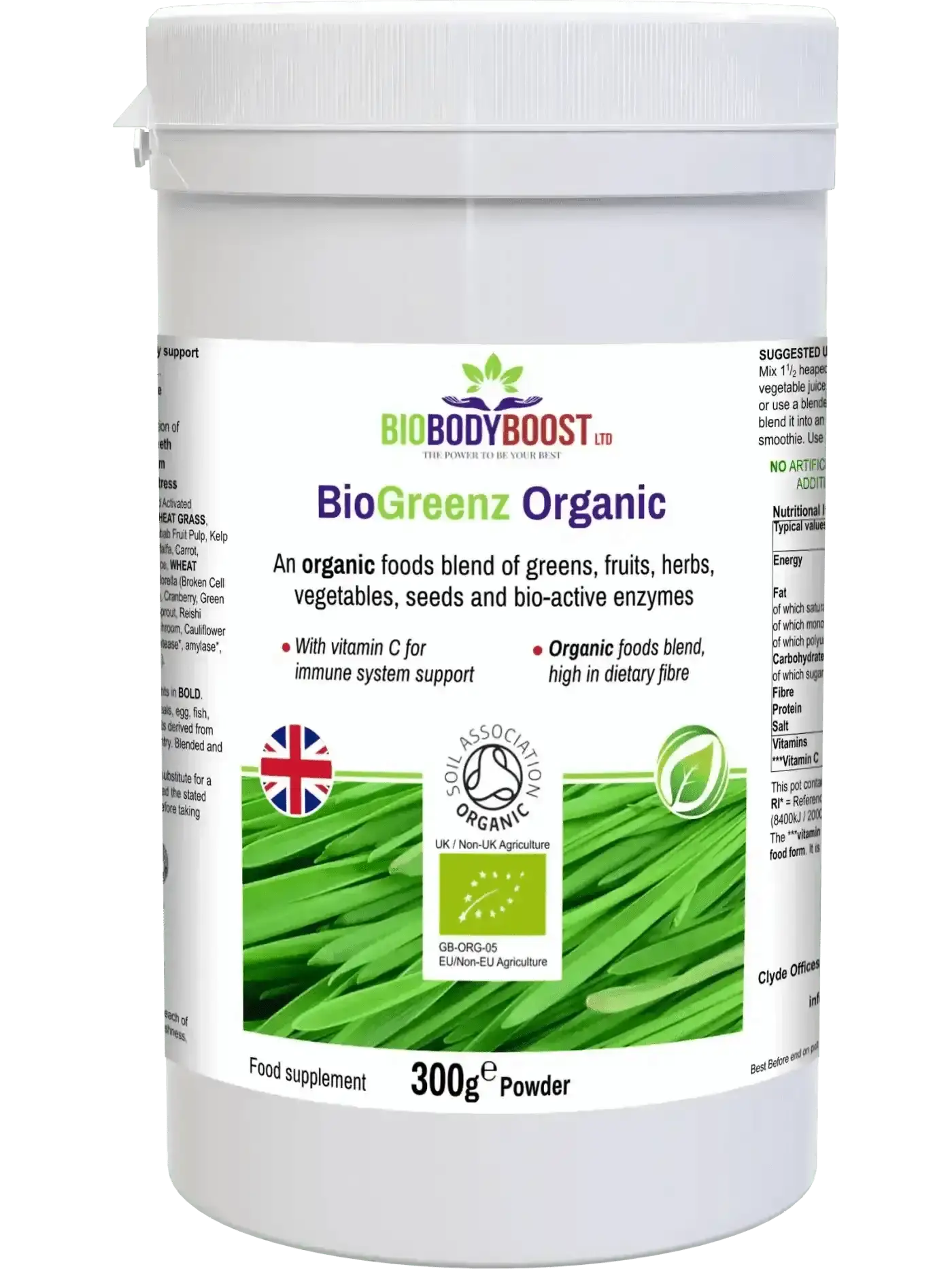
\n\nBioGreenz by BioBodyBoost combines 35 organic superfoods including spirulina, chlorella, wheatgrass and probiotics — at a fraction of AG1’s price. Full ingredient transparency. Halal certified, vegan, UK GMP. SuperBio provides the same organic greens blend in convenient capsule format — see our capsules vs powder comparison. Browse the full range.