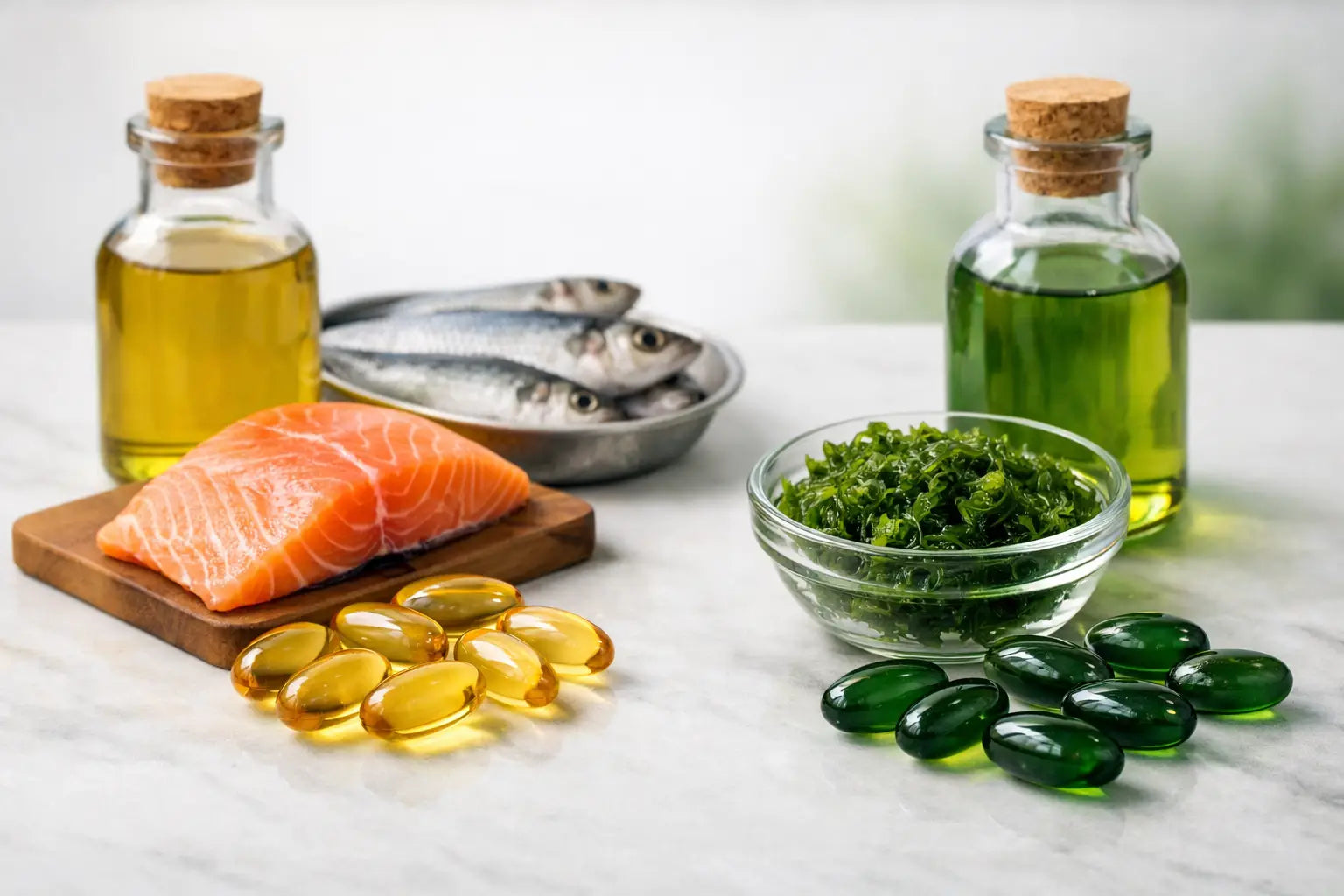
Quick answer: for DHA specifically, algae oil is equivalent to fish oil — it is the original source fish accumulate DHA from. For EPA, concentrated fish oil typically delivers more per capsule. At adequate doses of both EPA and DHA, the health outcomes are the same regardless of source. Algae oil is the only genuinely vegan option. Fish oil is typically cheaper per mg of omega-3.
What EPA and DHA actually do: the EU-authorised claims
Omega-3 marketing often outpaces the actual evidence. The EU-authorised claims (Regulation 432/2012) tell you what doses are required to substantiate specific health benefits:
- Normal heart function: 250mg EPA+DHA combined daily
- Normal brain function: 250mg DHA daily
- Normal vision: 250mg DHA daily
- Maintaining normal blood pressure: 3g EPA+DHA daily
- Maintaining normal blood triglycerides: 2g EPA+DHA daily
These thresholds apply regardless of whether the EPA and DHA come from fish or algae. Source does not change the dose required. A product can legitimately claim heart function support from either source at 250mg combined — and cannot legitimately claim blood pressure support from either source at 500mg.
Where fish get their omega-3: why algae oil is the original source
Fish do not synthesise DHA or EPA themselves. They accumulate these fatty acids by eating microalgae directly (small pelagic fish like anchovies and sardines) or by eating smaller fish that ate algae. Algae oil skips this food chain entirely — it is produced directly from cultivated marine microalgae (typically Schizochytrium or Nannochloropsis species), the same organisms that put omega-3 into fish in the first place.
This has two practical implications: algae oil is the only genuinely vegan source of preformed DHA and EPA (ALA from flaxseed converts to EPA/DHA at less than 5% efficiency in most adults), and it is produced in closed bioreactor systems rather than open-ocean fishing, which has traceability and purity advantages.
Is algae-derived DHA absorbed as well as fish oil DHA?
What research supports: A 1996 RCT in the American Journal of Clinical Nutrition (Arterburn et al.) compared algal DHA to cooked salmon in healthy volunteers and found equivalent increases in plasma and red blood cell DHA levels. A 2008 study in Prostaglandins, Leukotrienes and Essential Fatty Acids confirmed that algal DHA bioequivalence to fish DHA is well-established across multiple populations. The molecule is identical regardless of source.
EPA from algae: Traditional algae oils were DHA-only. Newer strains (particularly Nannochloropsis-derived oils) now deliver meaningful EPA alongside DHA. Check the label for the specific EPA+DHA split — a DHA-only algae oil will not meet the combined EPA+DHA thresholds for blood pressure or triglyceride claims.
Concentration: how much EPA+DHA per capsule?
This is where fish oil typically wins on value. A standard 1g fish oil softgel contains approximately 300mg EPA+DHA (30% concentration). Higher-potency fish oils reach 500–700mg EPA+DHA per capsule. Most algae oil products provide 200–400mg DHA per capsule with variable EPA, often at a higher cost per mg of omega-3 due to cultivation complexity.
Practical check: always compare products by mg of EPA+DHA per serving, not by total oil weight. A "1,000mg omega-3" claim means nothing without knowing the EPA+DHA content — the remaining weight is other fatty acids.
Contaminants: what the evidence shows
Fish accumulate lipophilic (fat-soluble) contaminants from seawater and the food chain — primarily PCBs, dioxins, and methylmercury. Commercial fish oil is refined (molecular distillation) to reduce these below EU maximum residue limits. A 2012 analysis in the Journal of Nutritional Science tested 171 fish oil products and found the majority below regulatory thresholds, though variation existed between products.
Algae oil produced in closed bioreactor systems has negligible exposure to these contaminants — the algae is grown in sterile, controlled medium without ocean water. Third-party batch testing (certificate of analysis) is the meaningful quality signal for both — do not assume clean-label branding means contaminant testing has been done.
Honest limit: Well-refined, third-party-tested fish oil has very low contaminant levels in practice. Algae oil's theoretical contaminant advantage is most meaningful when fish oil quality is unknown or unverified. For reputable brands with published COAs, the practical difference is small.
Fishy aftertaste: why it happens and how each source compares
Fishy aftertaste (and fish oil burps) result from oxidation of the oil — either from heat, light, or oxygen exposure before or after purchase. A fresh, well-stored, high-quality fish oil should have minimal aftertaste. A rancid fish oil — identifiable by a strong fishy or paint-like smell — indicates oxidation and degraded oil quality, and should be discarded.
Algae oil typically has a neutral to mildly nutty taste with no marine aftertaste, because it lacks the TMAO (trimethylamine oxide) compounds that break down to produce fishy odour in fish-derived oils. For people who consistently find fish oil repeats on them despite trying refrigerated or enteric-coated products, algae oil resolves this.
Sustainability
Fish oil relies on the harvest of small pelagic fish (anchovies, sardines, mackerel). Approximately 18–20 million tonnes of these fish are caught annually for fishmeal and fish oil production globally (FAO 2022). Sustainable fishery certification (MSC) exists but coverage is incomplete.
Algae oil is produced in closed bioreactor systems with no fishing pressure, significantly lower land and water use than animal farming, and no bycatch. It has a substantially smaller environmental footprint per gram of DHA produced. This is the clearest practical advantage of algae oil for buyers who weight sustainability in purchasing decisions.
Who should choose which
- Vegan or vegetarian: algae oil is the only option providing preformed DHA and EPA. Flaxseed/hemp/chia provide ALA, which converts at less than 5% to DHA in most adults — not a substitute for preformed omega-3.
- Halal buyers: both can be halal-compliant, but require certification. Fish oil must come from halal-approved fish sources and use halal-certified gelatine (or HPMC) capsules. Algae oil is inherently plant-derived — halal certification of the manufacturing process and capsule is still needed but the source concern is removed.
- Targeting EPA specifically (cardiovascular, anti-inflammatory): concentrated fish oil typically delivers more EPA per capsule. Check algae oil labels for EPA content specifically, not just DHA.
- Targeting DHA specifically (brain, vision, pregnancy): algae oil is as effective as fish oil and is the recommended source during pregnancy for women avoiding fish.
- Fishy aftertaste sensitivity: algae oil. If committed to fish oil, refrigerate capsules and take with food.
- Budget priority: fish oil delivers more EPA+DHA per pound at equivalent quality.
Our OmegaBalance covers omega 3, 6 and 9 from fish, flaxseed and sunflower in one formula — halal approved. For the full three-way comparison including krill oil, see our algae oil vs fish oil vs krill oil guide.
At equivalent EPA+DHA doses, yes. The EU-authorised claim for normal heart function requires 250mg EPA+DHA combined daily — achievable from either source. The cardiovascular evidence base was built primarily on fish oil trials, but mechanistically, the benefit comes from EPA and DHA as molecules, not from fish per se. Multiple trials confirm algal DHA raises blood EPA and DHA levels equivalently to fish-derived sources. The main practical caveat: check your algae oil provides meaningful EPA alongside DHA, since some products are DHA-only. Not reliably. Flaxseed provides ALA (alpha-linolenic acid), which the body can theoretically convert to EPA and DHA. However, conversion efficiency is less than 5% for EPA and less than 0.5% for DHA in most adults, and is further reduced by high omega-6 intake (which competes for the same conversion enzymes). Flaxseed is a useful source of ALA, but it does not reliably maintain blood DHA levels at the thresholds supported by the clinical evidence. Vegans wanting to support brain function, vision, or heart health via the EU-authorised DHA/EPA claims need algae oil — it is the only plant-derived source of preformed DHA and EPA. It depends on your goal. For general health maintenance (heart function, brain, vision): 250mg EPA+DHA combined daily is the EU-authorised minimum. For anti-inflammatory benefit relevant to joint comfort or recovery: most trials use 1.5–3g EPA+DHA daily. For blood pressure support: 3g EPA+DHA daily (EU-authorised threshold). For triglyceride management: 2g EPA+DHA daily. Most standard fish oil or algae oil capsules at 1g total provide 200–350mg EPA+DHA per capsule — check how many capsules are needed to reach your target dose, not just the total oil weight. All omega-3 oils can oxidise over time, including algae oil. However, algae oil typically oxidises more slowly than fish oil because it lacks the TMAO compounds and has a different fatty acid profile. The practical signs of rancidity in any omega-3 oil: a strong fishy, paint-like or unpleasant smell on opening the capsule. Fresh algae oil should smell neutral to mildly earthy. Store all omega-3 oils in a cool, dark place or refrigerate after opening to extend shelf life. Do not take any omega-3 product that smells strongly off — oxidised oil provides no benefit and may be harmful. Algae oil is plant-derived, which removes the fish-sourcing halal concern. For formal halal compliance, what still needs checking is the capsule material (HPMC = halal; standard gelatine may be porcine or bovine — requires halal-certified source) and manufacturing environment. Our OmegaBalance uses halal-approved ingredients — check the current product page for the full halal and allergen statement. Fish oil burps occur when the oil oxidises in the stomach and releases trimethylamine (TMA) compounds — the same molecules responsible for the smell of fish. Higher-quality fish oils with lower oxidation levels cause fewer burps. Enteric-coated capsules delay dissolution until after the stomach, reducing the effect. Algae oil lacks TMA precursors entirely, which is why it rarely causes this problem regardless of quality. If you regularly experience fish oil burps despite trying refrigerated and enteric-coated products, switching to algae oil resolves it.Is algae oil as good as fish oil for heart health?
Can vegans get enough omega-3 from flaxseed?
How much omega-3 per day do I actually need?
Does algae oil go rancid like fish oil?
Is algae oil halal?
Why does fish oil cause burps but algae oil usually doesn't?