Quick answer: magnesium is one of the few supplements with direct RCT evidence for sleep improvement — and it is deficient in approximately 70% of UK adults. The mechanism is not sedation: magnesium blocks NMDA receptors (which drive neural overactivation) and is a required cofactor for the HIOMT enzyme that produces melatonin. Without adequate magnesium, the brain stays more activated at sleep onset and melatonin synthesis is impaired. Magnesium glycinate is the optimal sleep form — it crosses the blood-brain barrier more readily than magnesium oxide or citrate. The evidence-backed dose is 300–400mg elemental magnesium daily, taken 30–60 minutes before bed.
Why magnesium affects sleep — the two mechanisms
1. NMDA receptor modulation
NMDA (N-methyl-D-aspartate) receptors are excitatory glutamate receptors that drive neural activation. Magnesium acts as a physiological NMDA channel blocker — when bound inside the NMDA channel, it physically prevents calcium ions from entering and reduces neural firing. At sleep onset, the brain requires a shift from high-frequency excitatory activity to lower-frequency parasympathetic (rest) dominance. Adequate magnesium supports this shift by blunting NMDA-driven overactivation. Magnesium deficiency results in higher baseline NMDA excitability — the “cannot switch off” pattern that many poor sleepers recognise: mind racing despite body exhaustion.
2. Melatonin synthesis cofactor
Melatonin is synthesised from serotonin via two enzymatic steps. The final step — conversion of N-acetylserotonin to melatonin by hydroxyindole-O-methyltransferase (HIOMT) — requires magnesium as a cofactor. Magnesium deficiency directly impairs HIOMT activity, reducing melatonin output at the pineal gland. This explains why some people experience poor sleep onset (low melatonin) despite adequate darkness and good sleep hygiene: the synthesis enzyme is starved of its mineral cofactor.
The clinical evidence
Abbasi et al. (2012, Journal of Research in Medical Sciences, double-blind RCT, n=46 older adults with insomnia): magnesium supplementation significantly improved sleep efficiency, total sleep time, sleep onset latency and early morning awakening vs placebo, alongside significantly reduced insomnia severity index score. Serum melatonin increased and cortisol decreased significantly in the magnesium group. A 2021 Nutrients systematic review (7 RCTs) confirmed magnesium supplementation significantly improved subjective sleep quality and objective sleep measures in multiple populations.
Which form of magnesium for sleep?
| Form | Absorption | Sleep relevance | GI tolerance |
|---|---|---|---|
| Magnesium glycinate | High | Best — glycine is also a calming neurotransmitter; crosses blood-brain barrier more readily | Excellent |
| Magnesium malate | Good | Good — malate supports Krebs cycle energy but less sleep-specific than glycinate | Good |
| Magnesium taurate | Good | Good — taurine has GABA-mimetic properties adding to the calming effect | Good |
| Magnesium oxide | ~4% | Poor — most is excreted; the pharmacy standard magnesium tablet | Laxative at higher doses |
| Magnesium citrate | Moderate | Moderate — better than oxide, less than glycinate | Laxative at higher doses |
Why glycinate specifically: the glycine component is itself a calming amino acid — a glycine receptor agonist in the spinal cord and brainstem that reduces motor neuron activity. Multiple small trials have found glycine supplementation alone (3g before bed) significantly improved subjective sleep quality. Magnesium glycinate delivers both the magnesium and the glycine calming effect simultaneously.
Dose, timing and what to combine
Dose: 300–400mg elemental magnesium glycinate daily. The Abbasi 2012 RCT used 500mg elemental (as oxide, lower bioavailability) — at glycinate’s higher absorption, 300mg elemental achieves equivalent tissue delivery. Don’t exceed 400mg elemental/day from supplements without medical guidance.
Timing: 30–60 minutes before bed. This aligns with the NMDA receptor calming and melatonin synthesis effects with the optimal sleep onset window.
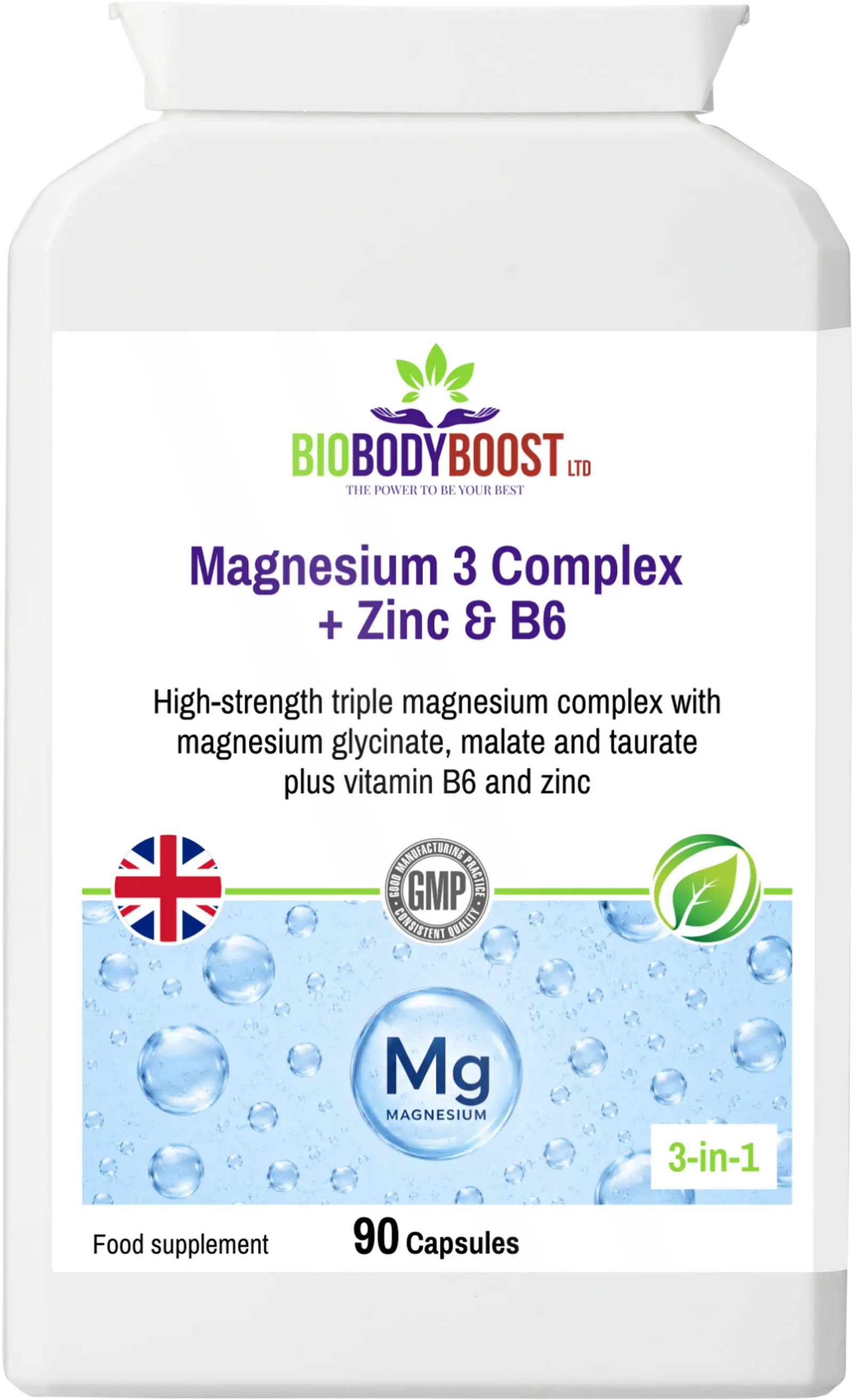
Combine with: For maximum sleep support, pair Magnesium 3 Complex (300mg elemental glycinate + malate + taurate) with BioSnooze (KSM-66 ashwagandha for cortisol + Montmorency cherry for melatonin precursors + passionflower). The stack addresses: magnesium-NMDA mechanism, melatonin synthesis, cortisol-driven evening alertness and botanical calming simultaneously.
Magnesium 3 Complex — 300mg elemental magnesium as glycinate + malate + taurate, zinc 10mg, B6 5mg. Halal certified, vegan, HPMC capsule. BioSnooze — KSM-66 250mg, Montmorency cherry 350mg, passionflower, chamomile, lemon balm. Halal and kosher certified, vegan.
Does magnesium really help you sleep?
Yes — with direct RCT evidence. Abbasi et al. 2012 (Journal of Research in Medical Sciences, n=46): magnesium supplementation significantly improved sleep efficiency, total sleep time, sleep onset latency and insomnia severity index. The mechanisms are specific: NMDA receptor channel blocking quiets neural overactivation at sleep onset; HIOMT enzyme cofactor requirement means magnesium is directly needed for melatonin synthesis. Approximately 70% of UK adults consume below the magnesium RNI — in this population, correcting deficiency is the most direct sleep improvement available without any pharmaceutical. Results are typically noticed within 2–3 weeks of consistent daily supplementation.
How long before bed should I take magnesium?
30–60 minutes before sleep. Magnesium glycinate absorbs well without food, though taking with a light evening snack reduces any mild GI discomfort in sensitive individuals. The NMDA receptor effect and melatonin cofactor activity are not instantaneous — magnesium accumulates in tissue over weeks of consistent use, so “just-in-time” dosing matters less than daily consistency. Most people notice improved sleep quality within 2–3 weeks of daily supplementation, not from the first night.
Is magnesium safe to take every night UK?
Yes — at supplement doses (300–400mg elemental/day). The NHS RNI for magnesium is 270mg/day for adult women and 300mg/day for adult men. Supplemental magnesium at 300–400mg elemental is safe for long-term daily use in healthy adults. Excess magnesium is excreted renally — people with kidney disease should consult a GP before supplementing. The NHS provides guidance on safe magnesium intake levels. Magnesium oxide at very high doses causes diarrhoea (osmotic laxative effect) — magnesium glycinate at therapeutic doses does not have this issue.