If your stomach behaves perfectly until you add dairy — or you simply feel better keeping it out — the supplement aisle gets frustrating fast. Plenty of gut products are built around milk-derived ingredients, or sneak in dairy-based carriers for stability. The result is a familiar loop: you buy something for bloating, and it gives you more bloating.
The good news is that dairy-free gut supplements exist and the evidence for specific strains and doses is strong enough to make an informed choice. This guide covers what actually matters: which strains, at what CFU count, and what honest limitations apply.
Why dairy ends up in probiotics
Dairy ends up in supplements for a few unglamorous reasons: it can act as a filler, a binder, a flavour base, or a protective matrix for sensitive probiotic strains. Some strains are also historically cultured on media that include milk derivatives, even if the final product contains little to no lactose. If you are highly sensitive, or avoiding dairy for religious reasons, that distinction matters — and it is the same reason most probiotics are vegetarian rather than vegan.
Who benefits most from dairy free gut supplements?
Anyone who gets cramps, wind, loose stools, or skin flare-ups after dairy will benefit from avoiding it in supplements too — no point adding a low-level trigger to a product meant to reduce gut symptoms. Dairy-free probiotics are also important for halal buyers, since gelatine capsules (typically bovine or porcine) are standard in many probiotic products.
That said, symptoms after dairy are not always lactose intolerance. Some people react to milk proteins (casein or whey), some are dealing with high-FODMAP food sensitivity, and some have IBS patterns where triggers vary. Removing dairy from your supplements is a sensible filter — not a diagnosis.
Probiotics: what the strain and dose evidence actually shows
Probiotics are not one-size-fits-all. The research is strain-specific — what works for post-antibiotic gut disruption is not the same as what works for IBS-C or traveller diarrhoea. Here is what the evidence shows for the most studied strains:
Lactobacillus acidophilus: A 2012 Cochrane review (Allen et al.) of 63 RCTs found Lactobacillus-containing probiotics reduced antibiotic-associated diarrhoea risk by approximately 42%. Effective doses across trials: 10–20 billion CFU/day.
Bifidobacterium longum: Particularly studied for constipation-predominant IBS. A 2011 RCT in Alimentary Pharmacology and Therapeutics (n=122) found B. longum 35624 at 1 billion CFU/day significantly reduced IBS symptom scores vs placebo at 8 weeks.
Lactobacillus rhamnosus GG (LGG): One of the most clinically validated strains for post-antibiotic recovery. A 2012 meta-analysis in JAMA found LGG reduced Clostridioides difficile-associated diarrhoea risk by 66% when started within 2 days of antibiotics. Effective dose: 10–20 billion CFU/day.
Multi-strain products: Evidence for multi-strain products is mixed — some trials show additive benefit, others show no advantage over single high-quality strains. The key is whether the strains are named and dosed, not just listed as a probiotic blend.
Honest limit: Most trials use specific, often pharmaceutical-grade strains. Consumer products rarely achieve identical strains or manufacturing conditions. CFU counts at time of manufacture also degrade by expiry — look for products guaranteeing CFU at end of shelf life, not just at manufacture.
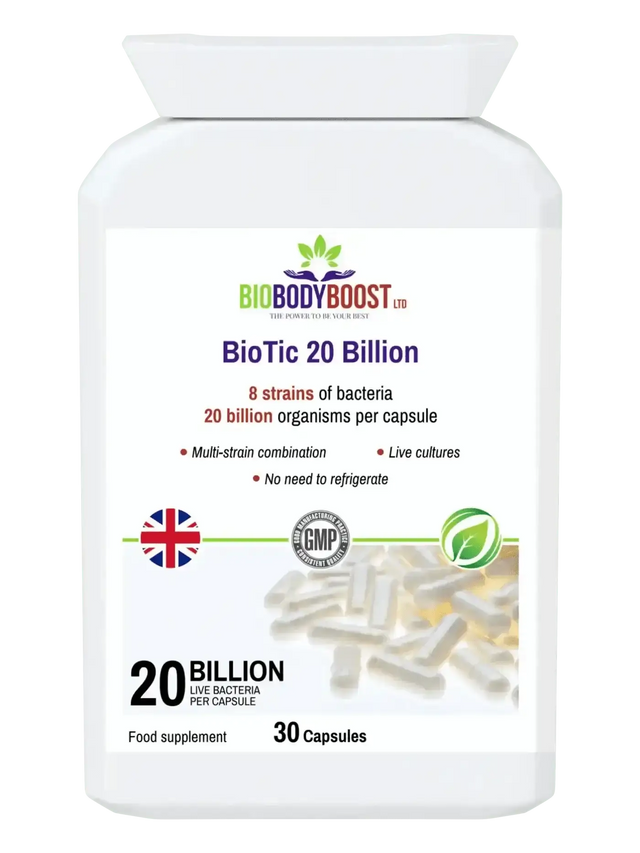
For dairy-free shoppers: BioTic 20 Billion and BioTic 4 Billion use HPMC (plant-derived) capsules with strains named on the label — check each product page for the current allergen statement before buying.
Prebiotics: what they do and when they backfire
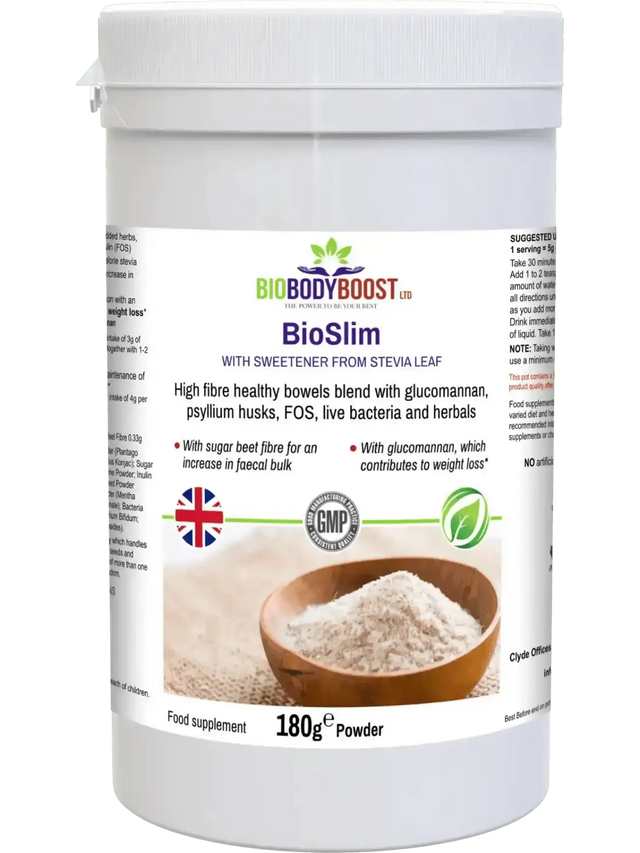
Prebiotics are fermentable fibres that feed gut bacteria — fuel rather than new bacteria. Most are naturally dairy-free, but they are also the most common reason a gut health product causes gas and bloating. Gut bacteria ferment the fibre and produce gas as a byproduct, which is fine at low doses but uncomfortable at higher ones.
The most studied prebiotic types and their evidence:
- Inulin and FOS (fructo-oligosaccharides): A 2017 meta-analysis in Nutrients found FOS supplementation at 3–10g/day significantly improved stool frequency in constipation. Well-evidenced but high gas risk in sensitive individuals.
- GOS (galacto-oligosaccharides): A 2013 RCT in Gut found GOS at 5.5g/day significantly reduced anxiety scores and improved bifidobacterial counts — suggesting gut-brain effects alongside microbiome impact.
- PHGG (partially hydrolysed guar gum): Lower gas potential than inulin, making it better tolerated in IBS. A 2006 study found PHGG at 5g/day improved stool consistency and reduced symptoms in IBS-C.
Honest limit: If you are already eating plenty of vegetables, legumes and wholegrains and you are still bloated, adding more prebiotic fibre via supplement may make things worse. Prebiotics are most useful when dietary fibre intake is low.
Digestive enzymes: best for after-meal discomfort
Enzymes do not change your microbiome — they help you break down food more effectively in the moment.
Lactase: Breaks down lactose. A 2018 Cochrane review confirmed lactase supplementation taken with dairy-containing food significantly reduces lactose intolerance symptoms. If you are fully dairy-free by choice rather than necessity, you may not need this — but it is useful for anyone who occasionally has hidden dairy in food.
Full-spectrum enzymes (amylase, protease, lipase): Evidence for general digestive enzyme supplementation in healthy people is limited. They are more robustly evidenced for specific conditions like exocrine pancreatic insufficiency. For occasional post-meal heaviness, low-dose enzyme supplements may help anecdotally — the research base for prevention in healthy people is thin.
Honest limit: Check that enzyme activity is declared in units (e.g. FCC units) rather than just milligrams — milligrams tell you nothing about actual enzyme activity.
What to check on the label
- Allergen statement: Look for "Contains milk" and also "may contain milk" if you are very sensitive.
- Capsule material: Vegan capsules are HPMC. Gelatine is animal-derived and often not halal unless from a certified halal source.
- CFU count timing: Guaranteed at end of shelf life is better than at time of manufacture.
- Named strains: A probiotic listed only as a proprietary blend with no strain names is a red flag — clinical evidence is strain-specific.
- Powders and sachets: Check the excipient list, not just active ingredients. Some use milk powder for texture.
Matching supplement type to your symptoms
- Bloating that builds through the day: probiotic first, particularly L. acidophilus or a named multi-strain. If no improvement after 4 weeks, consider whether diet is the main driver.
- Bloating immediately after meals: digestive enzymes — this is an in-the-moment breakdown problem, not a microbiome problem.
- Irregular bowel movements or constipation: prebiotic fibre (start low, build up) or magnesium. Our guide to anti-bloating supplements ranks options by evidence and symptom type.
- Gut disruption after antibiotics: probiotic with LGG or high-dose L. acidophilus, started within 2 days of beginning the antibiotic course.
- Travel or irregular routine: spore-forming probiotics (Bacillus species) — heat-stable, no refrigeration needed, well-documented for traveller diarrhoea prevention.
If your symptoms are intense, persistent, or paired with red flags (blood in stool, unexplained weight loss, severe pain, or waking at night to go), supplements are not the next step. See a GP and push for proper investigation.
A note on spore-based probiotics
Spore-forming probiotics (Bacillus coagulans, Bacillus subtilis) survive stomach acid without refrigeration. Many are naturally dairy-free and convenient for travel. A 2014 RCT in Beneficial Microbes found B. coagulans GBI-30 at 1 billion CFU/day significantly reduced IBS symptoms over 90 days.
Trade-off: research is thinner than for established Lactobacillus and Bifidobacterium strains, and some people with sensitive guts find spore-formers too stimulating initially. Starting at a lower dose makes sense.
The routine that makes any gut supplement work
Consistency matters more than the specific product. Most trials show meaningful changes at 4–8 weeks of daily use, not 3 days.
Timing matters: probiotics are often better tolerated with food. Enzymes should be taken right before or with the meal. Prebiotics are flexible, but if they cause gas, earlier in the day is usually more comfortable than evening.
One practical rule: test one product at a time. If you add a probiotic, a prebiotic fibre, and change your diet simultaneously, you will not know what helped. Pick the most likely candidate for your dominant symptom and run it for a month before adding anything else.
Browse the full Gut Health UK collection — every product uses HPMC capsules with strains and doses declared, and each product page carries its own allergen statement.
How many CFU do I need in a probiotic?
Most clinical trials use 1–20 billion CFU per day, depending on the strain and the condition studied. For general gut maintenance, 4–10 billion CFU/day from named strains is a reasonable starting point. For post-antibiotic recovery, trials typically use 10–20 billion CFU. Higher is not automatically better — strain specificity matters more than CFU count above a minimum threshold. The CFU count should be guaranteed at end of shelf life, not just at manufacture.
Do I need to refrigerate dairy free probiotics?
It depends on the strain. Traditional Lactobacillus and Bifidobacterium strains are typically more stable refrigerated, though modern encapsulation often allows room-temperature storage. Spore-forming probiotics (Bacillus species) are heat-stable and do not require refrigeration. Check the storage instructions on the product — a product that says refrigerate should be refrigerated to maintain CFU counts through to expiry.
Can I take a probiotic and prebiotic together?
Yes — this is called a synbiotic approach. The prebiotic feeds the probiotic strains, potentially improving their colonisation. However, if you are prone to bloating, starting both simultaneously makes it harder to identify which is causing discomfort. Start with the probiotic alone for 2–3 weeks, then add a low dose of prebiotic if you want the combined benefit.
How long does it take for gut supplements to work?
Probiotics: early changes (bloating, regularity) are sometimes noticeable within 1–2 weeks, but most trials measure outcomes at 4–8 weeks. Prebiotics: gas often increases in week 1 before settling — persistence matters. Digestive enzymes: effects are immediate per meal, since they work in real time during digestion. If you have seen no change at all from a probiotic after 4 weeks of daily use, you are likely using the wrong strain for your symptoms, or the product quality is poor.
Are dairy free probiotics suitable for halal diets?
Not automatically — dairy-free is only part of the halal requirement. The capsule material matters: standard gelatine capsules are typically bovine or porcine and not halal unless from a certified halal source. Look for HPMC (plant-derived) capsules, which are both vegan and inherently halal in terms of capsule material. Also check that the probiotic strains are not cultured on media containing pork-derived ingredients — reputable brands will disclose this. Our BioTic range uses HPMC capsules — check each product page for the full allergen and suitability statement.
What is the difference between a probiotic and a prebiotic?
A probiotic is a live microorganism — bacteria that, when consumed in adequate amounts, confer a health benefit on the host (per the WHO/FAO definition). A prebiotic is a substrate (typically a fibre) that is selectively used by gut microorganisms and confers a health benefit. In practical terms: probiotics add new bacteria; prebiotics feed the bacteria already there. They address different aspects of gut health and work best in combination once your gut tolerates both.