Written by the BioBodyBoost Nutrition Team · Reviewed by a Registered Nutritionist (RNutr) · May 2026

Urinary tract infections are the second most common bacterial infection in women, affecting an estimated 50% of women at least once in their lifetime, with up to 30% experiencing recurrent episodes. The standard treatment is antibiotics — effective short-term, but repeated courses alter the gut microbiome and increase the risk of antibiotic resistance. D-mannose has emerged as a non-antibiotic alternative with genuine clinical backing.
What is D-mannose?
D-mannose is a simple sugar (monosaccharide) that occurs naturally in small amounts in fruit, particularly cranberries, blueberries and peaches. Unlike most sugars, it is poorly metabolised by the body — approximately 90% of ingested D-mannose passes unchanged into the urine within hours of consumption. This is precisely what makes it useful for urinary tract health.
The mechanism: why it works differently to antibiotics
The most common cause of UTI is Escherichia coli (E. coli), responsible for 80–85% of uncomplicated infections. E. coli adheres to the urothelial lining of the bladder via surface proteins called type 1 fimbriae, which bind to mannose-rich receptors on bladder wall cells. D-mannose works by competitive inhibition — the sugar binds to the E. coli fimbriae before the bacteria can attach to the bladder wall, and the mannose-coated bacteria are then flushed out in urine.
This is a mechanical, non-antibiotic mechanism. Because it does not kill bacteria, it does not create antibiotic resistance, does not disturb the gut microbiome and has no known drug interactions.
What the clinical evidence shows
A landmark clinical trial published in the World Journal of Urology randomised 308 women with recurrent UTIs to D-mannose powder, nitrofurantoin (prophylactic antibiotic) or no treatment. D-mannose significantly reduced recurrence risk compared to no treatment, and produced similar recurrence rates to the antibiotic with a significantly better side effect profile. This is one of the most clinically significant trials in urinary supplement research, comparing directly to antibiotic prophylaxis.
D-mannose vs cranberry — which is better?
Both cranberry and D-mannose target E. coli adhesion, but by different mechanisms. Cranberry PAC (proanthocyanidin A2) prevents a different type of E. coli fimbriae (type P) from adhering. The most robust evidence favours D-mannose over cranberry for active prevention due to its direct mannose-binding mechanism and the ability to achieve therapeutic urinary concentrations through supplementation. However, combining both addresses a broader range of E. coli strains, which is why the most comprehensive urinary health formulas include both.
Comparison of urinary health approaches
| Approach | Mechanism | Evidence | Antibiotic resistance risk |
|---|---|---|---|
| D-Mannose | Competitive adhesion inhibition | Strong RCT evidence ✓ | None ✓ |
| Cranberry PAC | Type P fimbriae inhibition | Moderate evidence ✓ | None ✓ |
| Antibiotic prophylaxis | Bacterial killing | Strong evidence ✓ | High risk ✗ |
| High fluid intake alone | Mechanical flushing | Weak evidence | None ✓ |
How to take D-mannose
- For prevention: 500mg–1g D-mannose once or twice daily with water
- For active symptoms: 1–2g every 2–3 hours for 24–48 hours, then reduce frequency — always alongside GP assessment as antibiotics may be needed for active infection
- Timing: take with a full glass of water. Adequate hydration is essential to ensure urinary clearance of mannose-coated bacteria
- Duration: continuous use for 6 months is safe and the evidence base for prevention is strongest at this duration
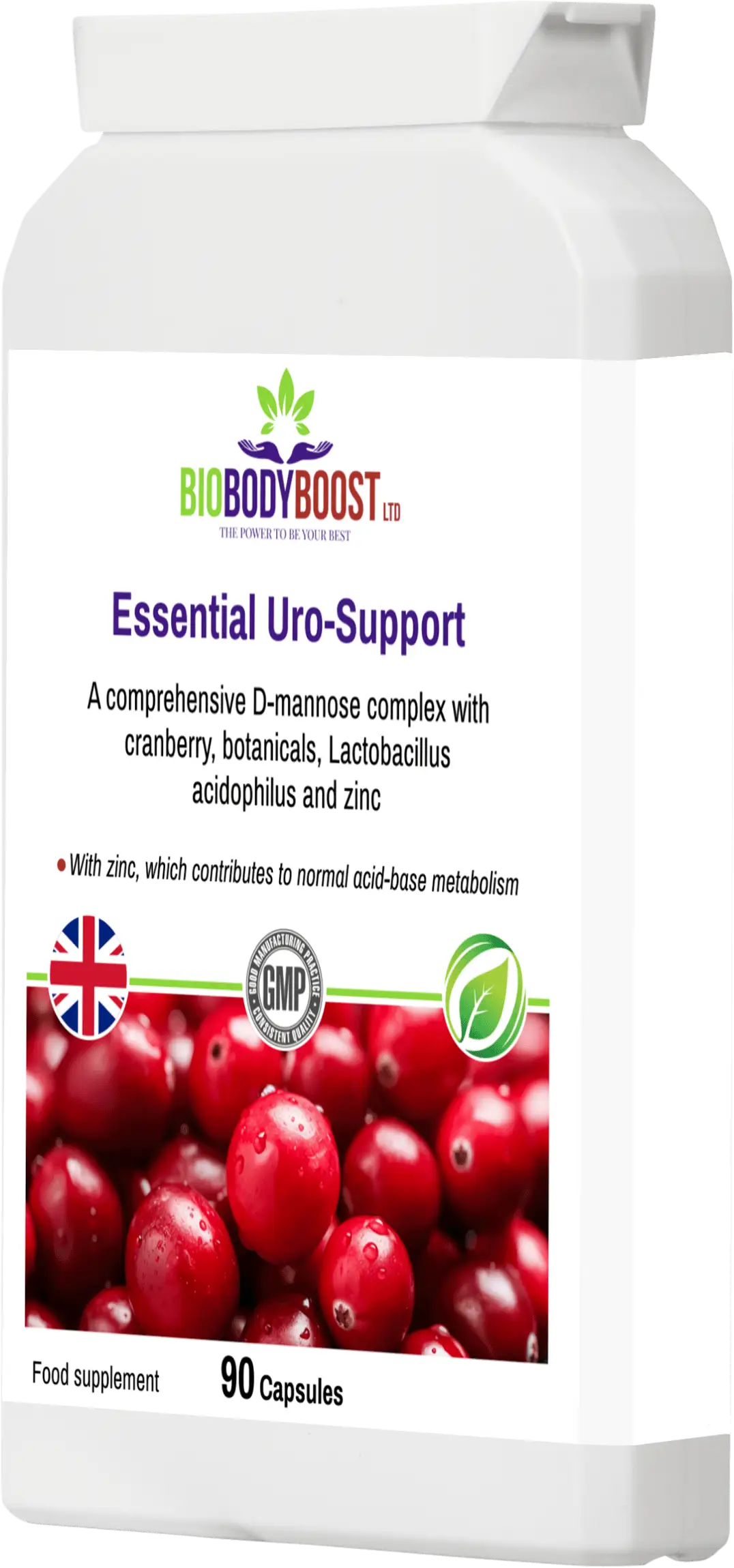
The BioBodyBoost Essential Uro-Support combines D-mannose with cranberry PAC extract, zinc (which contributes to normal immune function) and Lactobacillus probiotics in a halal certified, vegan, UK GMP capsule. Explore the full Women’s Wellness UK and Gut Health UK collections.
D-mannose is not a treatment for active UTI — consult your GP if you have symptoms of infection including burning, frequency, fever or blood in urine. This information is for educational purposes only.