Written by the BioBodyBoost Nutrition Team · Reviewed by a Registered Nutritionist (RNutr) · Updated August 2026

Urinary tract infections are among the most common bacterial infections in the UK. Around 50% of women will experience at least one UTI in their lifetime, and approximately one in four of those will develop recurrent infections — defined as two or more episodes within six months or three within a year. Standard treatment is antibiotics, but rising resistance rates and repeated gut microbiome disruption from antibiotic courses have driven significant clinical interest in preventive strategies. D-mannose is the most robustly evidenced of these.
What is D-mannose?
D-mannose is a simple monosaccharide (sugar) that occurs naturally in small amounts in fruits including cranberries, apples and blueberries. It is structurally similar to glucose but handled very differently by the body: approximately 90% of ingested D-mannose passes through the bloodstream without significant metabolism and is excreted unchanged in urine, where it concentrates in the urinary tract. This non-metabolised excretion is what makes it relevant for UTI prevention — and also why it has minimal impact on blood glucose at supplemental doses.
The mechanism: why D-mannose prevents E. coli adhesion
Approximately 80–90% of UTIs are caused by uropathogenic Escherichia coli (UPEC). UPEC attach to the urothelium (bladder wall lining) via type 1 fimbriae — hair-like surface structures with FimH adhesin tips that bind specifically to mannose residues on the surface of urinary epithelial cells. Once adhered, bacteria proliferate and establish infection.
D-mannose works by saturating urine with free mannose molecules that competitively bind to FimH adhesin, occupying the receptor sites before bacteria can. Bacteria with occupied fimbriae cannot adhere to the urothelium and are flushed out during urination. This mechanism is specific to type 1 fimbriae — it does not affect type P fimbriae (which cranberry PACs target), which is why the two work complementarily rather than redundantly.
Critically, this mechanism involves no antibiotic activity: no bacterial killing, no selective pressure for resistance, and no disruption to gut or vaginal microbiome.
What the clinical evidence actually shows
Kranjčeč et al. (2014), World Journal of Urology — the largest and most cited D-mannose RCT. n=308 women with recurrent UTIs randomised to: D-mannose powder 2g/day in water for 6 months, nitrofurantoin 50mg/day (standard prophylactic antibiotic), or no prophylaxis. Results: recurrent UTI rate was 14.6% in the D-mannose group vs 20.9% in the no-treatment group (statistically significant). Nitrofurantoin showed 6.8% recurrence — still lower, but 17.9% of the nitrofurantoin group reported side effects vs 8.0% in the D-mannose group. Conclusion: D-mannose significantly reduces recurrence risk with a substantially better side effect profile than antibiotic prophylaxis.
Honest limit: Nitrofurantoin still outperformed D-mannose on raw recurrence numbers in this trial. D-mannose is not a direct antibiotic equivalent — it is a meaningful prophylactic with a superior tolerability profile. It is not appropriate for treating an active, symptomatic UTI.
Porru et al. (2014), Journal of Clinical Urology — pilot RCT, n=43 women with recurrent UTIs. D-mannose 1.5g twice daily for 3 months vs no treatment. D-mannose group showed 85% reduction in recurrence rate. Smaller trial, but consistent with Kranjčeč findings and mechanistic prediction.
Lenger et al. (2020), Archives of Gynecology and Obstetrics — systematic review of D-mannose trials. Concluded D-mannose is effective for prevention of recurrent UTIs in women with a good safety profile, while acknowledging that larger, longer-term RCTs are needed to confirm optimal dosing and duration.
D-mannose vs cranberry: complementary, not competing
Cranberry's active compounds are type-A proanthocyanidins (PACs), which prevent E. coli adhesion by blocking type P fimbriae — a different adhesion pathway to the type 1 fimbriae targeted by D-mannose. This means the two mechanisms address different bacterial adhesion routes and combining both provides broader anti-adhesion coverage than either alone.
| Factor | D-Mannose | Cranberry PAC extract |
|---|---|---|
| Target fimbriae | Type 1 (FimH adhesin) | Type P fimbriae |
| Evidence strength | Strong — multiple RCTs | Moderate — mixed results by product |
| Effective dose | 2g/day (Kranjčeč trial) | 36mg PAC/day (Cochrane threshold) |
| Blood sugar impact | Minimal (not metabolised) | None |
| Combines well? | Yes — different pathways | Yes — different pathways |
Honest limit on cranberry: A 2012 Cochrane review (Jepson et al., 24 trials) found cranberry products significantly reduced UTI incidence vs placebo, but effects were inconsistent across trials and the benefit was less clear for men, elderly, and catheterised patients. PAC content varies enormously between cranberry products — juice and most capsules provide far less than the 36mg PAC/day threshold supported by evidence. Check the declared PAC content, not just "cranberry extract" in mg.
Who D-mannose is most suitable for
- Women with recurrent UTIs — the primary population in all clinical trials. Evidence in men is very limited.
- Anyone wanting to avoid repeated antibiotic courses for UTI prophylaxis — D-mannose offers comparable prevention with fewer side effects in the key RCT.
- Post-menopausal women — declining oestrogen reduces Lactobacillus colonisation in the vaginal and urinary microbiome, increasing UTI susceptibility. D-mannose addresses the adhesion mechanism independently of hormonal status.
- Women prone to antibiotic-associated thrush — D-mannose carries no antibiotic activity and does not disrupt vaginal flora.
Who should be cautious
- People with diabetes or on blood glucose medication: D-mannose is not significantly metabolised but is still a sugar. At the 2g/day dose used in trials, blood glucose impact is minimal in healthy individuals. People on insulin or glucose-lowering medication should discuss with their GP before starting, as individual responses may vary.
- Active UTI with symptoms: D-mannose is a preventive supplement, not a treatment. If you have burning urination, frequency, pain, blood in urine, or fever, see a GP or pharmacist. Untreated UTI can progress to kidney infection (pyelonephritis). Do not use D-mannose to delay seeking treatment for symptomatic infection.
- Recurrent UTIs with no obvious trigger: If UTIs are frequent despite D-mannose use, investigate underlying causes (bladder anatomy, diabetes, kidney stones, catheter use) with a GP rather than increasing supplement doses.
Dosing: what the trials used
- Prevention (daily maintenance): 2g D-mannose per day — the dose used in the Kranjčeč 2014 RCT. Take dissolved in a full glass of water, split across the day if preferred.
- At first sign of symptoms: some practitioners suggest increasing to 1.5g twice daily (as in Porru et al.) — but symptomatic UTI requires medical assessment, not supplement escalation.
- Duration: both main trials ran 3–6 months. D-mannose is generally well tolerated for long-term daily use, with loose stools the most commonly reported side effect at higher doses.
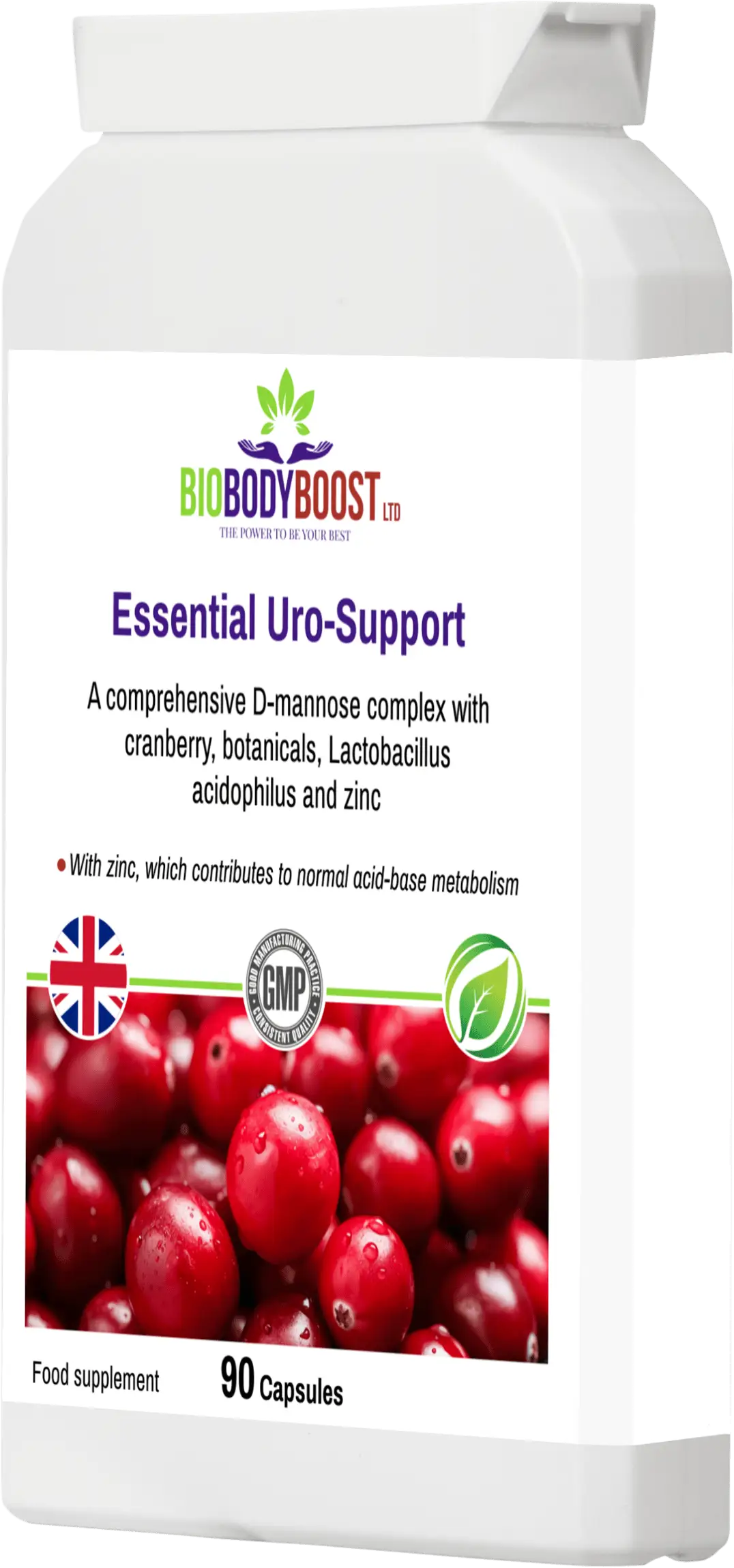
Our Essential Uro-Support combines D-mannose with cranberry PAC extract, zinc glycinate and Lactobacillus acidophilus for comprehensive urinary tract support — halal approved, vegan, UK GMP manufactured. Explore the full Women's Wellness UK collection.
D-mannose is a food supplement and does not treat active UTI infections. If you have symptoms of a UTI — burning urination, frequency, pain, or fever — consult your GP or pharmacist promptly. Not a replacement for prescribed antibiotics. People with diabetes should consult their GP before use.
Does D-mannose actually work for UTI prevention?
Yes, with meaningful clinical evidence. The key trial (Kranjčeč et al., 2014, World Journal of Urology, n=308) found D-mannose at 2g/day for 6 months reduced recurrent UTI rates significantly compared to no treatment, and produced fewer side effects than nitrofurantoin prophylaxis (8.0% vs 17.9% reporting side effects). Nitrofurantoin still showed a lower absolute recurrence rate (6.8% vs 14.6%), so D-mannose is not equivalent to antibiotics in efficacy terms — but its tolerability profile is substantially better. A smaller RCT (Porru et al., 2014) found 85% reduction in recurrence at 1.5g twice daily over 3 months.
Can D-mannose treat an active UTI?
No — D-mannose is a preventive supplement, not an antibiotic. It works by preventing E. coli from adhering to the bladder wall in the first place. Once bacteria have adhered and an infection is established, D-mannose does not remove them. If you have symptoms of an active UTI — burning urination, urgency, pain, blood in urine, or fever — you need antibiotics prescribed by a GP or pharmacist. Do not delay treatment by trying supplements first. Untreated UTI can progress to kidney infection, which is a serious condition.
How long does D-mannose take to work for UTI prevention?
D-mannose reaches the urinary tract within hours of ingestion — it is rapidly absorbed and excreted in urine, so urinary mannose concentrations rise quickly after a dose. For prevention, the trials showing benefit ran for 3–6 months of daily use, so meaningful reduction in recurrence rate is a medium-term outcome. You will not know if it is working from a single dose — assess results over a full 3-month period of consistent daily use.
Is D-mannose safe to take every day long term?
The available evidence suggests yes for most healthy adults. Both main trials ran 3–6 months with good tolerability. The most commonly reported side effect is loose stools or mild diarrhoea, particularly at doses above 2g/day. D-mannose is not significantly metabolised, so it does not accumulate. There are no known serious long-term adverse effects at supplemental doses, though trials beyond 6 months are limited. People with diabetes or kidney disease should discuss long-term use with their GP.
Is D-mannose better than cranberry for UTI prevention?
D-mannose has stronger and more consistent clinical trial evidence than cranberry. The Kranjčeč 2014 RCT (n=308) is more robust than most cranberry trials. Mechanistically, D-mannose targets type 1 fimbriae (FimH adhesin) while cranberry PACs target type P fimbriae — different bacterial adhesion pathways. This means combining both provides broader coverage than either alone, and there is no reason to choose one over the other when both can be used together. The key with cranberry is ensuring the product declares 36mg type-A PAC per day — the threshold supported by the evidence. Most cranberry juice and many capsules provide far less.
Is D-mannose suitable for halal and vegan diets?
D-mannose is a plant-derived sugar — it is inherently vegan and halal by origin. The relevant checks are the capsule material (HPMC = plant-derived = vegan and halal; standard gelatine requires halal-certified sourcing) and any additional ingredients in a combined formula. Our Essential Uro-Support is halal approved, vegan, and uses HPMC capsules — check the current product page for the full allergen and halal statement.