Key takeaways
- Most supermarket “cranberry juice” is a juice drink: mostly water and sugar, with a small share of cranberry.
- Pure cranberry juice is very sour, so it's usually sweetened or diluted.
- Capsules provide cranberry without the sugar, but doses vary by brand.
- If you take warfarin, the NHS advises avoiding cranberry products.
In this guide
The three types compared
| Juice drink | Pure juice | Capsules | |
|---|---|---|---|
| Cranberry content | Often around a quarter | 100% | Concentrated powder or extract |
| Sugar | Usually high, or sweeteners | Natural fruit sugar; very sour | Negligible |
| Calories | Adds up over a day | Moderate | Negligible |
| Teeth | Sugary and acidic | Acidic | No contact |
| Convenience | Easy to buy | Harder to find | Easy to take and travel with |
The sugar problem
Cranberries are naturally very sharp, so juice drinks add sugar or sweeteners to make them drinkable. A daily glass or two can add a surprising amount of sugar.
Check the label: look at “carbohydrates, of which sugars” per 100ml, and the percentage of cranberry juice in the ingredients. The NHS recommends adults have no more than 30g of free sugars a day.
What about the evidence?
Cranberry has been studied for urinary health for decades, and research reviews have produced mixed results depending on the group studied and the product used.
In the UK, cranberry has no authorised health claim, and it isn't a treatment for an infection. If you have symptoms of a UTI, see a pharmacist or your GP. Our guide to UTI or thrush explains where to get help quickly.
What to check on a cranberry capsule label
- The amount of cranberry per serving, and whether it's whole fruit powder or extract
- Proanthocyanidins (PACs): some brands state this; methods of measuring vary
- Other ingredients, such as D-mannose or live cultures
- The capsule shell: plant-based HPMC rather than gelatine
- Halal and vegan approval of the finished product

Who should be careful with cranberry
- Taking warfarin: the NHS advises avoiding cranberry juice and cranberry products, as they may affect how warfarin works
- A history of kidney stones: speak to your GP before taking concentrated cranberry regularly
- Diabetes: watch the sugar in juice drinks
- Pregnant or on regular medication: check with your pharmacist

No sugar · halal & kosher approved · vegan
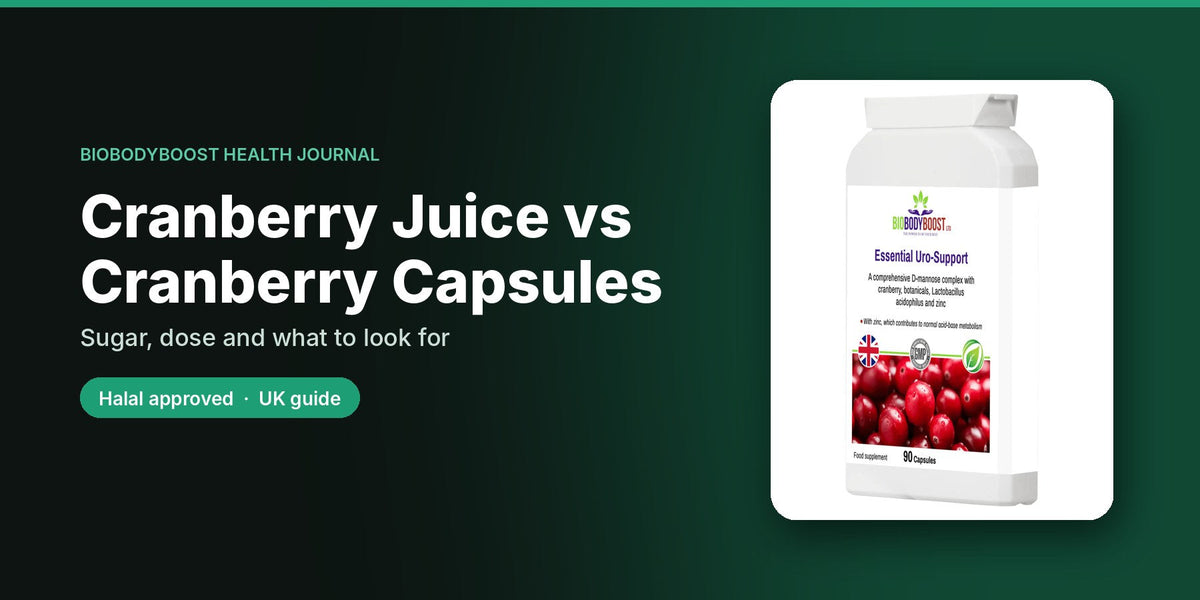
Uro-Support
- 2160mg cranberry and 900mg D-mannose per serving
- With 2 billion CFU Lactobacillus acidophilus
- Zinc contributes to the normal function of the immune system
HALAL10 10% off your first order
Shop Uro-Support →Questions people ask
Is cranberry juice or capsules better?
Capsules avoid the sugar and calories of juice drinks. Juice is fine as an occasional drink if you watch the sugar.
How much cranberry is in cranberry juice drink?
It varies by brand. Check the ingredients list for the percentage of cranberry juice.
Can I take cranberry with antibiotics?
Check with your pharmacist. Cranberry isn't a replacement for treatment you've been prescribed.
Is cranberry safe with warfarin?
The NHS advises people taking warfarin to avoid cranberry juice and cranberry products.
Is cranberry halal?
Cranberry is a fruit, so it's halal in itself. Check juices for additives and capsules for the shell.
Sources: NHS: warfarin · NHS: sugar · GB NHC register
This article is general information, not medical advice. If you have symptoms of an infection, see a pharmacist or your GP. Food supplements should not replace a varied, balanced diet and healthy lifestyle.