CoQ10 (coenzyme Q10, also called ubiquinone) is a fat-soluble compound produced by every cell in the human body and essential for mitochondrial energy production. The most important population for CoQ10 supplementation are people taking statin medications — the most commonly prescribed drugs in the UK, taken by approximately 8 million British adults — because statins block the same pathway that produces CoQ10. For this group, supplementation has genuine evidence. For healthy younger adults, evidence is less clear-cut.
What Does CoQ10 Do?
CoQ10 performs two distinct biological roles:
- Mitochondrial electron transport — CoQ10 is a mobile electron carrier in the mitochondrial inner membrane, shuttling electrons between Complexes I/II and Complex III of the electron transport chain. This is central to ATP production — every cell’s energy currency. Without adequate CoQ10, mitochondrial efficiency falls. Tissues with the highest energy demands are most affected: the heart, skeletal muscle, liver and kidney have the highest CoQ10 concentrations in the body.
- Antioxidant protection — CoQ10 in its reduced form (ubiquinol) is a potent membrane antioxidant, protecting cell membranes from lipid peroxidation. It also regenerates vitamin E from its oxidised form. This antioxidant role is particularly important in tissues generating large amounts of reactive oxygen species (ROS) — again, high-energy tissues.
Why Do Statins Deplete CoQ10?
Statins work by inhibiting HMG-CoA reductase — the enzyme that produces mevalonate, an early step in the cholesterol synthesis pathway. But mevalonate is also an early intermediate in the biosynthesis of CoQ10 via the same metabolic pathway. When statins block mevalonate production to reduce cholesterol, they simultaneously reduce CoQ10 synthesis. This is not a side effect or coincidence; it is a mechanistic consequence of the drug’s action.
Multiple studies confirm that statin use reduces plasma CoQ10 levels by 16–54% depending on the statin, dose and duration. This CoQ10 depletion is proposed as a contributing mechanism to the muscle symptoms (myalgia) reported by 5–10% of statin users — muscle tissue has high CoQ10 requirements, and statin-induced depletion may impair mitochondrial function in muscle cells.
Does CoQ10 Supplementation Help Statin Side Effects?
This is the most clinically relevant question. The evidence is mixed but leans positive:
- A 2015 meta-analysis found CoQ10 supplementation significantly reduced statin-associated muscle pain scores versus placebo
- A 2018 RCT found CoQ10 (200mg/day) significantly improved muscle symptoms in statin users compared to placebo
- However, a 2014 Cochrane review found insufficient evidence to make a definitive recommendation, citing trial heterogeneity
The clinical consensus is that CoQ10 supplementation is reasonable to try in statin users experiencing muscle symptoms, given its safety profile. The NHS does not formally recommend it but many cardiologists suggest it.
CoQ10 and Heart Failure
The heart has the highest CoQ10 concentration of any tissue and is highly dependent on mitochondrial ATP production. The Q-SYMBIO trial (2014) found CoQ10 supplementation (300mg daily) in chronic heart failure patients significantly reduced major cardiovascular events (28% vs 36% placebo) and cardiovascular mortality. This is the most compelling clinical evidence for CoQ10 in a specific disease context. For heart failure patients specifically, CoQ10 has substantial evidence.
Ubiquinol vs Ubiquinone: Is the More Expensive Form Worth It?
CoQ10 exists in two forms: ubiquinone (oxidised, the form in most supplements) and ubiquinol (reduced, the antioxidant-active form). The body interconverts these freely. Most supplemental ubiquinone is converted to ubiquinol in the gut and bloodstream.
| Factor | Ubiquinone | Ubiquinol |
|---|---|---|
| Form | Oxidised (inactive antioxidant form) | Reduced (active antioxidant form) |
| Absorption | Good; converted to ubiquinol after absorption | Good; already in active form |
| Bioavailability comparison | Standard | Modestly better in older adults (>50) |
| Cost | Lower | Significantly higher |
| When to choose | Most adults under 50 | Adults over 50; people with absorption issues |
For most adults under 50, standard ubiquinone at 100–200mg is appropriate and cost-effective. For adults over 50 — when the body’s ability to convert ubiquinone to ubiquinol declines — ubiquinol is more bioavailable and may be worth the premium.
What Dose of CoQ10 Is Effective?
- General supplementation and antioxidant support: 100–200mg daily
- Statin-associated muscle symptoms: 100–300mg daily
- Heart failure (under medical supervision): 300mg daily (as used in Q-SYMBIO)
- Blood pressure support: 100–200mg (modest reductions in systolic BP documented in meta-analyses)
CoQ10 is fat-soluble — take with a meal containing fat for optimal absorption. It has an excellent safety profile with no established upper limit and no serious adverse effects reported at supplemental doses.
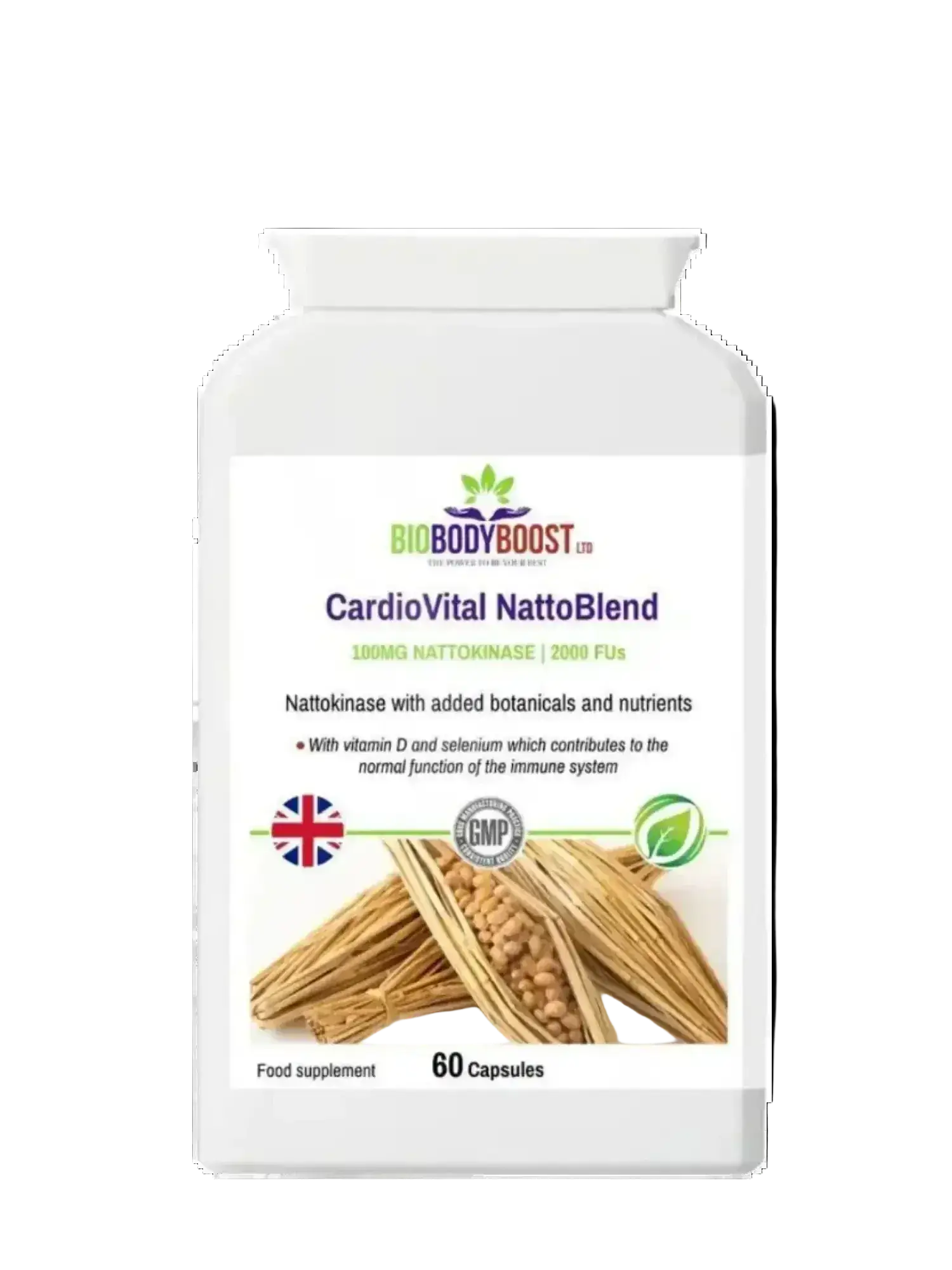
CardioVital Natto Blend by BioBodyBoost supports cardiovascular health with nattokinase, vitamin D, selenium and N-acetyl cysteine — complementary to CoQ10 for heart health. Halal certified, UK GMP manufactured. Browse the full halal supplement range.