Open almost any UK eye supplement label and you'll see bilberry and lutein listed together, as if they're interchangeable or two names for the same thing. They're not. They come from entirely different plants, work through entirely different mechanisms, and target different parts of the eye. Understanding the difference is the difference between buying a supplement that makes sense and buying one because the label looked thorough.
Bilberry: The Traditional Circulation Botanical
Bilberry (Vaccinium myrtillus) is a European relative of the blueberry, traditionally associated with vision since British RAF pilots reportedly ate bilberry jam before night missions in WWII — an association that's more folklore than rigorous trial evidence, but one that's kept bilberry in eye formulas for decades. What bilberry actually contains: anthocyanins, the same antioxidant pigment class found in blueberries and blackcurrants. These compounds have research interest around circulation and capillary support, which is the traditional rationale for including bilberry in vision formulas — supporting blood flow to ocular tissue rather than acting directly within the eye itself.
Bilberry carries no authorised UK health claim of its own. Any formula honest about that will say so rather than imply otherwise.
Lutein and Zeaxanthin: The Carotenoids That Physically Live in Your Eye
This is the mechanistic difference that matters. Lutein and zeaxanthin are carotenoids — plant pigments — that your body cannot produce itself and can only obtain from diet or supplements. Unlike bilberry's circulation-support role, lutein and zeaxanthin do something bilberry doesn't: they physically accumulate in the macula, the central part of the retina responsible for sharp, detailed vision. Once there, they form what's called macular pigment — filtering high-energy blue light and acting as a localised antioxidant defending photoreceptor cells from oxidative stress.
This is genuinely different biology from bilberry's traditional circulation angle. Lutein and zeaxanthin are structural — they become part of the eye's own protective tissue. Bilberry is supportive — it's about blood flow reaching that tissue.
Zinc: The One With the Actual Authorised Claim
Here's what most formulas don't make clear: neither bilberry nor lutein carries a UK/EU authorised health claim. Zinc does — it contributes to the maintenance of normal vision, a genuine EU-authorised claim under Regulation 432/2012. If a product's marketing leans entirely on bilberry and lutein language without mentioning zinc's role, it's leading with the ingredients that sound impressive rather than the one that's actually regulator-approved.
So Do You Need Both?
Given they work through different mechanisms — lutein/zeaxanthin structurally, bilberry via traditional circulation support — combining them isn't redundant, it's complementary, provided both are dosed meaningfully rather than one being a token addition to make the label look fuller. What to actually check on any bilberry-lutein product:
- Are both lutein and zeaxanthin present, not just lutein? They're often paired in research at specific ratios; zeaxanthin is frequently the smaller, easier-to-skip ingredient.
- Is the zinc dose meaningful, since that's the ingredient actually carrying the claim?
- Is bilberry framed honestly — as traditional support, not as a proven vision treatment?
Our Formula
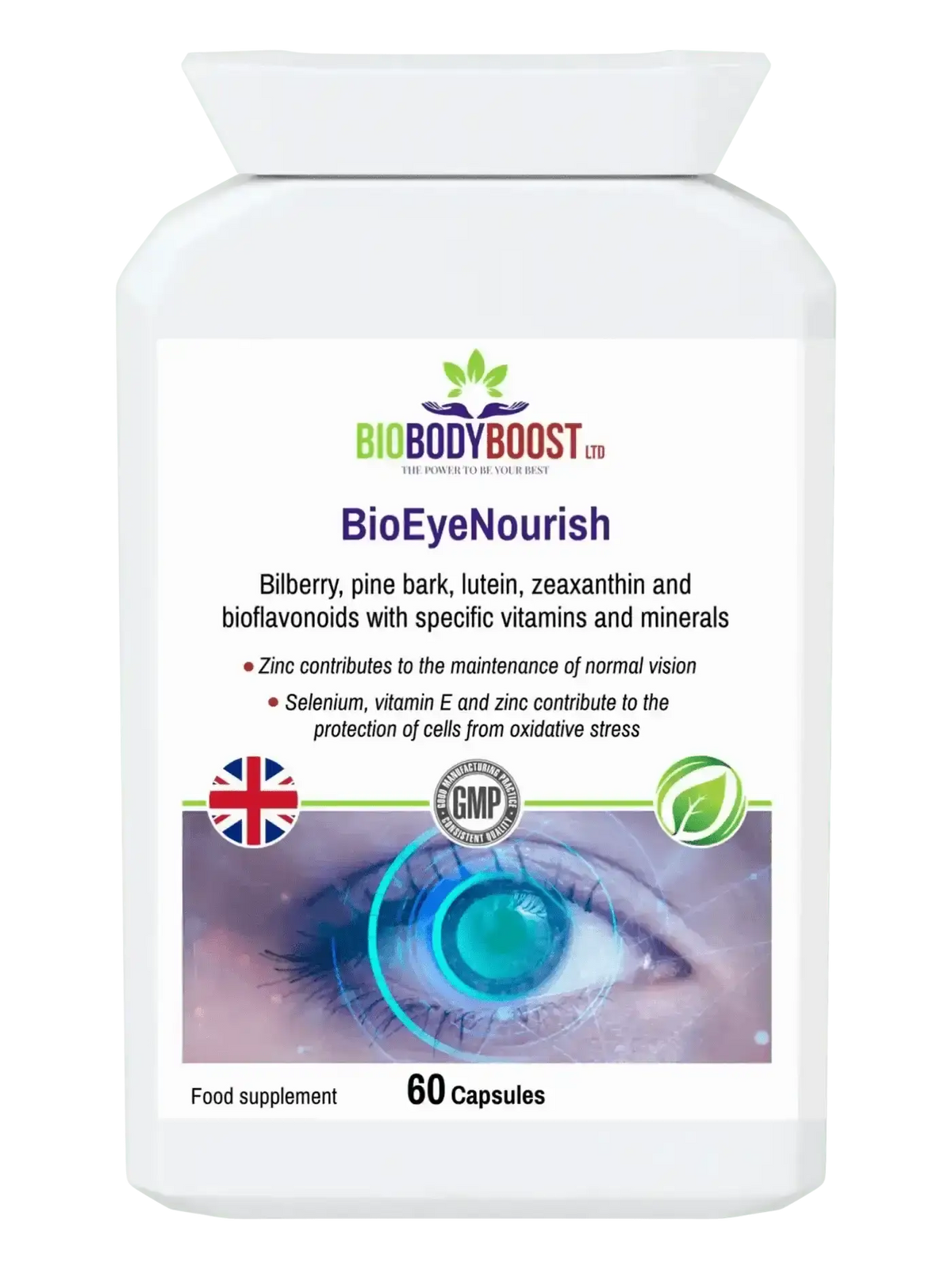
BioEyeNourish combines bilberry with both lutein and zeaxanthin, plus pine bark and zinc — the ingredient carrying the authorised vision claim. Vegan, halal approved, no gelatine. We say plainly that bilberry and the carotenoids carry no authorised claims of their own; zinc is what does the regulatory work here, and we'd rather you knew that than assume otherwise from the ingredient list alone.
FAQs
Is bilberry the same as lutein?
No — different plants, different compounds, different mechanisms. Bilberry provides anthocyanins linked to traditional circulation support; lutein and zeaxanthin are carotenoids that physically accumulate in the eye's macula.
Which is more important, bilberry or lutein?
Neither carries an authorised UK health claim, so "more important" isn't a claim either can legally make. Lutein and zeaxanthin have the more direct, well-documented mechanism (macular pigment accumulation); bilberry's role is traditional and circulation-focused.
Does bilberry actually improve night vision?
The RAF-pilot association is a well-known piece of eye-health folklore rather than a robustly evidenced claim, and bilberry carries no authorised UK health claim for vision or night vision specifically.
What's the actual regulator-approved ingredient for eye health?
Zinc — it contributes to the maintenance of normal vision under EU Regulation 432/2012. Check any eye supplement includes a meaningful zinc dose alongside its more marketable botanical ingredients.
Browse the full Hair, Skin & Beauty UK collection.
Food supplements should not replace a varied diet. Consult your GP before use if pregnant, breastfeeding, taking medication, or managing a diagnosed eye condition. Any change in vision needs assessment by an optician or doctor, not a supplement.