Key takeaways
- Beta-alanine itself is generally considered halal: supplement-grade beta-alanine is made by chemical synthesis or microbial fermentation, not from animals.
- The halal question is about the rest of the product: gelatine capsules, flavourings, colours and other amino acids in the blend.
- Research uses 4–6g a day for at least 2–4 weeks. Most pre-workouts contain far less.
- The tingle is a known, harmless effect. Smaller split doses reduce it.
In this guide
The short answer
Yes, beta-alanine is generally considered halal. Supplement-grade beta-alanine is produced in factories by chemical synthesis or fermentation. It is not extracted from pork or any other animal.
Whether a product containing beta-alanine is halal depends on its other ingredients. Check the full label, or choose a product that is halal approved.
One large branded ingredient, CarnoSyn, describes its beta-alanine as "kosher and halal" (CarnoSyn FAQ). That covers the raw ingredient, not every product that uses it.
How beta-alanine is made
Beta-alanine is a non-essential amino acid. Your body makes it, and small amounts occur in meat, fish and poultry. That last point is where the confusion comes from.
Supplements do not use meat as a source. A 2023 review of industrial production describes two routes (Frontiers in Bioengineering and Biotechnology, 2023):
| Route | Starting materials | Animal-derived? |
|---|---|---|
| Chemical synthesis | Acrylic acid or acrylonitrile reacted with ammonia | No |
| Biological (enzymes or fermentation) | Microbes or enzymes using glucose or glycerol as feedstock | No, though the growth medium and glycerol source can matter for halal approval |
For fermented ingredients, halal approval bodies look at the culture medium as well as the final product. We explain why in are probiotics halal?, which covers the same issue.
Where the halal risk really is
Beta-alanine is usually sold inside a pre-workout blend or as capsules. Check these on the label:
- Capsules: gelatine shells are usually pork or non-halal beef. Look for HPMC or "vegetable capsule".
- Flavourings: "natural flavouring" can use alcohol as a carrier.
- Colours: carmine (E120) is made from insects.
- Other amino acids: BCAAs and L-cysteine can come from feathers or hair. See is taurine halal? for a related myth.
- Excipients: glycerine and magnesium stearate can be animal or plant derived.
Our halal gym supplement label check walks through all nine red flags.

How much the research uses
The International Society of Sports Nutrition position stand says 4–6g of beta-alanine daily for four weeks significantly raises muscle carnosine (ISSN, 2015).
It describes the most noticeable effects in hard efforts lasting 1 to 4 minutes, after at least 2 to 4 weeks of daily use. Beta-alanine works by building up over time, so a single scoop before a session is not how it was studied.
Check the amount per serving. Many pre-workouts include beta-alanine at well under 1g per scoop. Our own pre-workout contains 400mg per 5.5g scoop, alongside citrulline, arginine, creatine and 40mg caffeine. It is a general pre-workout, not a research-dose beta-alanine product.
What it can and cannot claim in the UK
There is no authorised health claim for beta-alanine in the UK or EU. EFSA assessed a claim on physical performance during short, high-intensity exercise and concluded that "a cause and effect relationship has not been established" (EFSA, 2014).
So be wary of UK labels that promise beta-alanine will "boost endurance" or "delay fatigue". Sports scientists still study it, but a product cannot legally make that claim.
Safety and the tingle
The ISSN says beta-alanine "currently appears to be safe in healthy populations at recommended doses", and that the only reported side effect is paraesthesia, a pins-and-needles tingle. It suggests divided doses of about 1.6g, or a sustained-release form, to reduce it (ISSN, 2015).
More on why it happens in pre-workout tingles: is the itch harmless?
Speak to your GP or pharmacist first if you are pregnant or breastfeeding, under 18, take medication, or have a heart, kidney or other medical condition. Pre-workouts also contain caffeine: EFSA considers up to 400mg a day safe for healthy adults, and up to 200mg a day in pregnancy (EFSA). If you compete under anti-doping rules, use only batch-tested products.
A halal approved pre-workout

Vegan · Halal approved
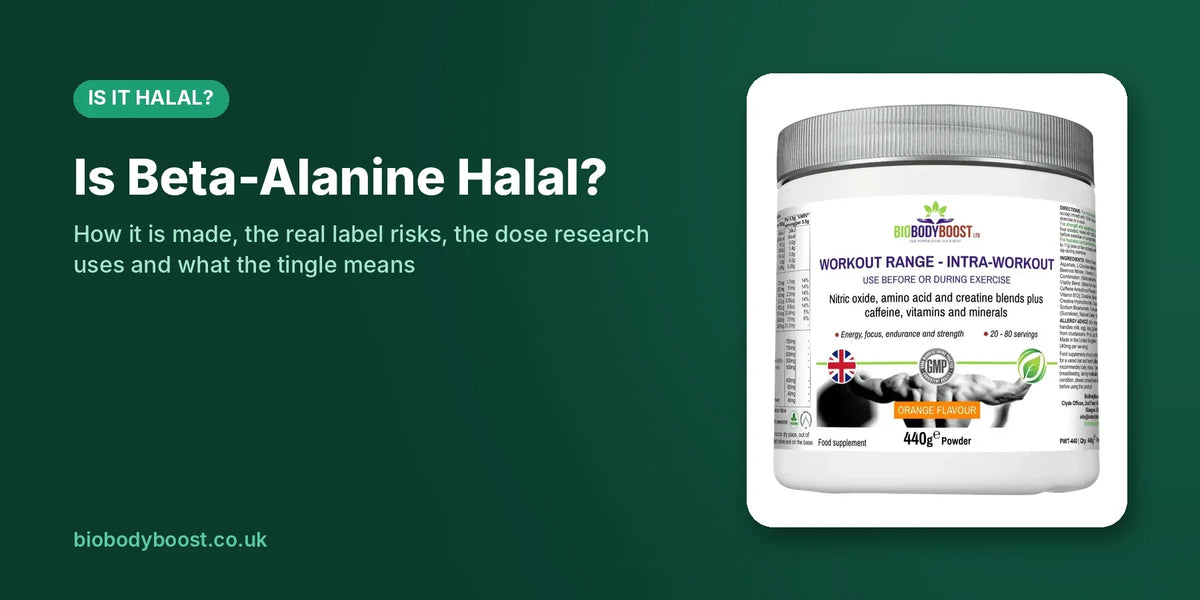
Pre-Workout Powder, Orange 440g
- 400mg beta-alanine, 750mg citrulline malate and 40mg caffeine per scoop
- Creatine increases physical performance in successive bursts of short-term, high-intensity exercise (effect seen with 3g creatine a day)
- Made in the UK in an Informed Manufacturer Facility
HALAL10 10% off your first order
Shop Pre-Workout →Want less stimulant? See our low-caffeine pre-workout guide and citrulline vs arginine.
Common questions
Is beta-alanine haram?
No. Beta-alanine is made by synthesis or fermentation, not from animals, so it is generally considered halal. Check the other ingredients in the product.
Is beta-alanine vegan?
Supplement-grade beta-alanine is normally vegan. The capsule, flavourings and other ingredients decide whether the whole product is vegan.
Is beta-alanine made from meat?
It occurs naturally in small amounts in meat, fish and poultry, but supplements are not made from them. Industrial beta-alanine comes from chemical synthesis or fermentation.
Can I take beta-alanine while fasting in Ramadan?
Take it in the eating window, with suhoor or iftar. Because it works by building up over weeks, the exact time of day matters less than taking it consistently.
Is the beta-alanine tingle a sign of an allergy?
The tingle (paraesthesia) is the known side effect and usually fades within an hour or two. Swelling, a rash or difficulty breathing are not normal: stop and get medical help.
Sources: ISSN position stand: beta-alanine (2015) · EFSA opinion on beta-alanine · Advances in the synthesis of β-alanine (2023) · CarnoSyn FAQ · EFSA: caffeine
General information, not medical advice. Food supplements should not replace a varied diet and healthy lifestyle. Not for under-18s. Contains caffeine: not recommended during pregnancy or breastfeeding. If you take medication or have a medical condition, speak to your GP before use.