Search "best probiotic for kids UK" and most results give you a vague reassurance — "good bacteria for happy tummies" — and a product link, with nothing about what actually makes one children's probiotic better formulated than another. Parents deserve better than that when it's going into a child's diet. Here's what to actually look for — or for a fuller Q&A including constipation and vegan status, see our complete kids probiotics guide.
1. Named Strains, Not Just "Probiotic Blend"
Different bacterial strains do different things — some support general digestion, others are studied specifically for infant and toddler gut development. A label that just says "probiotic blend" without naming the strains (e.g. Lactobacillus rhamnosus, Bifidobacterium infantis, L. casei) is hiding information you're entitled to before giving something to a child daily. The strain names are not marketing detail — they're the actual active ingredient.
2. CFU Count Stated Clearly
CFU (colony forming units) tells you the live bacteria count. A trustworthy children's product states this plainly — usually in the 1 to 10 billion range for kids' formulas — rather than hiding behind vague language like "millions of beneficial bacteria." If a brand won't commit to a number, that's worth noticing.
3. Age-Appropriate Dosing, From Birth If Claimed
Not every kids' probiotic is genuinely suitable from birth, whatever the packaging implies. If a product claims newborn suitability, check for a genuinely adjustable dose — a scoop that can be reduced for the smallest amounts, or drops that scale by weight — rather than a single fixed serving marketed as "one size fits all ages."
4. No Unnecessary Additives
Children's supplements are more likely than adult ones to carry added sugar, artificial flavouring or colouring to make them palatable. A tasteless, unflavoured powder that mixes invisibly into milk or food avoids that trade-off entirely — worth prioritising over a flavoured version if your child doesn't need convincing.
5. Shelf-Stable Storage
Some probiotics require refrigeration to stay viable, which is impractical for a bag, a nursery, or forgetful mornings. A genuinely shelf-stable formulation survives stomach acid and everyday storage without a fridge — check this before committing to a routine you can't actually keep up.
Our Formula
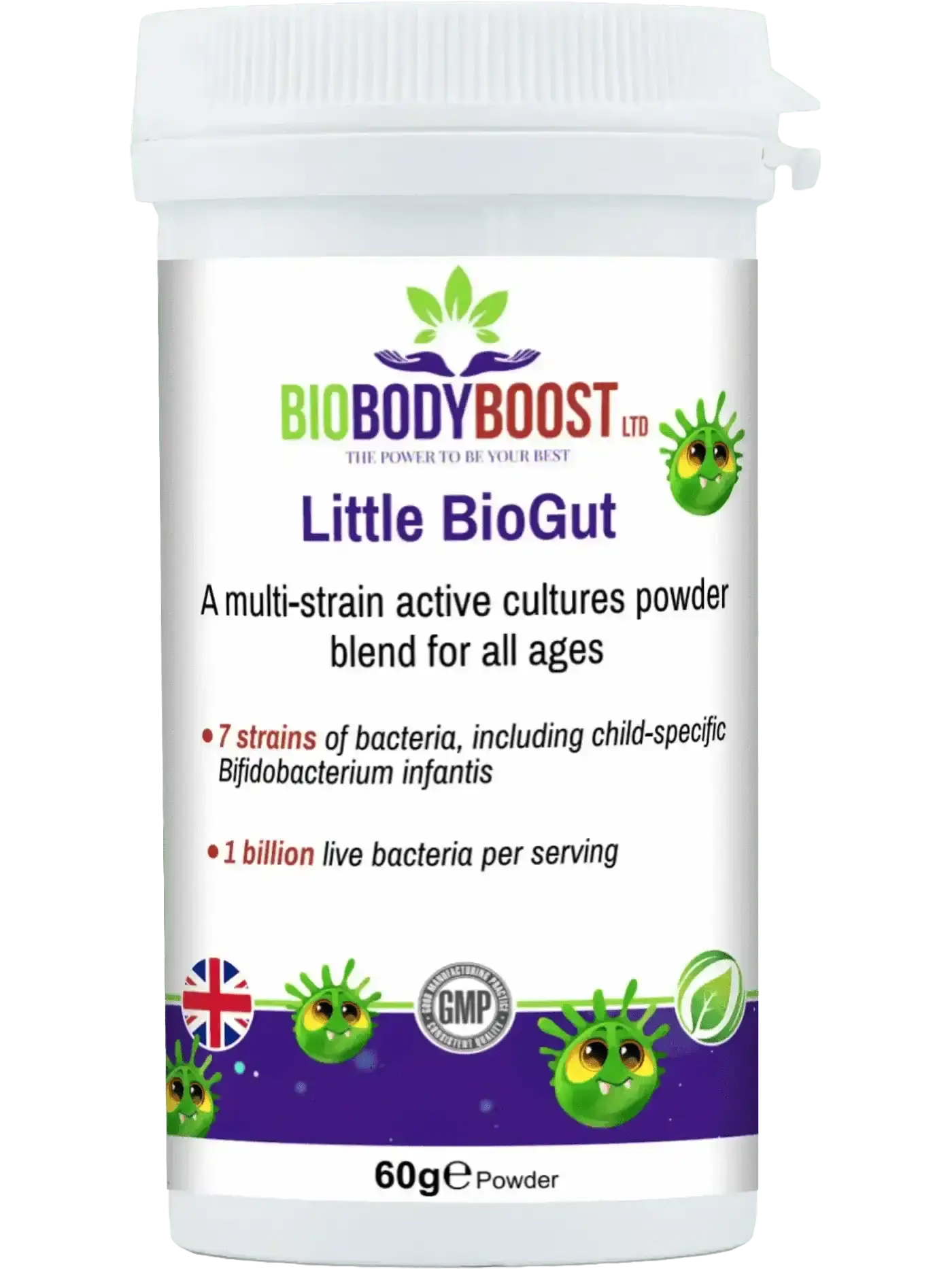
Little BioGut is built against every point above: 7 named live-culture strains (L. casei, L. rhamnosus, Streptococcus thermophilus, B. breve, L. acidophilus, L. bulgaricus, B. infantis), plus prebiotic FOS fibre to feed them, in a tasteless vegan powder that mixes into milk, water or food. Adjustable from ¼ scoop for young babies. Shelf-stable — no fridge needed.
A Note on Claims
No authorised health claims exist for probiotics in children under UK/EU regulation — any children's probiotic product implying it "boosts immunity" or "cures tummy troubles" is going beyond what's actually established. We'd rather be straightforward: this is a live-culture food supplement, offered on that basis, not as a treatment for any condition.
FAQs
What's the best probiotic strain for kids?
There's no single "best" — a multi-strain formula covering several well-studied species (Lactobacillus and Bifidobacterium types especially) offers broader support than a single-strain product.
Can I give my baby probiotics from birth?
Only products specifically formulated and dosed for that age, and always after checking with your GP, health visitor or paediatrician first — this applies to any new supplement given to an infant.
How much CFU should a children's probiotic have?
Most reputable children's formulas sit in the 1-10 billion CFU range. More isn't automatically better for a child's smaller system — consistency of use matters more than maximising the number.
Do kids' probiotics need to be refrigerated?
Not if properly formulated — many shelf-stable strains survive room temperature storage. Check the label rather than assuming either way.
Browse the full Kids Health UK collection, or see our complete kids probiotics Q&A for more, including vegan status and constipation.
Always consult your GP, health visitor or paediatrician before giving any new supplement to a child, particularly infants, and especially if your child is unwell, immunocompromised or has a diagnosed condition.