Always speak to your GP, pharmacist or health visitor before giving supplements to children. The NHS recommends discussing children’s supplements with a healthcare professional.
Quick answer: the most clinically researched children’s probiotic strain is Lactobacillus rhamnosus GG (LGG) — with more paediatric RCTs than any other single probiotic strain. A 2014 Cochrane Review (Hempel et al., 63 trials) found probiotics significantly reduce antibiotic-associated diarrhoea risk in children. A 2011 Cochrane Review found probiotic supplementation significantly reduced the number of days of illness and school absence. For UK Muslim families, the critical compliance checks are the growth media used to culture probiotic bacteria (must not use porcine peptone) and the delivery format (HPMC not gelatine capsule, no E120 carmine colouring in chewables).
Why children’s probiotics are different from adult formulas
Children’s gut microbiome composition differs significantly from adults — it is still developing and more responsive to dietary and supplement-driven changes. The strains with the strongest paediatric-specific evidence are: Lactobacillus rhamnosus GG (LGG), Bifidobacterium infantis (dominant in breastfed newborns), Lactobacillus reuteri DSM 17938 (infant colic evidence) and Saccharomyces boulardii (antibiotic-associated diarrhoea in children). Not all strains evidenced in adult trials have equivalent evidence in children — always check for paediatric-specific research on the strain.
What the evidence shows for children
Antibiotic-associated diarrhoea
Hempel et al. (2012, JAMA, systematic review and meta-analysis, 63 RCTs, n=11,811) found probiotic supplementation significantly reduced antibiotic-associated diarrhoea risk by 42% across adults and children, with LGG showing the most consistent effect in paediatric subgroups. Starting probiotics at the same time as the antibiotic course (taken 2 hours apart) is the evidence-based protocol — not after the course ends.
Acute infectious diarrhoea
A 2010 Cochrane Review (Allen et al., 63 trials) found probiotics significantly reduced the duration of acute infectious diarrhoea in children by approximately one day and significantly reduced the risk of diarrhoea lasting beyond 3 days. The evidence is strongest for LGG and S. boulardii in this application.
Respiratory infections and school absence
Hao et al. (2011, Cochrane Review, 14 trials) found probiotic supplementation significantly reduced the number of participants experiencing acute upper respiratory tract infections, the duration of illness and school absences vs placebo in children. The gut-immune axis mechanism (70% of immune tissue in gut-associated lymphoid tissue) is biologically consistent with this finding.
Infant colic — L. reuteri DSM 17938
A 2014 systematic review (Schreck Bird et al., Pediatrics) found L. reuteri DSM 17938 specifically significantly reduced daily crying time in breastfed infants with colic vs placebo — one of the most specifically strain-evidenced paediatric findings. Less consistent evidence in formula-fed infants.
What to check on the label for halal compliance
- Growth media for bacterial cultures: probiotic bacteria are typically grown on dairy or plant-based media. Some manufacturers use porcine peptone (from pork) as a bacterial growth medium — not declared on the finished product label but impermissible. Third-party halal certification covering the entire manufacturing process (including growth media) is the meaningful check. Without it, the growth media source is unknown.
- Capsule or chewable format: gelatine capsules may be porcine or bovine. Chewable formats may contain E120 (carmine colouring — insect-derived, haram) for the red/pink colouring common in children’s gummy vitamins. Look for HPMC capsules or E120-free chewables.
- Named strains, not blends: “probiotic blend” without named species and strains cannot be evaluated against the clinical evidence. Specific strain names (e.g. Lactobacillus rhamnosus GG) are the minimum standard for evaluating evidence relevance.
- CFU at expiry, not at manufacture: viable bacteria count (CFU) declines during shelf life. Reputable products guarantee CFU at end of shelf life, not just at production.
Little BioGut — the halal children’s probiotic
Little BioGut — 7 named probiotic strains at 1 billion CFU per serving in a powder format. Powder mixes into cold food, water or milk — the most practical format for children who cannot swallow capsules. No gelatine. No E120 carmine. Halal approved, vegan, UK GMP manufactured. Check the product page for current age guidance and full allergen information.
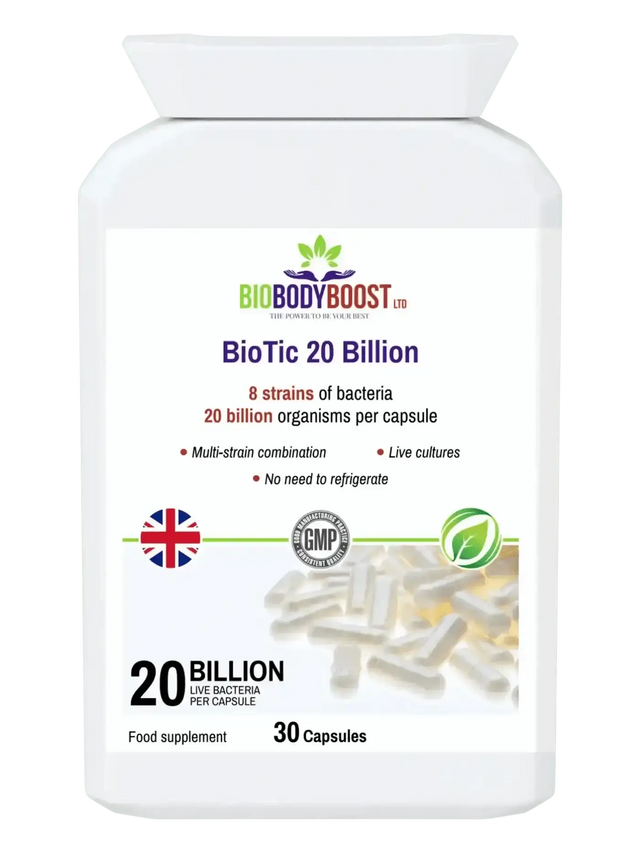
For adult probiotic support alongside children’s supplementation: BioTic 20 Billion — 20 billion CFU, 8 strains, halal certified. Browse the full Gut Health UK collection.
What is the best probiotic for children UK?
By clinical evidence: Lactobacillus rhamnosus GG (LGG) has the most paediatric RCTs, with consistent evidence for antibiotic-associated diarrhoea prevention and acute diarrhoea reduction. S. boulardii has strong evidence for antibiotic-associated diarrhoea specifically (not destroyed by antibiotics unlike bacterial strains). L. reuteri DSM 17938 has specific evidence for infant colic in breastfed babies. For general daily microbiome support in children: a multi-strain formula with named species at 1 billion CFU minimum per serving, in a halal-certified format without E120 or gelatine, is appropriate. Always discuss with your GP or pharmacist — particularly for children under 2 years.
Are children’s probiotics halal UK?
Many are not — or are unverified. The compliance risks: porcine peptone in bacterial growth media (not declared on label), gelatine capsule shells (common in adult probiotics given to children), and E120 carmine in red/pink chewables. Third-party halal certification of the full manufacturing process — including growth media — is the only meaningful verification. Little BioGut carries full halal approval in a powder format: no capsule shell concern, no E120, vegan throughout.
When should I give my child a probiotic?
The clearest evidence-backed applications: (1) during and after antibiotic courses — start simultaneously with antibiotics, take 2 hours apart, continue for 2 weeks after the course ends (Hempel 2012, 42% reduction in antibiotic-associated diarrhoea risk); (2) during travel when gut disruption risk is high; (3) during winter months for potential respiratory infection protection (Hao 2011 Cochrane, significant reduction in upper respiratory tract infection duration and school absence). For general daily use in healthy children — discuss with your GP or health visitor. There is no established need for daily probiotic supplementation in all healthy children eating a varied diet, though it has a good safety profile.
Can babies take probiotics UK?
L. reuteri DSM 17938 has specific evidence for breastfed infants with colic at 10–8 drops (10^8 CFU) daily. Any probiotic use in babies under 12 months should be discussed with your health visitor or GP first. Little BioGut’s powder format can be mixed into breast milk or formula — check the product page for current age guidance. Not all probiotic products are appropriate for very young infants regardless of halal status.