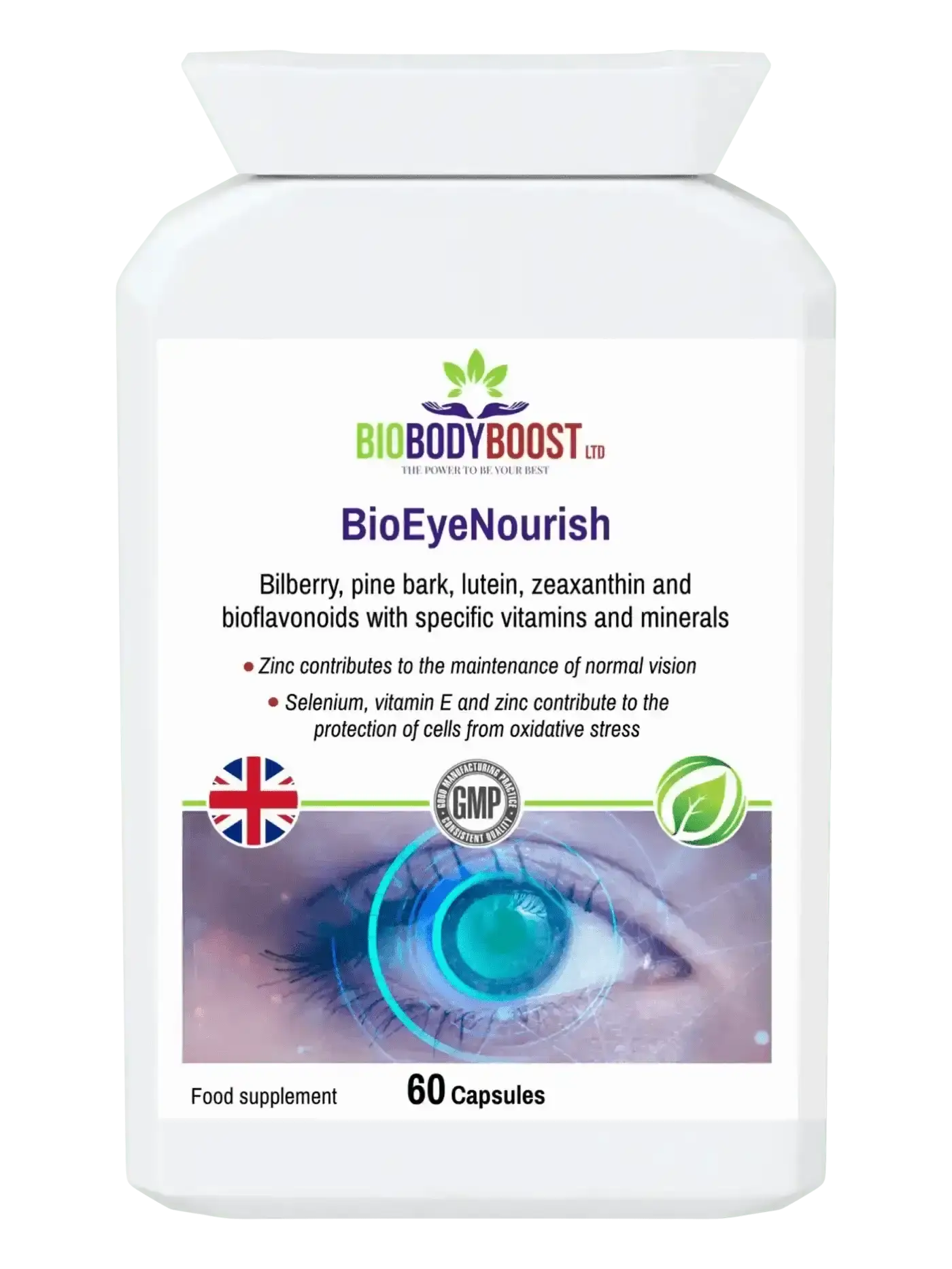
Quick answer: lutein and zeaxanthin are the only dietary compounds that physically accumulate in the macula as macular pigment — filtering blue light before it reaches photoreceptors. The clinical foundation is the AREDS2 trial (Age-Related Eye Disease Study 2), the largest eye supplement trial ever conducted. Zinc has an EU-authorised claim for normal vision. Vitamin A is essential for rhodopsin synthesis in the retina. These four are the evidence-based eye supplement foundation. Everything else — bilberry, goji, eyebright — has significantly weaker or no clinical evidence. BioEyeNourish provides all four in a halal-certified, vegan, HPMC formula.
Why macular pigment matters
The macula is the central region of the retina responsible for sharp, detailed and colour vision. It contains the highest concentration of photoreceptor cells (cones) in the eye. High-energy blue light from screens, LED lighting and sunlight causes cumulative oxidative stress in the macula’s photoreceptor cells, contributing to the progressive photoreceptor loss that characterises age-related macular degeneration (AMD) — the leading cause of irreversible vision loss in adults over 50 in the UK.
Lutein and zeaxanthin accumulate selectively in the macula (and in the lens) from dietary and supplemental sources. There they form macular pigment — a yellow carotenoid layer that absorbs blue light before it reaches photoreceptors and provides antioxidant protection against oxidative stress in macular tissue. The body cannot synthesise lutein or zeaxanthin — they must come from diet (kale, spinach, egg yolk) or supplementation.
AREDS2 — the clinical foundation
Age-Related Eye Disease Study 2 (AREDS2, JAMA 2013, n=4,203 participants with intermediate-to-advanced AMD): the modified AREDS2 formula with lutein 10mg + zeaxanthin 2mg significantly reduced the risk of progression to advanced AMD by 25% vs placebo over 5 years, outperforming the original AREDS formula with beta-carotene. The AREDS2 formula that emerged as the standard: lutein 10mg, zeaxanthin 2mg, vitamin C 500mg, vitamin E 400 IU, zinc 80mg, copper 2mg. Lutein 10mg and zeaxanthin 2mg daily are the doses now used as reference points for quality eye supplement formulas.
A 2017 Cochrane Review of 19 studies confirmed lutein and zeaxanthin supplementation significantly improved macular pigment optical density (MPOD) — the measurable biomarker of macular protection — across multiple populations. MPOD improvement takes 8–12 weeks of consistent supplementation to become measurable.
Zinc — EU-authorised vision claim
Zinc has the EU/UK-retained authorised health claim: “zinc contributes to the maintenance of normal vision.” The mechanism: zinc is the most concentrated mineral in the eye (particularly in the retina and choroid), where it is required for retinol-binding protein synthesis (transporting vitamin A to the retina), rhodopsin synthesis in rod photoreceptors (night vision) and antioxidant enzyme activity (superoxide dismutase). The NHS confirms zinc is essential for normal vision.
Vitamin A — the retinal essential
Vitamin A (retinol) is required to synthesise rhodopsin — the light-sensitive protein in rod photoreceptors that enables vision in low-light conditions. Vitamin A also maintains the mucous membranes of the cornea. The EU-authorised claim: vitamin A “contributes to the maintenance of normal vision.” Vitamin A deficiency (rare in UK adults eating a varied diet) causes night blindness. Even mild insufficiency can compromise rod function.
What does NOT have strong evidence for eyes
- Bilberry: the traditional eye botanical. As a botanical, it carries no EU-authorised health claims for vision. Its anthocyanins have antioxidant activity, and some small studies have shown improvements in night vision adaptation, but no large RCT has confirmed significant clinical benefit for AMD or visual acuity. Treat as heritage rather than evidence.
- Goji berry / wolfberry: contains zeaxanthin but at lower concentrations than dedicated lutein/zeaxanthin supplements. Weak evidence base for eye-specific benefits at supplement doses.
- Eyebright (Euphrasia): traditional botanical with no robust RCT evidence for any measurable eye health benefit.
Screen eyes — what actually helps
The most widespread complaint: tired, dry eyes after prolonged screen use. This is digital eye strain — reduced blink rate during screen work (from 15/min to 5/min) causing tear film evaporation and surface dryness. The most effective interventions are behavioural: the 20-20-20 rule (every 20 minutes, look at something 20 feet away for 20 seconds), conscious blinking, adequate ambient humidity and screen brightness matched to room light. Omega-3 DHA/EPA supports tear film lipid layer quality and reduces evaporative dry eye — see the omega-3 guide.
Is EyeNourish halal?
Lutein and zeaxanthin are produced from Tagetes erecta (marigold flower) by solvent extraction and saponification — entirely plant-origin. Zinc and vitamin A (as retinyl palmitate from plant-based sources) are halal. EyeNourish — lutein, zeaxanthin, zinc, vitamin A, bilberry, in HPMC capsules. Halal approved, vegan, UK GMP manufactured. Take 1 capsule daily with food. Browse Halal Vitamins UK.
Do lutein and zeaxanthin supplements actually work?
For macular pigment density: yes — 2017 Cochrane Review (19 studies) confirmed supplementation significantly increases macular pigment optical density (MPOD). For AMD prevention and progression: the AREDS2 trial (n=4,203) found the lutein+zeaxanthin formula reduced advanced AMD progression risk by 25% over 5 years vs placebo. These are meaningful effects for a common and serious cause of irreversible vision loss. The effects build over 8–12 weeks of consistent supplementation — macular pigment accumulates gradually. Take at least 10mg lutein and 2mg zeaxanthin daily, the doses used in AREDS2.
Can eye supplements improve my vision?
No — eye health supplements do not correct refractive errors (short-sight, long-sight, astigmatism) or reverse existing structural damage. Their role is protective and maintenance: lutein and zeaxanthin build macular pigment to filter damaging blue light and reduce oxidative stress over time. Zinc and vitamin A support normal retinal function. The NHS recommends regular eye tests (every 2 years for adults) to monitor vision changes. New or worsening blurred vision requires an optician, not a supplement.
How long do eye supplements take to work?
Macular pigment optical density (MPOD) changes are measurable at 8–12 weeks of consistent supplementation at 10mg lutein + 2mg zeaxanthin daily. The AREDS2 trial measured outcomes over 5 years. Eye health supplementation is long-term preventive maintenance — not a quick fix. Take daily consistently for at least 3 months before assessing any subjective change in screen tolerance or eye comfort.
Are eye supplements halal UK?
Lutein and zeaxanthin are plant-derived (marigold flower). Zinc is mineral-derived. Vitamin A is typically from retinyl palmitate (synthetic or plant-derived). The compliance check is the capsule shell (HPMC not gelatine) and any added ingredients. EyeNourish uses HPMC plant-derived capsules and carries full halal approval. For further context on the halal status of UK eye supplements, the gummy vitamin halal guide covers E120, gelatine and compliance checks across vitamin formats.