Quick answer: astaxanthin is a carotenoid (from microalgae and krill) with one uniquely important structural property — it physically spans the entire mitochondrial membrane bilayer, positioning its antioxidant activity exactly where the electron transport chain produces reactive oxygen species (ROS). It is not simply a “general antioxidant” that circulates in the bloodstream. It is a membrane-integrated antioxidant that works at the site of mitochondrial energy production itself. This specificity is what separates astaxanthin from vitamin C, vitamin E or generic antioxidant supplements for mitochondrial applications.
Why mitochondria produce damaging ROS
The electron transport chain (ETC) produces ATP by transferring electrons through a series of protein complexes embedded in the inner mitochondrial membrane. This process is not perfectly efficient. Approximately 0.1–0.2% of electrons leak from the ETC and react with oxygen to form superoxide — a reactive oxygen species that damages proteins, lipids and DNA. In young, well-functioning mitochondria, endogenous antioxidant enzymes (superoxide dismutase, glutathione peroxidase) manage this damage. With age, ROS production increases and endogenous antioxidant capacity declines — creating a cycle of oxidative damage that progressively impairs mitochondrial function.
The mitochondrial membrane is the primary target of this oxidative damage. The membrane’s phospholipid composition (particularly its cardiolipin content — a phospholipid unique to mitochondria) is highly susceptible to lipid peroxidation. Damaged membrane phospholipids alter the electrochemical gradient that drives ATP synthesis, increase proton leak, and impair ETC protein function.
What makes astaxanthin uniquely suited to mitochondrial protection
Astaxanthin is a xanthophyll carotenoid — its molecular structure includes both polar end groups (hydrophilic) and a non-polar central chain (lipophilic). This amphiphilic structure allows it to physically orient across the entire lipid bilayer of the mitochondrial membrane, with its polar ends anchored at the membrane surfaces and its central chain extending through the hydrophobic interior. This positioning provides antioxidant protection at all three layers of the membrane simultaneously — outer surface, interior and inner surface.
Vitamin E, by contrast, sits only at the outer surface of membranes. Beta-carotene sits in the hydrophobic interior. Neither covers the full bilayer. Astaxanthin is one of very few compounds structurally suited to full-bilayer mitochondrial membrane protection.
What research shows: A 2003 study in Biochemical and Biophysical Research Communications (Lee et al.) demonstrated that astaxanthin significantly inhibited lipid peroxidation in mitochondrial membranes at lower concentrations than vitamin E or beta-carotene in comparative assays. A 2011 Journal of Nutritional Science study found astaxanthin supplementation significantly reduced mitochondrial ROS production and preserved mitochondrial membrane potential in exercised animal models compared to vitamin E. A 2016 paper in Marine Drugs confirmed astaxanthin’s unique positioning in lipid bilayers using molecular dynamics simulation, providing mechanistic explanation for its superior membrane-level antioxidant activity.
Astaxanthin and exercise-induced mitochondrial stress
High-intensity exercise dramatically increases ETC activity and ROS production — this oxidative stress is part of the signal that drives mitochondrial biogenesis and adaptation. But excessive oxidative stress impairs recovery and can damage mitochondrial proteins faster than repair mechanisms can correct. Astaxanthin’s membrane-integrated antioxidant activity reduces the net oxidative burden on mitochondria during exercise without blocking the hormetic signal that drives adaptation — a balance that generic antioxidant supplementation at high doses does not achieve.
A 2011 RCT in the International Journal of Sports Medicine (Res et al.) found astaxanthin supplementation at 4mg/day for 4 weeks significantly reduced exercise-induced lipid peroxidation and improved fat oxidation rates during cycling in trained males. The fat oxidation improvement is directly consistent with improved mitochondrial fatty acid utilisation — suggesting astaxanthin supports not just protection but mitochondrial metabolic efficiency.
Astaxanthin in AstaxaKrill
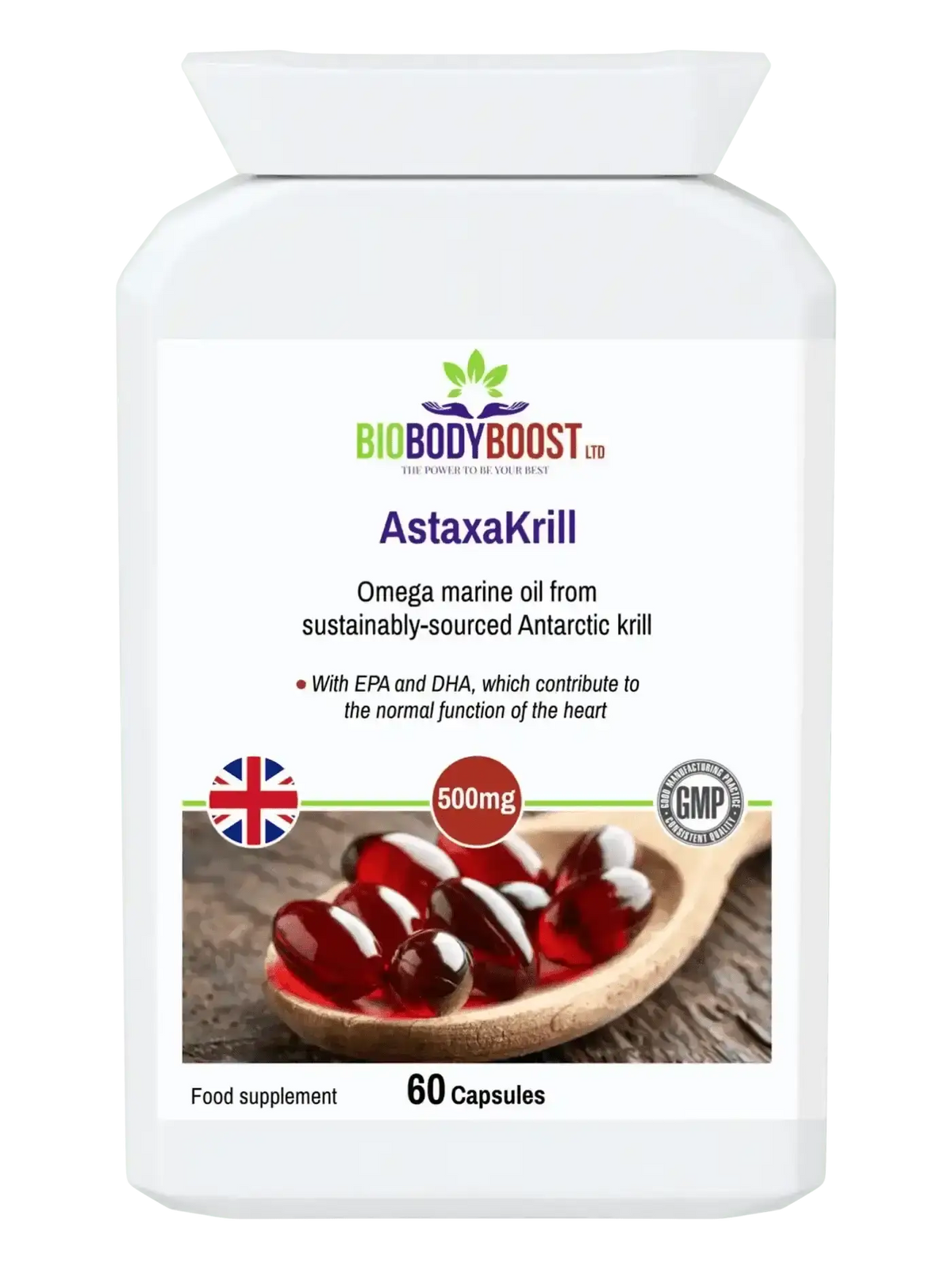
AstaxaKrill provides 50μg naturally occurring astaxanthin per capsule within 500mg Antarctic krill oil (Euphausia superba) — the astaxanthin is present in its natural esterified form within the phospholipid matrix of krill oil, rather than as an isolated extract. The phospholipid krill omega-3 (200mg phospholipids per capsule) additionally supports mitochondrial membrane phospholipid composition — EPA and DHA from krill are incorporated into the mitochondrial inner membrane, improving its fluidity and ETC efficiency. Halal registered. Note: AstaxaKrill contains crustacean and bovine gelatine capsule — not vegan, not suitable for shellfish allergy.
See the complete mitochondria and aging guide for the full longevity stack context.
Is astaxanthin the best antioxidant for mitochondria?
For mitochondrial membrane-specific protection, astaxanthin has structural properties that no other common antioxidant matches. Its amphiphilic molecular structure allows it to span the entire mitochondrial membrane bilayer — providing antioxidant protection at the outer surface, interior and inner surface simultaneously. Vitamin E covers only the outer surface; beta-carotene only the interior. A 2003 BBRC study confirmed astaxanthin significantly outperformed vitamin E for mitochondrial membrane lipid peroxidation inhibition. For general circulating antioxidant activity, vitamin C and E remain well-evidenced. For the specific application of protecting the mitochondrial membrane from ETC-generated ROS, astaxanthin is uniquely positioned.
What is the best dose of astaxanthin for mitochondrial support?
Human trials showing mitochondrial and exercise-performance benefits have used 4–8mg/day of astaxanthin (from natural sources — esterified astaxanthin from Haematococcus pluvialis algae or krill). Most positive trials run 4–12 weeks. AstaxaKrill provides 50μg per capsule within the natural krill phospholipid matrix — the natural esterified form with phospholipid context is considered superior to free-form synthetic astaxanthin for bioavailability. For higher-dose dedicated astaxanthin supplementation (4–8mg/day), a dedicated astaxanthin algae extract supplement at that dose range would be needed alongside AstaxaKrill.
Does astaxanthin support brain mitochondria as well?
Yes — astaxanthin crosses the blood-brain barrier (unlike most carotenoids including beta-carotene) and has been shown to reduce neuronal oxidative stress in animal models. Neurons are among the most mitochondria-dense cells in the body and depend heavily on mitochondrial ATP for synaptic function. A 2012 study in Carotenoid Science found astaxanthin significantly reduced brain oxidative stress markers and improved cognitive performance in aged animal models. Human cognitive trial data for astaxanthin is limited — mechanistically compelling but not yet confirmed by large human RCTs.