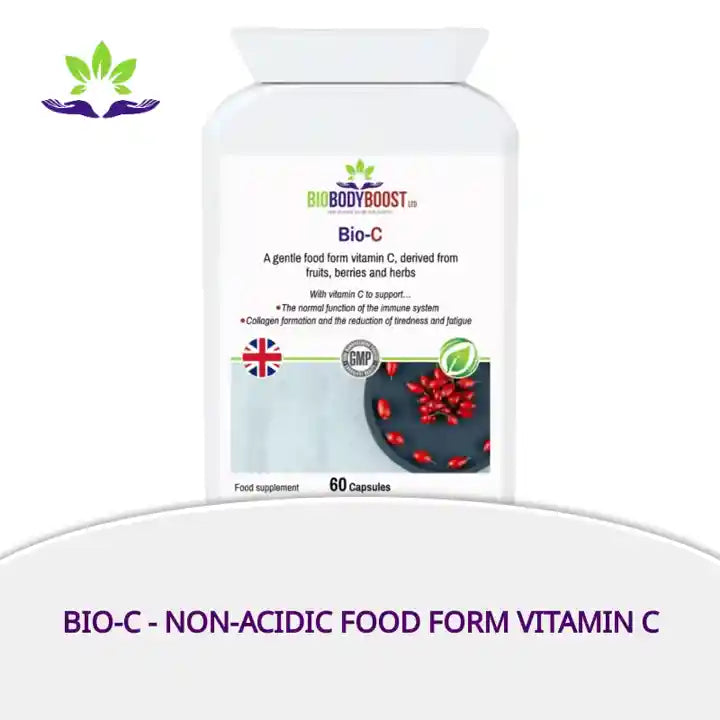
Most vitamin C supplements are ascorbic acid — synthesised, isolated, and acidic enough that high doses cause stomach upset for a great many people. Bio-C takes the opposite approach: food-form vitamin C, drawn entirely from five fruits and herbs, with no ascorbic acid at all. Gentle, non-acidic, and accompanied by the bioflavonoids and polyphenols that occur alongside vitamin C in nature.
Why Food-Form Vitamin C Behaves Differently
Isolated ascorbic acid is absorbed quickly and excreted quickly — a large single dose largely ends up in your urine. Food-form vitamin C arrives inside the fruit matrix that produced it, alongside the co-factors the body evolved to encounter it with.
The other practical difference is comfort. Ascorbic acid is, as the name says, an acid. If high-dose vitamin C has ever given you stomach discomfort, that's why. Bio-C contains none.
How Other UK Vitamin C Supplements Compare
Standard ascorbic acid tablets — cheap, high dose, acidic. 1000mg for a few pounds, and perfectly effective for most people. But it is synthetic, acidic, rapidly excreted, and comes without the fruit co-factors.
Buffered vitamin C — gentler, still synthetic. Ascorbic acid buffered with calcium or magnesium to reduce acidity. Better tolerated, but still an isolated synthetic vitamin.
Liposomal vitamin C — high absorption, high price. A genuinely interesting delivery format at several times the cost, and still built on ascorbic acid.
What's in Every Capsule
Vitamin C — 125mg (156% NRV), entirely from food-form acerola cherry. No synthetic ascorbic acid.
The nine EU-authorised vitamin C claims:
- Contributes to the normal function of the immune system
- Contributes to normal collagen formation for the normal function of blood vessels, bones, cartilage, gums, skin and teeth
- Contributes to normal energy-yielding metabolism
- Contributes to the normal functioning of the nervous system
- Contributes to normal psychological function
- Contributes to the protection of cells from oxidative stress
- Contributes to the reduction of tiredness and fatigue
- Contributes to the regeneration of the reduced form of vitamin E
- Increases iron absorption
The five food sources — doses declared:
-
Acerola cherry — 500mg, at 25% vitamin C · Malpighia glabra · one of the richest natural vitamin C sources of any fruit · this is what provides the 125mg of vitamin C
-
Blackcurrant — 108mg equivalent · Ribes nigrum · dark berry flavonoids and polyphenols
-
Rosehip — 108mg equivalent · Rosa canina · the traditional British vitamin C source
-
Parsley leaf — 50mg · Petroselinum sativum · culinary herb rich in flavonoids
-
Elderberry — 42mg equivalent · Sambucus nigra · dark berry polyphenols
60 capsules in an HPMC vegetarian shell, with microcrystalline cellulose as anti-caking agent and rice extract. Vegan. Vegetarian. Halal approved. Kosher approved.
Every capsule is: ✓ 125mg food-form vitamin C (156% NRV) · ✓ No ascorbic acid · ✓ Non-acidic · ✓ Halal & kosher · ✓ Vegan · ✓ UK made
Bio-C vs Other UK Vitamin C
|
Bio-C
BioBodyBoost · 60 caps
|
Ascorbic acid tablets |
Liposomal vitamin C |
| Free from ascorbic acid |
✓ Food form only |
✗ Synthetic |
✗ Synthetic |
| Non-acidic |
✓ Yes |
✗ Acidic |
Partly |
| Natural fruit co-factors |
✓ 5 sources |
✗ None |
✗ None |
| Halal & kosher approved |
✓ Both |
Varies |
Varies |
| Vitamin C per capsule |
125mg (156% NRV) |
500–1000mg |
500–1000mg |
Based on publicly available product information. Prices approximate. Always verify current specs on manufacturer websites.
A Note on Dose
Bio-C provides 125mg per capsule — well above the NRV, but lower than the 1000mg tablets on every pharmacy shelf. That is deliberate. If you specifically want a high-dose protocol, take 2 to 3 capsules daily rather than one, or use an ascorbic acid product alongside.
How to Take It
Take 1 capsule, one to three times daily, or as required. There is no acidity to worry about if you take it on an empty stomach.
Pair with Lipovita D3 + K2 through the winter months, or with Bio Mushroom Boost for broader immune support.
Is This You?
- High-dose vitamin C has upset your stomach before — ascorbic acid is the usual culprit
- You'd rather take vitamin C in the form it occurs in food than as an isolated synthetic compound
- You want the fruit co-factors — polyphenols and flavonoids — not just the vitamin
- You need halal and kosher approved vitamin C
- You're taking iron and want vitamin C alongside it, since it increases iron absorption
Explore the full Immunity UK and Halal Vitamins UK collections.
Questions We Get Asked
Why is there no ascorbic acid in it?
Because the whole point of the product is that the vitamin C comes from food. Ascorbic acid is the synthesised, isolated form — effective, cheap, and acidic. Bio-C draws its vitamin C entirely from acerola cherry, with blackcurrant, rosehip, parsley and elderberry alongside. That means no acidity, and the vitamin arrives with the polyphenols and flavonoids that accompany it in the fruit.
Is 125mg enough?
It is 156% of the Nutrient Reference Value, so comfortably above requirement from a single capsule. The label allows up to three capsules daily if you want more.
Will it upset a sensitive stomach?
It is considerably less likely to than ascorbic acid, because there is no acid in it. That is the main reason people move to food-form vitamin C. If you have a diagnosed digestive condition, check with your GP before starting any new supplement.
Does vitamin C really help iron absorption?
Yes — it is one of the nine EU-authorised claims for vitamin C, and one of the better-established interactions in nutrition. Taking Bio-C alongside an iron-rich meal or an iron supplement is a sensible pairing.
Food supplements should not replace a varied diet or healthy lifestyle. Consult your GP before use if pregnant, breastfeeding, taking prescription medication, or managing a diagnosed health condition.