Quick answer: vitamin K2 directs calcium to bones and keeps it out of arteries — via two key proteins: osteocalcin (binds calcium into bone matrix, activated by K2) and matrix Gla protein (MGP, prevents calcium depositing in arterial walls, also activated by K2). This is the critical context for anyone taking high-dose vitamin D3: D3 significantly increases calcium absorption from the gut, but without adequate K2 to activate the proteins directing that calcium, there is a theoretical (and increasingly evidence-supported) concern about calcium depositing in soft tissues including arterial walls. The combination of D3 + K2 addresses both parts of calcium metabolism. MK-7 (from natto fermentation) is the preferred K2 form — it has the longest half-life (>24 hours) and highest biological activity per dose.
The two vitamin K forms — K1 vs K2
Vitamin K exists in two primary dietary forms:
- Vitamin K1 (phylloquinone): found in leafy green vegetables (kale, spinach, broccoli). Primarily used by the liver for blood clotting factor synthesis. Short half-life (1–2 hours). Less relevant to bone and cardiovascular calcium metabolism than K2.
- Vitamin K2 (menaquinones): found in fermented foods (natto, aged cheese, certain fermented dairy) and some animal products. K2 activates the extra-hepatic vitamin K-dependent proteins — osteocalcin and matrix Gla protein — that are responsible for calcium metabolism in bone and arteries. K2 comes in multiple forms: MK-4 (short half-life, 1–2 hours), MK-7 (long half-life, 24–72 hours), MK-8, MK-9.
Why MK-7 is the preferred K2 form
MK-7 (menaquinone-7) is primarily derived from Bacillus subtilis fermentation of soybeans (natto) — the same traditional Japanese food. Key advantages over MK-4:
- Half-life: MK-7 has a plasma half-life of 72 hours vs 1–2 hours for MK-4. A single daily dose of MK-7 maintains stable blood and tissue levels throughout the day. MK-4 requires multiple daily doses to maintain activity.
- Tissue carboxylation at lower doses: MK-7 at 45–180mcg/day is as effective as MK-4 at much higher doses (1,500mcg/day) for osteocalcin and MGP carboxylation.
- Evidence base: the most important K2 clinical trials (Knapen 2013, Knapen 2015) used MK-7 specifically.
The bone evidence
Knapen et al. (2013, Osteoporosis International, 3-year RCT, n=244 postmenopausal women) found MK-7 at 180mcg/day significantly reduced bone mineral content and bone strength decline vs placebo at 3 years. Osteocalcin carboxylation (the K2-dependent activation) increased significantly in the MK-7 group, confirming the mechanism. A 2014 PLoS ONE meta-analysis (13 RCTs) confirmed vitamin K2 supplementation significantly reduced bone loss and fracture risk in postmenopausal women.
The cardiovascular evidence
Geleijnse et al. (2004, Journal of Nutrition, Rotterdam Study, n=4,807) found high dietary vitamin K2 intake was associated with 57% lower cardiovascular mortality, 52% lower aortic calcification and 41% lower all-cause mortality vs low K2 intake. This is observational data (not RCT) but from one of the most rigorously conducted European epidemiological studies.
Knapen et al. (2015, Thrombosis and Haemostasis, RCT, n=244 healthy postmenopausal women): MK-7 180mcg/day for 3 years significantly improved arterial stiffness measures — a direct cardiovascular endpoint, not just a biomarker. The mechanism: activated MGP prevents calcium deposition in arterial walls, maintaining arterial elasticity.
The D3 + K2 synergy — why they belong together
Vitamin D3 significantly increases intestinal calcium absorption — at high D3 doses (4,000 IU/day), calcium absorption increases substantially. Without adequate K2 to activate osteocalcin (which binds calcium into bone) and matrix Gla protein (which prevents calcium depositing in arteries), the absorbed calcium has to go somewhere. The concern: it may preferentially deposit in soft tissues. While direct human evidence for D3-without-K2 causing arterial calcification is not yet definitive in RCTs, the mechanistic argument is compelling and the Rotterdam Study data supports the association between K2 and reduced aortic calcification.
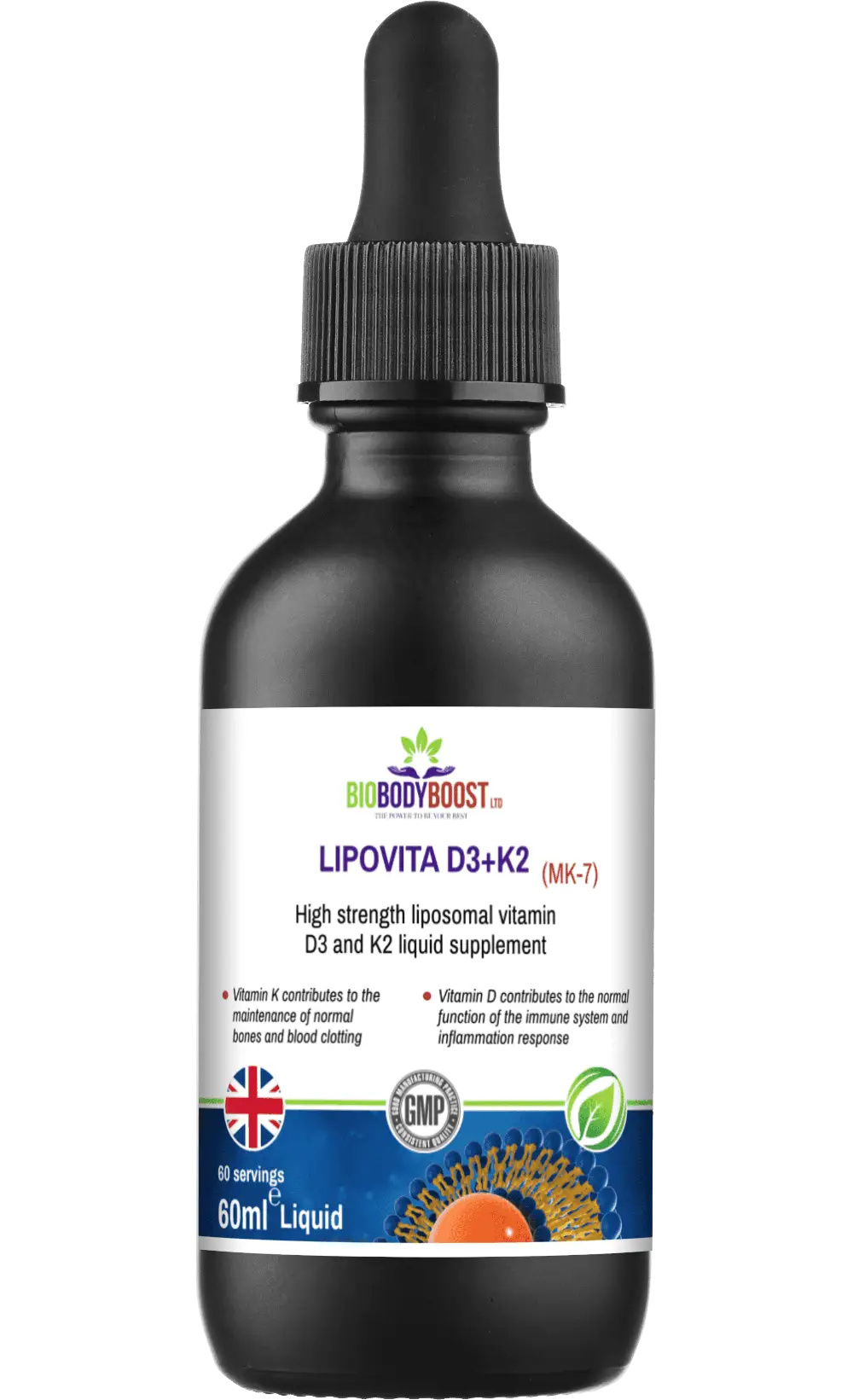
The practical recommendation: anyone taking D3 at doses above 1,000 IU daily should consider K2 alongside it. At 4,000 IU D3 (Lipovita D3+K2), K2 100mcg MK-7 is the appropriate pairing. Lipovita D3+K2 provides both in a single liposomal liquid — 4,000 IU algae-derived D3 + 100mcg MK-7 per 1ml serving. Halal certified, vegan, liposomal absorption technology.
Is vitamin K2 halal?
MK-7 from natto fermentation: yes, unambiguously halal. Natto is fermented soybeans using Bacillus subtilis bacteria — entirely plant and bacterial fermentation origin. No animal involvement. The fermentation process is halal, the soybean substrate is halal, and the extracted MK-7 is halal. K2 as MK-7 is also vegan. MK-4 from some sources is synthesised from geranylgeranyl pyrophosphate — also plant-derived synthesis. Lipovita D3+K2 uses MK-7 menaquinone-7 from natto fermentation — fully halal and vegan.
Who should prioritise vitamin K2
- Anyone taking D3 above 1,000 IU daily (D3 without K2 may increase calcium absorption without adequate direction to bone)
- Postmenopausal women — where bone density loss and cardiovascular calcification risk both increase
- Adults over 50 generally — dietary K2 intake typically falls with age (lower natto, fermented food consumption)
- Vegans and plant-based eaters — K2 is almost absent from vegan diets (natto is the only plant K2 food source, rarely consumed in the UK)
- South Asian women — osteoporosis risk is elevated; D3 deficiency compounds bone loss without K2 to optimise the calcium that D3 delivers
What does vitamin K2 do?
K2 activates two critical calcium-regulating proteins: (1) osteocalcin — a protein in bone matrix that binds calcium ions to build bone mineral density; without K2, osteocalcin is undercarboxylated (inactive) and cannot retain calcium in bone; (2) matrix Gla protein (MGP) — the most potent known inhibitor of soft tissue calcification; without K2, MGP is undercarboxylated and cannot prevent calcium from depositing in arterial walls. Together, these functions describe K2 as the “calcium director” — it puts calcium in bones and keeps it out of arteries. Knapen 2013 (bone RCT n=244) and Rotterdam Study (cardiovascular, n=4,807) are the key evidence sources.
Should I take vitamin D3 and K2 together?
Yes, especially at D3 doses above 1,000 IU daily. D3 increases intestinal calcium absorption significantly. K2 activates the proteins that direct that absorbed calcium into bone (osteocalcin) and away from arteries (MGP). Taking high-dose D3 without K2 may theoretically increase calcium absorption without optimal direction to bone. The Rotterdam Study found high K2 intake associated with 52% lower aortic calcification. Lipovita D3+K2 combines 4,000 IU algae-derived D3 with 100mcg MK-7 in a liposomal liquid for optimal absorption of both fat-soluble vitamins simultaneously.
Is vitamin K2 safe to take if on warfarin?
No — do not take vitamin K supplements if on warfarin (or other anticoagulants) without explicit GP guidance. Vitamin K directly affects blood clotting factor synthesis and K2 supplementation will alter your INR (clotting time). Warfarin dosing is calibrated against your vitamin K intake — starting K2 supplementation destabilises anticoagulation. Discuss with your prescribing doctor before starting any form of vitamin K supplementation. This is the most important drug interaction for K2 and applies regardless of halal status.